Check out the conversation on Apple, Spotify, and YouTube.
Brought to you by: LogRocket

This is the AI analytics, logs, and session replay tool you need. I ran a head-to-head eval against PostHog to test their AI, and published my results here.
Today’s episode
There are hundreds of guides on writing PRDs with Claude. Dozens on running user interviews. Almost nothing on how a VP of product actually uses it in-depth.
Matt Wensing is the VP of Product and Design at Customer.io. They crossed $100M ARR, just shipped an AI agent, and are one of the fastest growing companies in B2B SaaS right now. I asked him to show me his actual documents, his actual Slack threads, and the exact sessions where Claude helped him produce leadership grade output.
What he showed me changed how I think about AI for leaders. Claude has the instincts of a brilliant new hire, it wants to deliver before it fully understands what you need, and at the VP level that gap shows up fast.
Matt has spent months figuring out how to manage it, and in this episode he shows you everything. You’re not going to find another video in the world with real VP of product examples from their real work.
To get access to my AI tool stack - Dovetail, Arize, Linear, Descript, Reforge Build, Relay.app, Magic Patterns, Speechify, Bolt.new and Mobbin - become an annual subscriber ($150), and grab Aakash’s bundle.
To get access to my AI PM customizations - PM OS, Job Search OS, and Prompt Library - become a founding subscriber ($250).
Newsletter Deep Dive
Thank you for having me in your inbox. Here is how a VP of product at a $100M ARR company actually uses Claude:
How a VP of Product Actually Works With Claude
Why Claude produces slop, and why executives catch it instantly
How to build leadership grade presentations with Claude
Using Claude as a thinking partner vs. output machine
A VP of Product’s AI stack
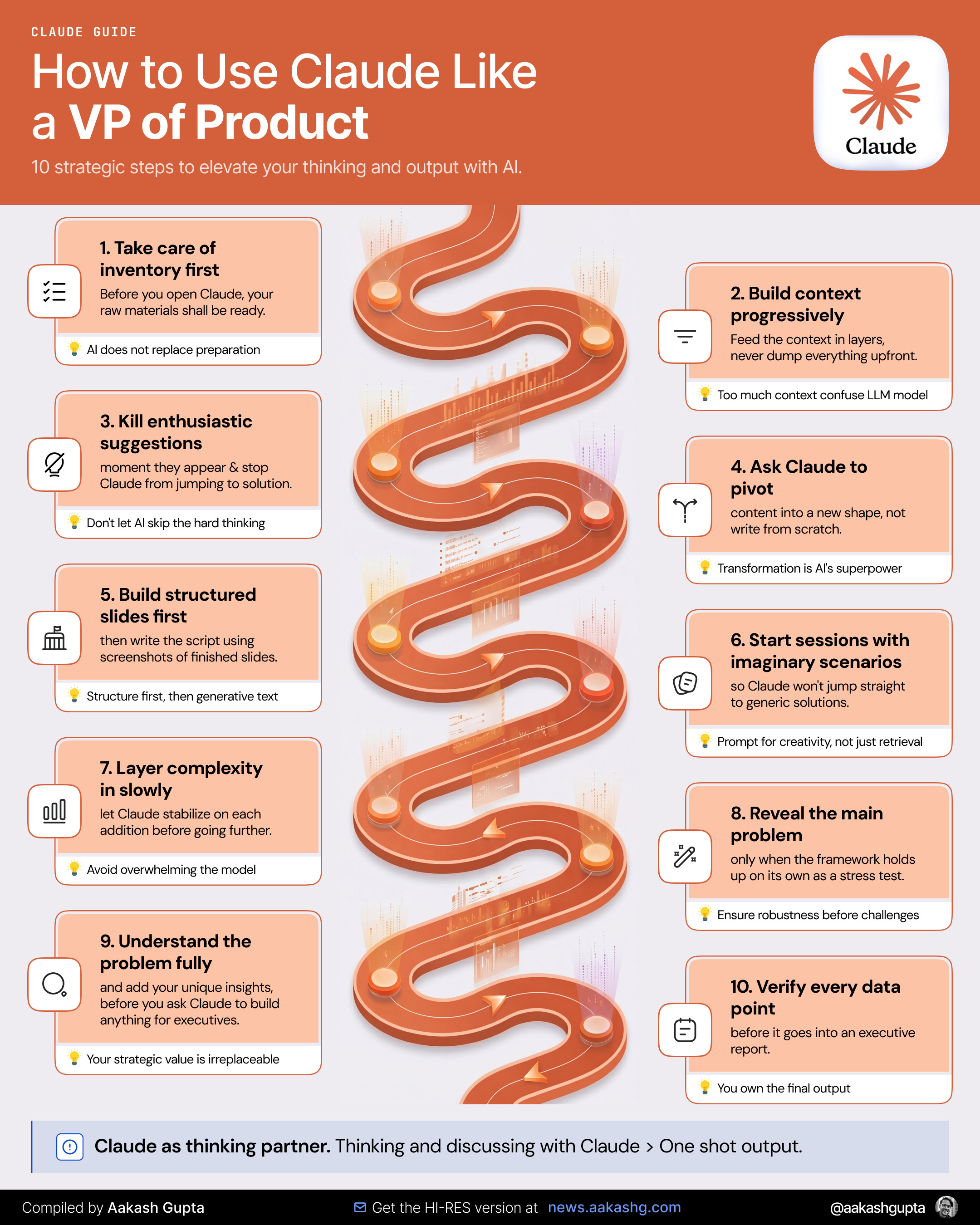
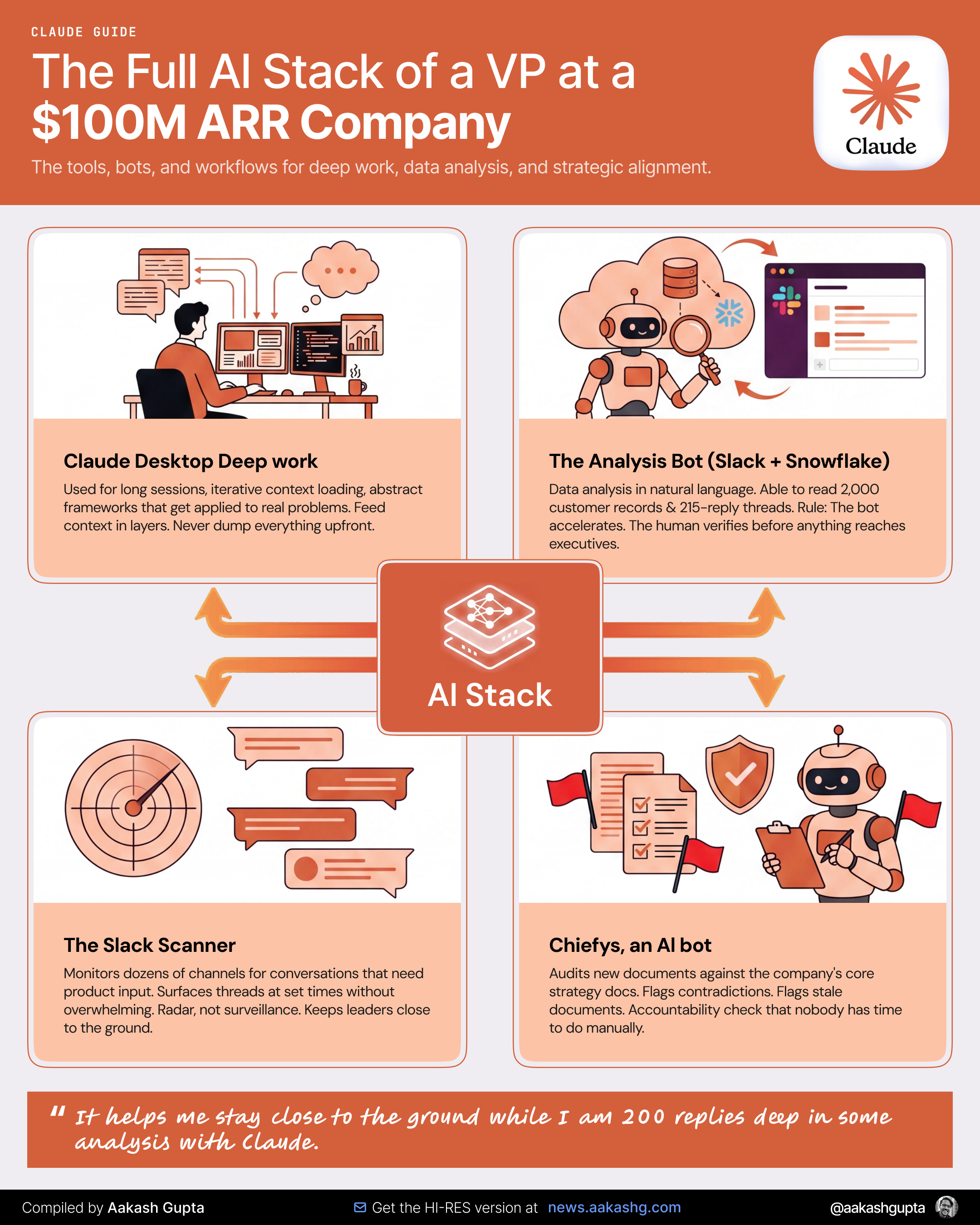
Before we get to the longer article, here’s the most important takeaway in an infographic.
Now into the deep dive…
1. How a VP of Product Actually Works With Claude
Why Claude produces slop, and why executives catch it instantly
Matt has a rule he shares with every new hire at Customer.io:
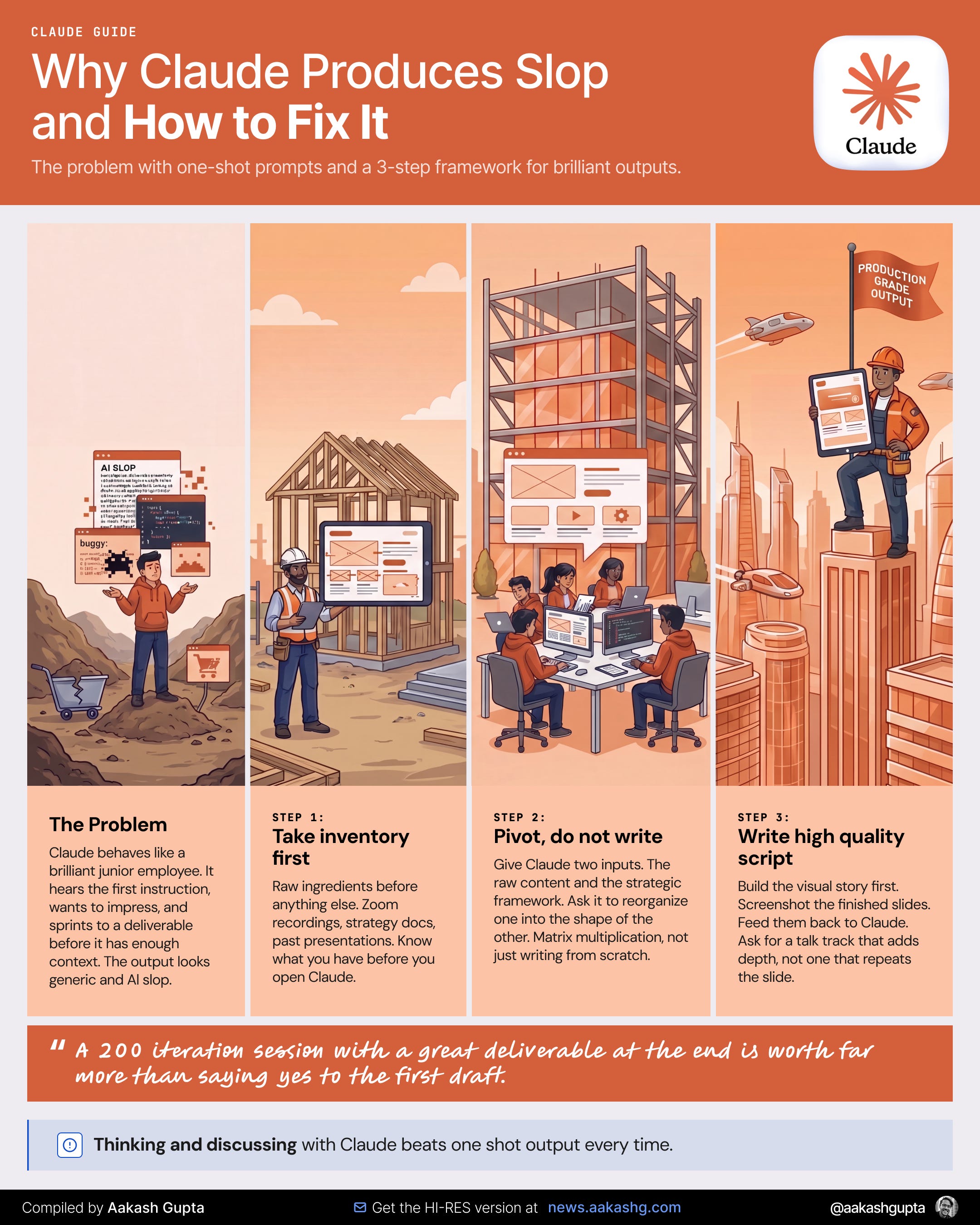
Junior employees, however talented, will race to the finish line before they have enough context to do the job well. They hear the first instruction, want to impress, and just go.
They skip the clarifying questions. They come back with something that looks complete but misses the point entirely, and now you have to tear it down and start over.
Claude does the exact same thing.
Give it a goal and it will sprint. It will generate a low grade Word doc. It will use jargon mid session and put it straight into the executive document. It will suggest the next step before you have finished thinking through the current one, nudging you toward a deliverable you are not ready for yet.
Matt calls this “the slop problem.” And it gets worse the higher up you go, because the audience reading your output gets sharper.
Executives are the best slop filters in the room
Senior leaders spend their careers reading documents that try to persuade them. They have a filter that kicks in within the first paragraph. They are not looking for polish. They are looking for evidence that the person who wrote this actually understands the multi dimensional nature of the problem.
A one shot alignment deck fails that test every time. Years of organizational history and unspoken context get compressed into a clean seven slide narrative. Matt calls this the “flat projection problem.” You present a shadow of the problem to people who have been staring at the real thing for months. They filter it out, and depending on where you sit in the hierarchy, that looks like polite nodding or your work simply getting ignored.
The fix is a different way of working with Claude entirely.
Instead of giving it the full problem upfront, you feed it context in layers, one piece at a time, making it earn the right to generate the final output. You kill the eager suggestions the moment they show up. You stay in control of the pace.
Matt puts it simply - a 200 iteration session with a great deliverable at the end is worth far more than saying yes to the first draft.
The document you produce is less polished but higher in insight density. When an executive reads something that matches the complexity they have been living with, they do not filter it out. They lean in.
Thinking and discussing with Claude > One shot output
How to build leadership grade presentations with Claude
In the episode, Matt shared an interesting story, he woke up at 5am with a company all hands due at 11. His week had been fully booked, the way every leadership week is (you know this better).
He started with - Six hours, a blank slide deck, and Claude.
By 11am, he had a polished Q2 roadmap presentation in front of 400 employees.
Here is exactly how he built it.
Step 1: Take inventory before you touch Claude
The single biggest mistake leaders make is jumping straight into building. Matt’s first move was not opening Claude. It was taking stock of what raw material he already had.
In this case he had two things. A Zoom recording of the engineering team’s demo day, and a strategy doc outlining Customer.io‘s three investment themes for the year. Neither was shaped correctly for the audience he needed to reach. The demo day was engineering talking to engineering. The strategy doc was internal direction, not a story for 400 people across sales, marketing, and engineering.
Raw ingredients first. Always.
Remember, whether it is Claude or other AI, it’s always “Garbage in, Garbage out”, it’s all about the quality of what you feed it.
Step 2: Pivot, don’t write
Once Matt had his ingredients, he did something specific. He did not ask Claude to write slides. He asked it to reorganize the demo day Zoom transcript around the three themes from the strategy doc.
Think of it as matrix multiplication. You have content shaped one way. You have a framework shaped another way. You ask Claude to pivot the first into the shape of the second. The output is not a finished product. It is strategically shaped raw material you can actually work with.
Step 3: Using Claude as Script Writer
Matt is a believer in show don’t tell. So he built the slides before he wrote a single word of the talk track.
Once the slides were done, he took screenshots of each finished slide and fed them back into the same Claude session. Then he asked Claude to write the talk track using all the context it had already ingested, the Zoom transcript, the strategy doc, the slides themselves, with one specific instruction. Do not just repeat what is on the slide. Use everything you know to say something more interesting than what is already there.
The result was a talk track that added depth instead of narrating the obvious.
Order matters more than people think. Build the show first. Let the tell follow from it.
Using Claude as a thinking partner vs. output machine
Matt does a lot of his Claude sessions by voice, on walks. You will see why this detail matters in a moment.
He was trying to build a pricing philosophy document for his CEO. The kind of document that shapes how an entire company thinks about value and growth for the next two years.
He did not tell Claude any of that upfront.
Start in the abstract, reveal the domain last
If he had opened with “help me build a pricing philosophy for Customer.io,” Claude would have pattern matched against every pricing philosophy document in its training data and produced something that looks like all of them. Generic tiers. Value metrics. A document that could have been written for any SaaS company.
So Matt tricked it.
He opened with a biology metaphor. An ecosystem. A two by two grid. Things enter from one corner, move through it, sometimes grow, sometimes stall, sometimes leave. He asked Claude to think about the different paths something could take through this system.
If you can see, he talked in completely abstract terms, never mentioning customers or pricing.
Claude had no idea where he was going. And that was exactly the point.
Here's the exact prompt he tried, transcribed straight from voice mode, stumbles and all:
Assume you have a 2 x 2 matrix and you have each of those representing a stage of life where things begin at the bottom left proceed to either the top left or top top left or bottom right and then finish at the top right. Things can also enter any of those grow and die or they can enter and leave or they can not enter at all or they can enter and exit from any lifecycle stage in a healthy state, but what we would call rewritable nutrition of the system. Can you summarize the number of permutations of these pathways and movements for me?
Layer complexity in slowly
Matt did not dump everything into the session at once. He started with the simplest version of the framework, four boxes, basic rules of movement between them. Once Claude understood that, he added one layer of complexity. Then another and another.
He compares over prompting to a bad game night host. The person who explains every rule and every exception before anyone has touched a card. Nobody understands the goal. Nobody knows how to win.
Feed Claude the core rules first. Let it stabilize on those. Then add the exceptions.
Reveal the domain only when the model is clean
It was not until deep into the session, many iterations in, that Matt finally told Claude what the exercise was actually for. A pricing philosophy document for his CEO.
You have spent all that time building a clean mental model in the abstract. The moment you reveal the domain, you can apply that model as a stress test. Does it generate things that match reality? Does the framework hold up when pointed at actual customers? If yes, you have something worth presenting to a CEO.
Spending time talking with Claude is slower. I know. But it is also the fastest way to produce something high quality, try this today with a simple task, you can see a clear difference of output quality.
2. Customer.io’s full weekly AI stack
Most of what you have read so far is about Claude desktop. Long sessions. Iterative context loading. Abstract frameworks that get applied to real problems. That is the deep work layer of Matt’s stack.
But there is a whole other layer running underneath it, every day, without Matt having to think about it.
The analysis bot
His team built an internal Slack bot with access to Snowflake. Matt had 2,000 customer records he needed to analyze for a report going to other executives. Instead of waiting for a data pull or writing SQL himself, he talked to the bot in natural language. Asked questions. Got answers. Followed up. Went deeper.
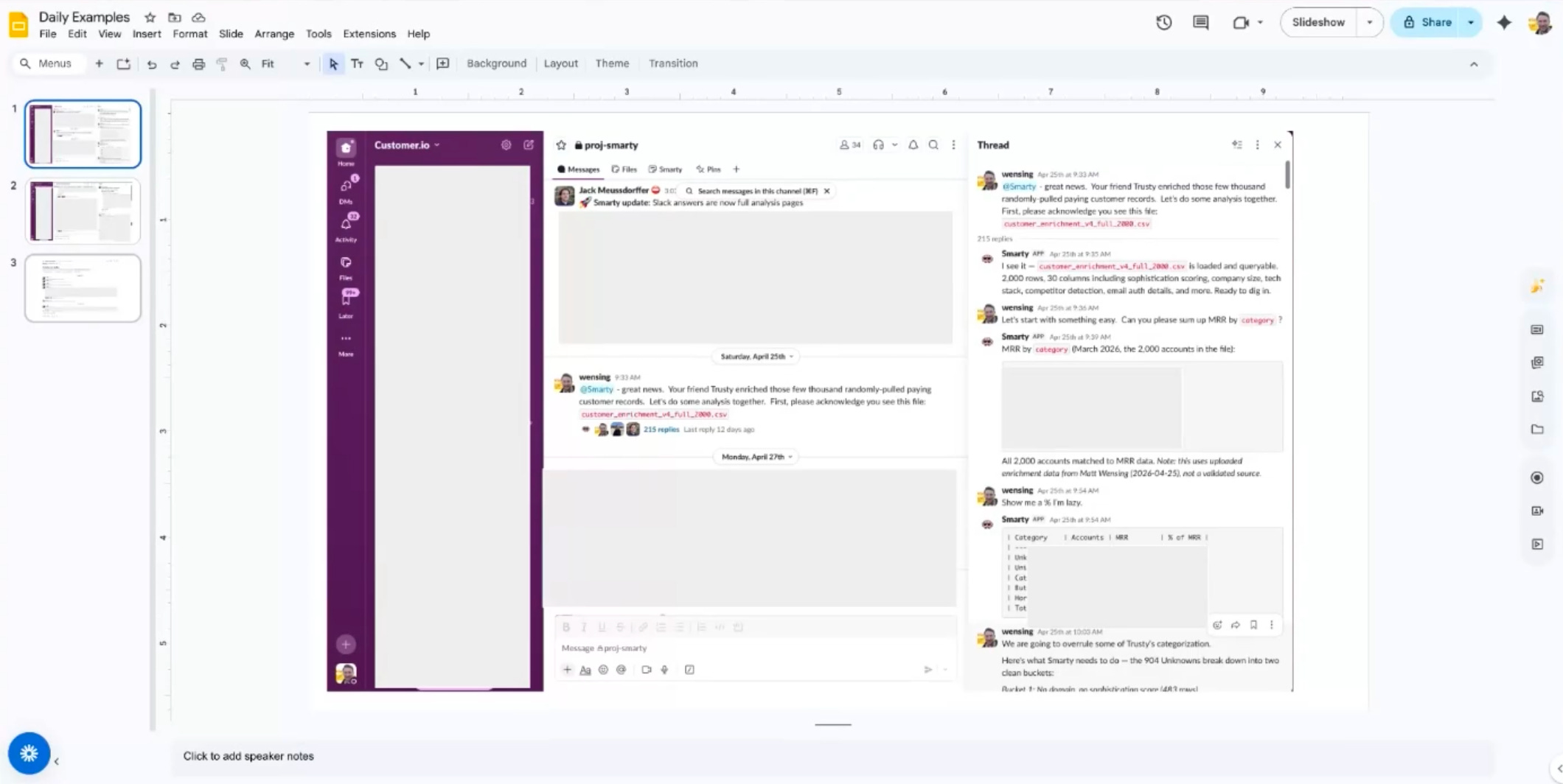
Two things he is careful about here. One, he has a data team that can jump in when the bot produces something that does not look right. Two, he never takes a non-deterministic answer at face value for something going into an executive report.
The bot accelerates the analysis. The human still verifies it.
The Slack scanner
Customer.io has over 400 employees spread across dozens of Slack channels. There is no version of Matt’s job where he can read every thread that might need a product perspective.
So one of his teammates built a scanner. It runs across several dozen channels continuously, looking for conversations where a product person should probably be involved but is not. It surfaces those threads to Matt at set times during the day, without overwhelming him.
Matt is clear about what this tool is and is not. It keeps him close to the ground while he is deep in a Claude session or running back to back executive meetings. He can see a support conversation with a specific customer that needs product input, flag it, tag the right person, and turn it into a process improvement opportunity all in the same thread.
This is the thing most leaders lose as they get more senior. Proximity to the real problems. The scanner gives it back without adding hours to the day.
Chiefys
The third tool is the most strategic one. Chiefys is a bot that Customer.io‘s CEO Colin built. It lives in Slack and has one job. It holds the corpus of Customer.io‘s official company documents, the operating model, the strategy docs, the things the company actually runs on, and it checks new work against all of them.
When Matt produces something new, like a pricing philosophy, he can run it through Chiefys. It will tell him whether what he just wrote contradicts anything already established across the company’s core documents.
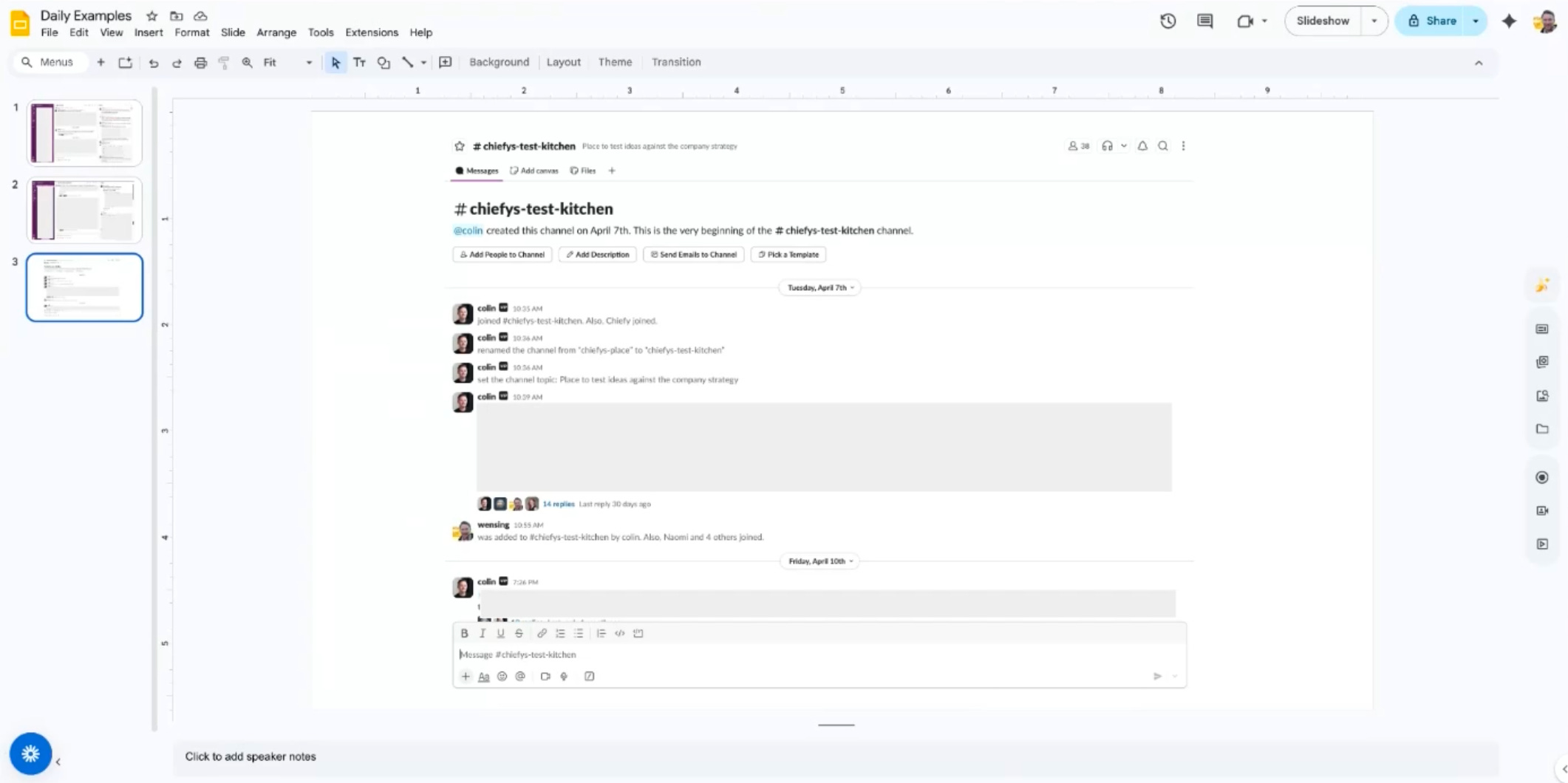
It works in both directions. New document contradicts an old one, Chiefys flags it. Old documents go stale because the company shipped something new, Chiefys flags those too. Every leader has experienced the pain of getting alignment on something in January and watching that document become invisible by April because three other things changed around it. Chiefys is the accountability check that nobody has time to do manually.
So the full stack - Claude desktop for deep thinking, the analysis bot for data, the scanner for proximity, and Chiefys for consistency. Four tools. Each one doing a job that used to require either a team or a lot of luck.
Where to find Matthew Wensing
Related content
Podcasts
Newsletters
PS. Please subscribe on YouTube and follow on Apple & Spotify. It helps!