Check out the conversation on Apple, Spotify and YouTube.
Brought to you by:
Customer.io - Send smarter messages using your product data
Ariso - Ship AI agents and features faster with fewer regressions
Viktor - AI employee connected to 3k+ tools. Every action approved by your team
Bolt - build a complete design system from your code
Product Faculty - Get $150 off their #1 AI PM Certification: code AAKASH150
Today’s episode
2023: Prompt Engineering
2024: Context Engineering
2025: Harness Engineering
2026: Loop Engineering
As the founder of OpenClaw said:

Loops are all the hype now. I’ve already written the web’s deepest guide to loops for PMs. Today, I bring you the practical screenshare.
My guest is Tyler Folkman, Chief AI and Product Officer at JobNimbus, which just raised Utah’s largest Series B ever.
And they are operating in the future. Design is building design loops that meet product loops that PMs build that meet engineering loops that engineers build.
Today, Tyler shows you everything:
Today’s deep dive
As a thank you for having me in your inbox, I wrote up my key takeaways and expanded upon some of Tyler’s key insights. Here’s your guide to loops for PMs:
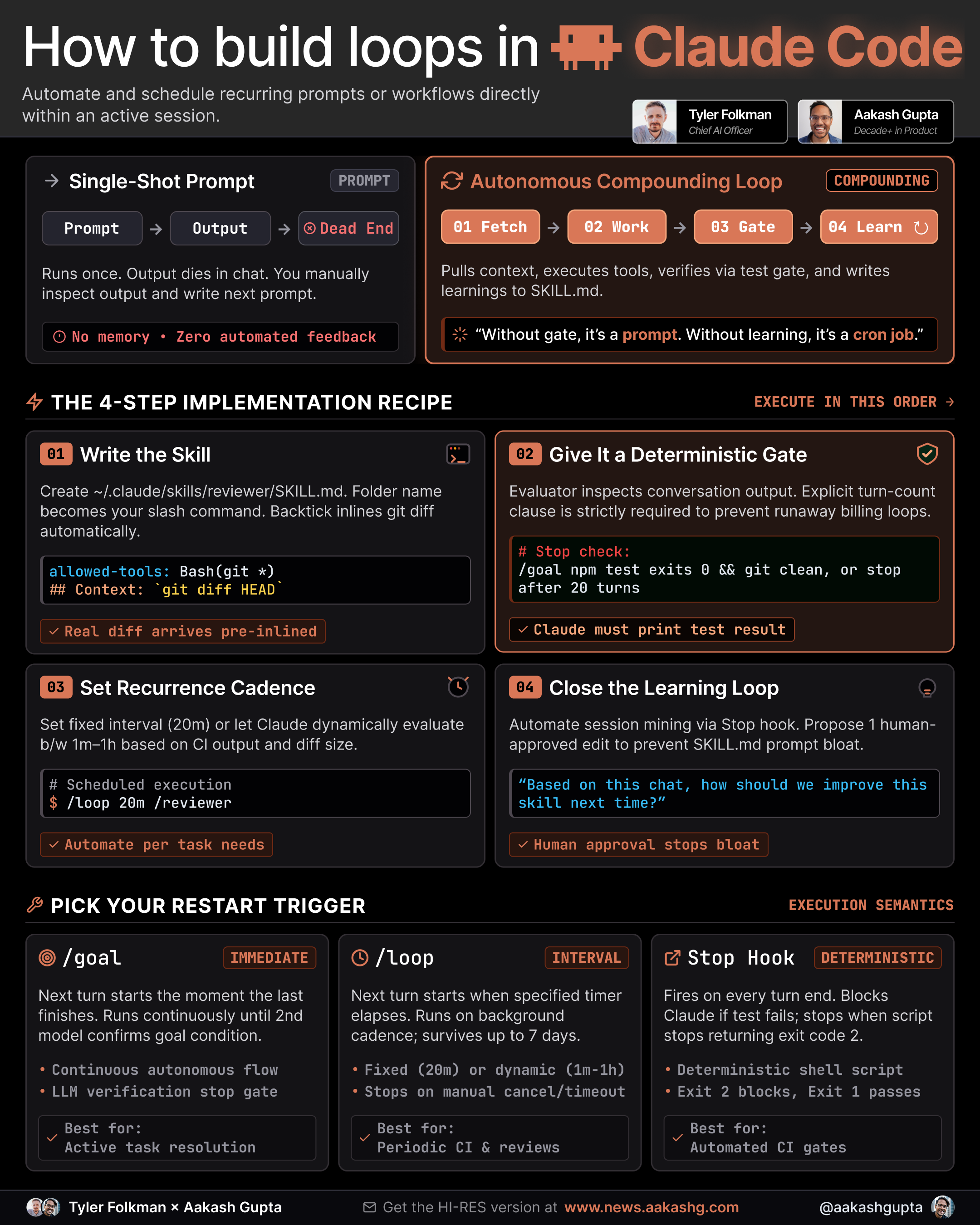
What makes a loop a loop?
How to write your first loop in 10 minutes
5 Loops every PM should build
1. What makes a loop a loop?
The first thing to understand is why do we care about loops? Tyler put it very well:
Where prompting got hard is you always had to keep yourself in the loop, so you didn’t feel the gains from what you get from Agentic.
So that’s why we have loops. What is a loop?
Anyone can easily say ‘build a loop in claude code’ or run an agent forever and call it a loop. But are those legit? Probably not.
Tyler visualizes a legit loop like this:
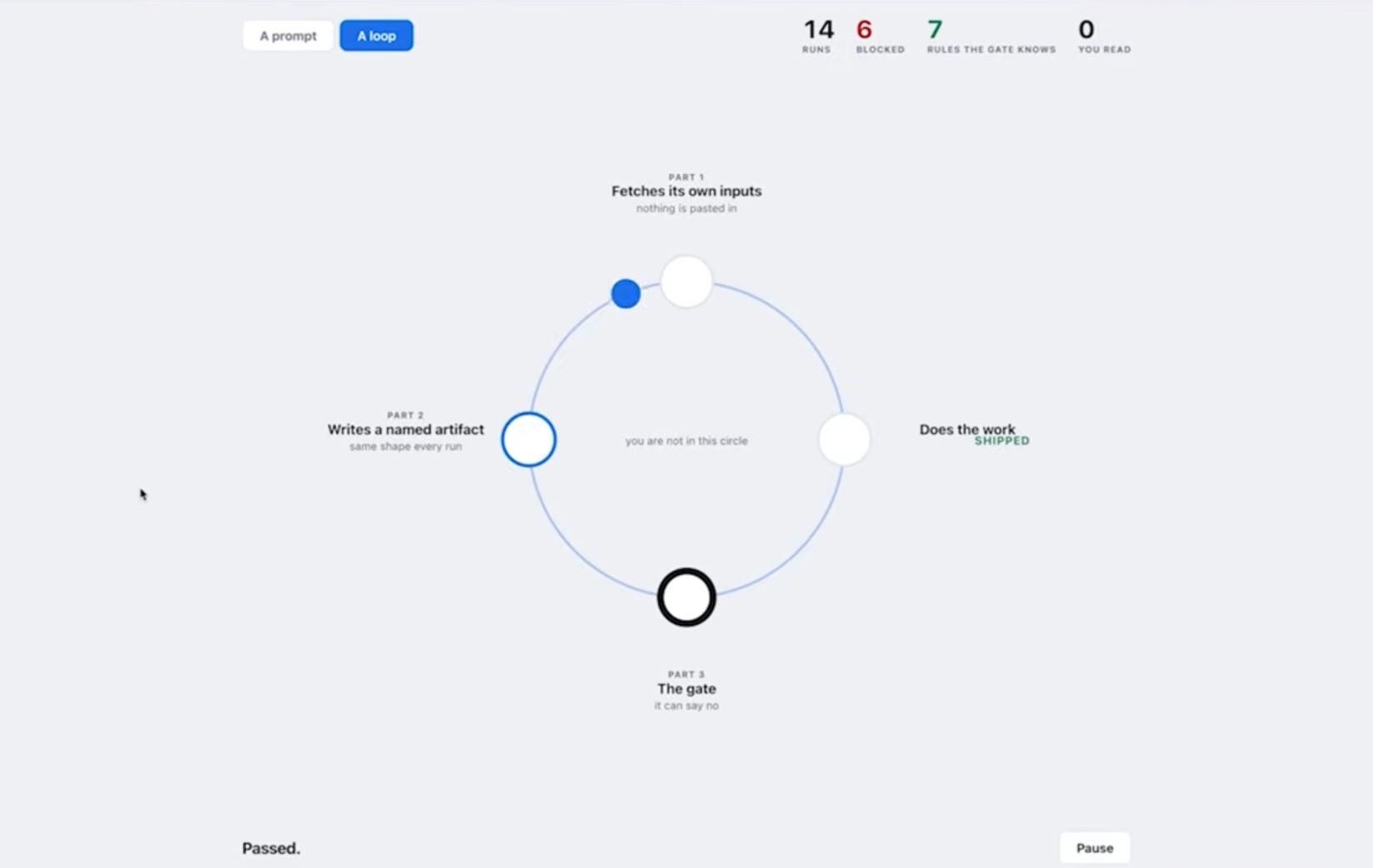
Fetches its own inputs
Does the work
Has a gate
Writes a named artifact
And goes back to fetching its own input again.
That’s basically it. An agent or prompt become a loop when you feed the session back in and let it rewrite itself.
2. How to write your first loop in 10 minutes
Here’s some real alpha for you: write your first loop by hand, not with AI.
The advice genuinely surprised me, but Tyler was firm on it:
I’ve read some papers that suggest that skills authored by humans are often better than the ones authored by AI. You know more and can express more of what you want this thing to do.
And then he gave a second reason, too:
People are like, yeah, I got an ebike, but don’t worry, I still want to get exercise and we’ll pedal. Once you get on the ebike, you’re not pedaling.
Once you start using AI to write loops, it’s like an ebike. You only use the AI for pedaling (writing the loops).
So he opened an empty file and typed a skill by hand live. This is roughly it:
# Decide

Help me make good decisions.

I struggle with decision fatigue. Push me toward a decision once enough
thinking has been done.

Use contrarian thinking. Question me, use the Socratic method, and call
my BS. Bring in the latest research where it's relevant.

Be succinct.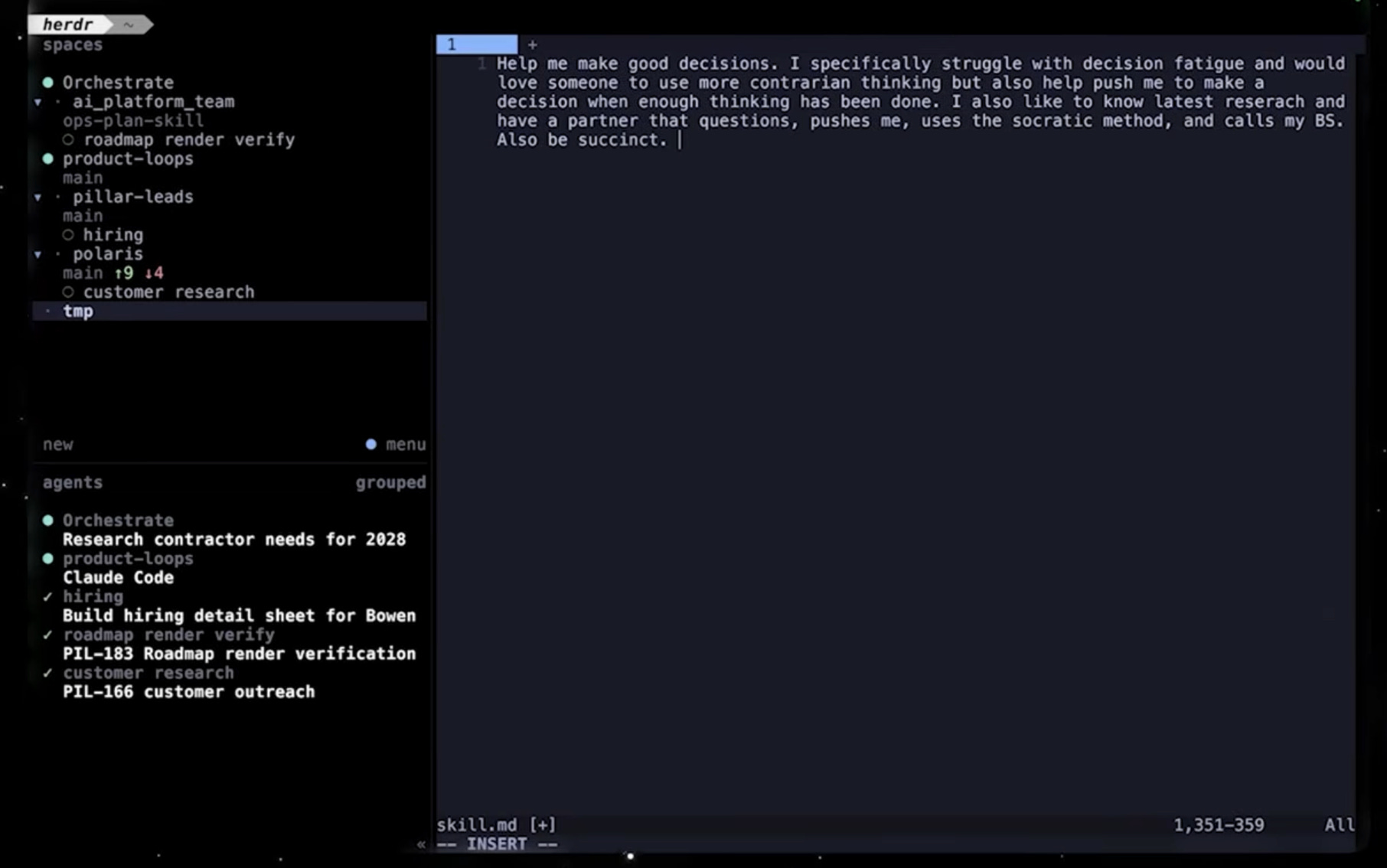
That’s a skill. Then you save it, test it, and improve it. When that’s done, it’s one easy command to make it a loop:
Can you set this up as a loop and ask me what you need including a learning hook before closing out sessions that learns from the log.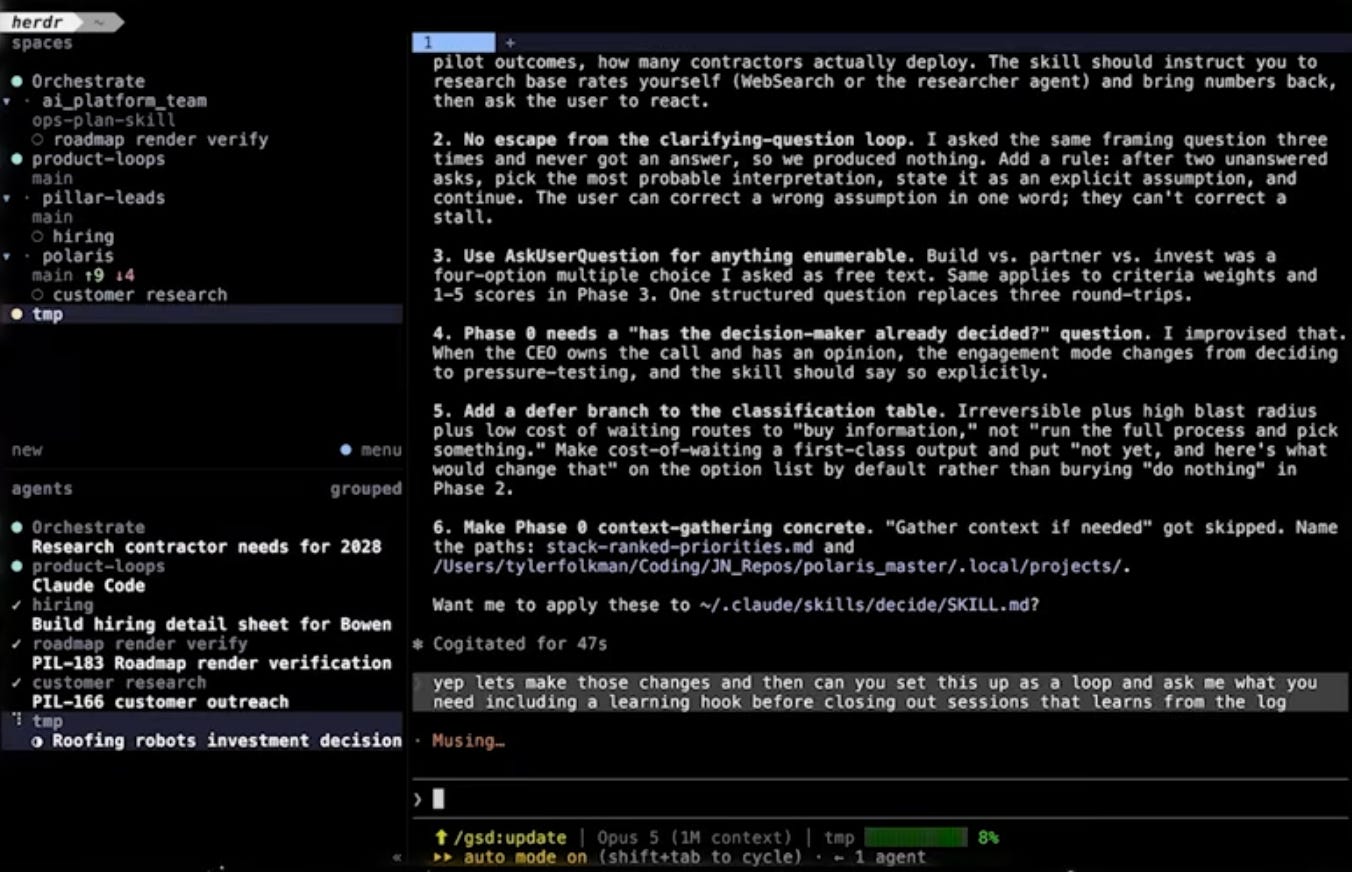
It’s as simple as that. You set up a skill. You test it. You improve it. Then, you set it up as a loop.
You can also close the loop by hand, which is worth doing once so you see what it's actually doing:
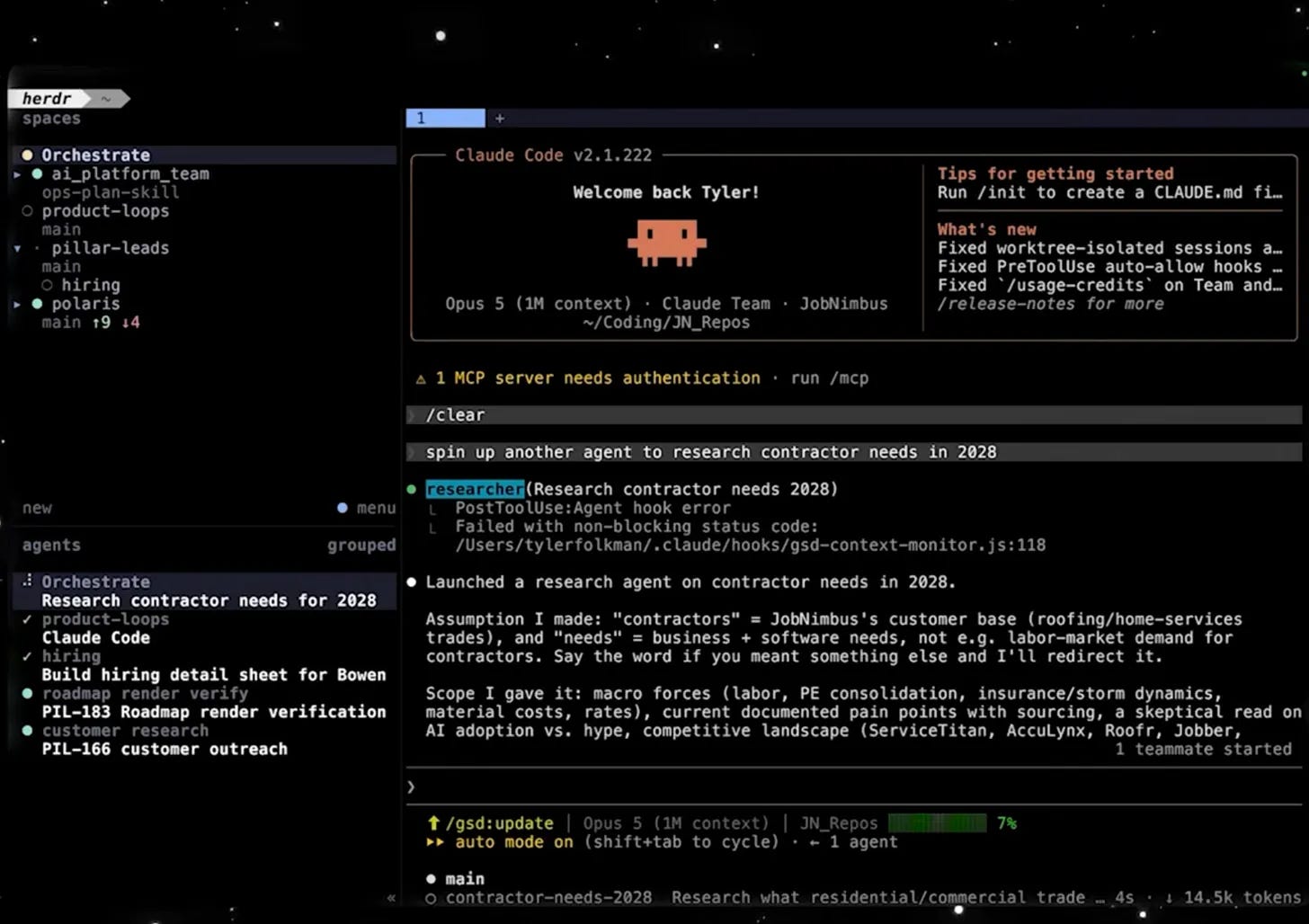
Based on this conversation, how should we improve our skill to be better and more effective next time? It works in regular Claude Code. Tyler uses herdr, a terminal tool for running several Claude agents side by side, which further simplifies the process because it will set them off with the keyword ‘agent’ in your Claude Code prompts:
3. 5 Loops every PM should build
Tyler recommends PMs build at least these 5 loops:
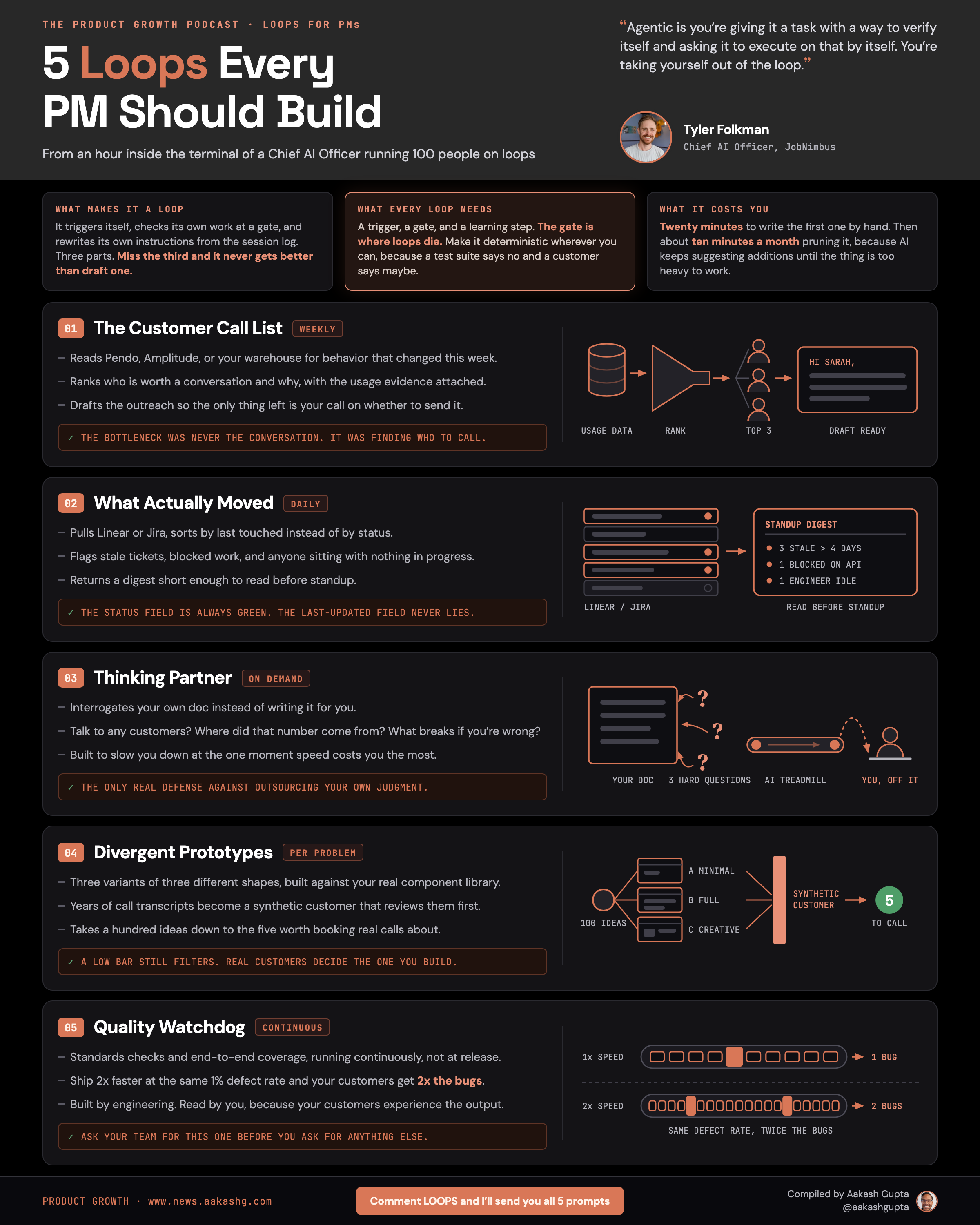
Loop 1 - Customer outreach
This is the one Tyler says he gets the most value out of himself:
It’s a really good way to keep close to the customer without one of the biggest challenges, which was just the time to go find who to reach out to and send them a message.
Loop 2 - Project status
This is the boring one that saves the most hours. Pull the tickets, find what’s stale, find who’s blocked. Nothing clever about it.
Loop 3 - Thinking partner
This is the opposite of what everyone’s building. So I want to highlight it.
Tyler’s team writes skills that push back on the person instead of doing the person’s work:
It’s less about doing and more about pushing the thinking of the people on the team. Did you talk to customers? Did you look at the benchmarks in the industry? Where does the data come from?
The reason is that the treadmill is genuinely addictive:
You get all this stuff back and you’re like, I can’t possibly go and evaluate this, so I might as well just send it up the chain and see what happens. That’s not doing product work. That’s outsourcing your thinking.
That’s career damage for a PM in 2026. A year ago a huge deck made you look like a machine. Now people recognize it on sight and know you didn’t think.
Loop 4 - Divergent prototypes
While we were talking, his product skill was building prototypes in the background off a prompt this thin:
Create a crew schedule prototype for a contractor in a product like JobNimbus.
Build three variants: A minimal, B full-featured, C creative.
And this led to 3 divergent prototypes in just a few minutes. From Tyler’s point of view, you should always do this:
Never skip it, in my opinion. We used to talk about what your test coverage is, and now it should just be 100%. It’s basically free. Why not do it?
And then his product loops actually uses a synthetic customer to review the prototypes before any human sees them.
Loop 5 - Quality Watchdog
This is one to ask engineering for, not build yourself.
Here’s the math Tyler walked me through, and it’s the thing most teams are getting wrong right now:
If you ship twice as fast with AI and your quality rate maintains the same rate, your customer experiences twice as many bugs.
That’s his read on why uptime at big companies has been so bad lately. So build this loop to avoid low uptime!
And with these 5 loops, you’ll be ahead of most PMs out there.
Final words
A large part of the PM job used to be production for the majority of the last decade. That work was slow and deliberate and hence the most valued. It is now close to free.
So where does that leave you? Loops. My prediction is that they will be the fastest way to hand over the production half of your job to something that never gets tired of it.
And with the hours won back you can focus on calibration and discovery. So build the loops and then go spend the time in a room with a customer.
I will see you in the next issue.
Where to find Tyler
Go Deeper
If you don’t know where to start on Claude loops, I got you covered with my ultimate guide on Loops for PMs. This includes my library of 12 top PM loops.
Then follow it up with The Complete PM Guide to /goal in Claude Code.
Finally, Tyler mentioned the evolving role of PMs and how it is shifting into a Product Builder role, so you can learn more in my podcast with Mahesh Yadav on How to Become a Builder PM.
Finally, please subscribe on YouTube and follow on Apple and Spotify. I have much more content like this coming!
If you want access to my AI tool stack including Dovetail, Arize, Linear, Descript, Bolt.new and many others - become an annual subscriber ($150) and grab Aakash’s bundle.