

Check out the conversation on Apple, Spotify, and YouTube.
Brought to you by
Mobbin - The internet’s best library of real design patterns

Get a full year of Mobbin Pro, along with 8 other AI tools, at bundle.aakashg.com.
Today’s Episode
Srini Raghavan, the CPO of Freshworks, predicted that the title “Product Builder” will replace engineer, designer, and product manager in 5 years.
If that’s true, we all have a lot of catching up to do.
So today I break it all down with one of my most popular guests, Ankit Shukla (founder, HelloPM):
Is the Product Builder role legit…
How much are Product Builders paid and where do they work…
And what you need to know to become a product builder
Want a free live class covering the AI you need to know to become a product builder?
Join me tomorrow morning at 9AM:
Newsletter Deep Dive
I am so glad you let me in your inbox :)
As a thank-you, I wrote this complete guide to becoming a product builder. Enjoy!
What even is a Product Builder, who’s hiring, and does it pay?
How to find AI problems that are actually worth solving
How to ship a production app with Claude Code
How to land a product builder role
1. What even is a Product Builder, who’s hiring, and does it pay?
What Even is a Product Builder
The big question on the role “Product Builder” right now is:
Is this a real job or just a rebrand?
Ankit’s take? It’s real.
In the episode, Ankit pulled 12,500 PM job descriptions from top companies and had Claude and GPT read them. More than 30% of PM roles now ask for AI skills.
The number one skill those postings asked for was judgment: knowing which problems deserve AI.
So that judgment is what people are paying for.
- Ankit
Indeed, LinkedIn shut down its Associate Product Manager program and replaced it with an Associate Product Builder program.
So how does this differ from other jobs out there?
The two commonly confused ones are forward deployed engineer and product builder. Here’s the difference between the three:
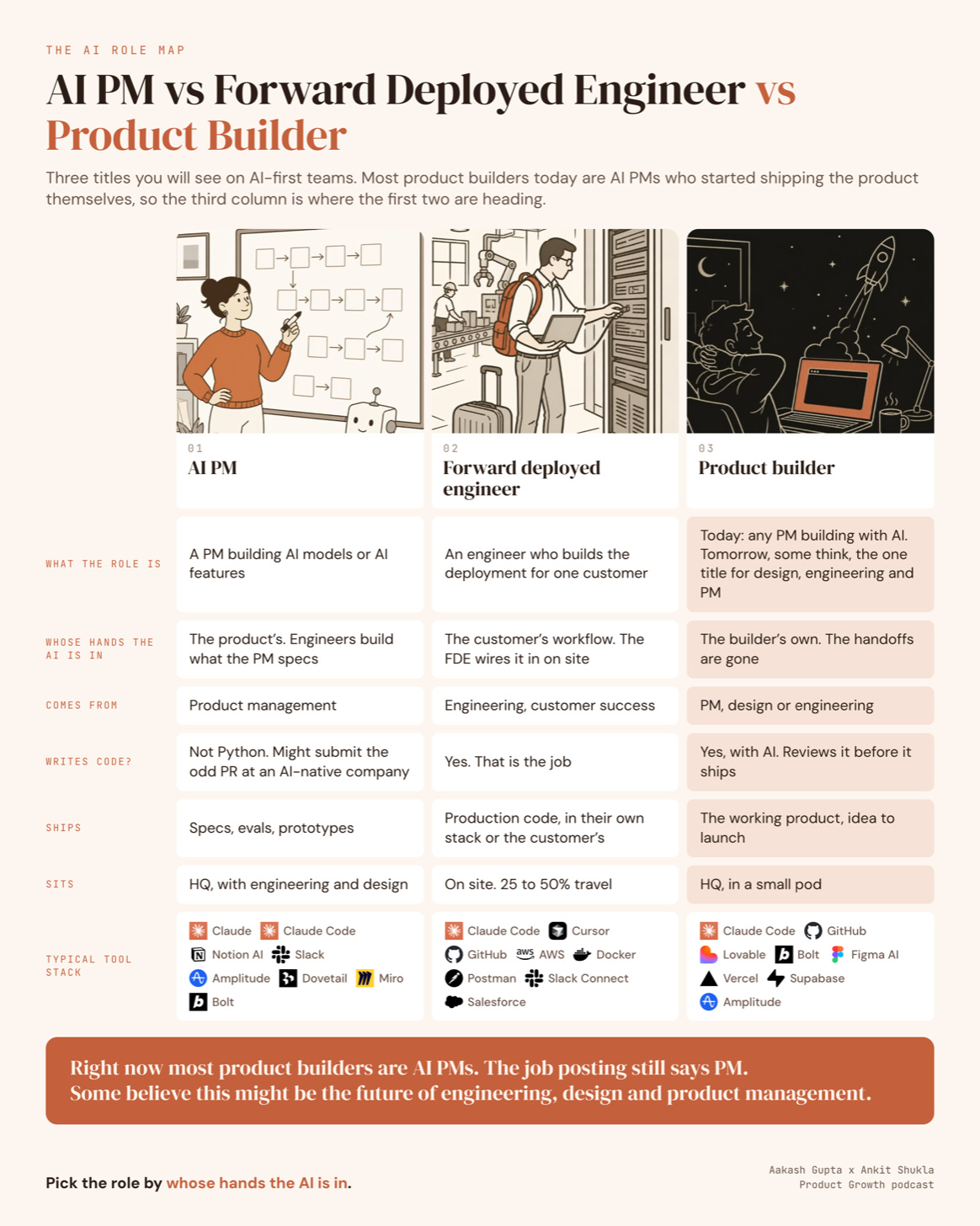
Put simply:
AI PMs are the PMs building AI models or features
Forward Deployed Engineers are the on-the-ground consultants helping build deployments of an AI product for specific customers
Product Builders are, today, any PM building with AI. Some believe it becomes the one title for design, engineering, and product management.
How Much Does it Pay
Right now, product builders really hold the title AI PM.
Looking at those roles, AI-skilled PM roles pay 15 to 20% more than traditional ones in the US and Europe, and 30 to 50% more in India.
How this breaks down in the US and India is:
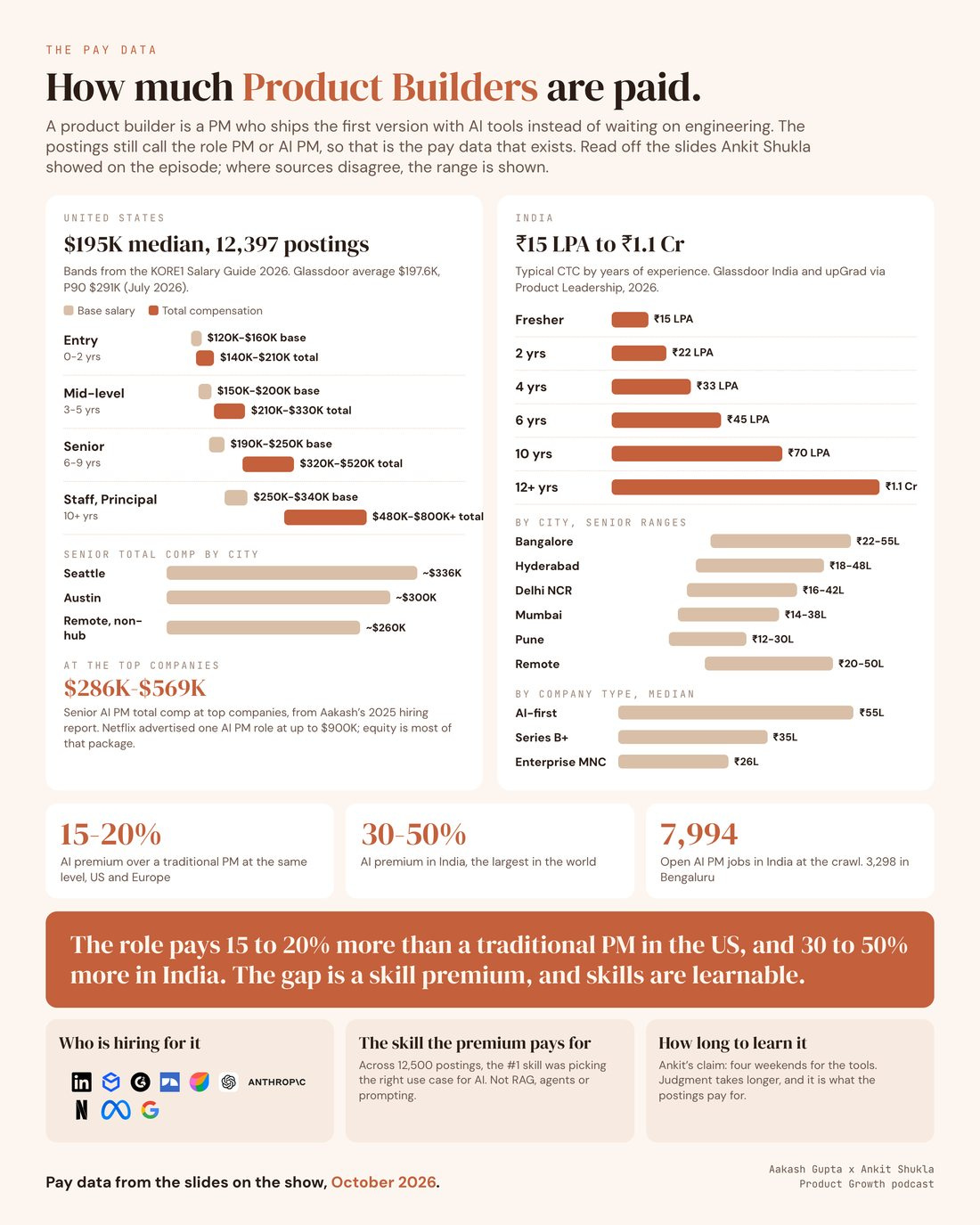
In the US, Ankit found:
$195K median
Around $120K base if you’re just starting out
$340K to $350K in senior roles
Up to $2.5M in total comp for senior roles at the top labs
In India:
₹12 to ₹16 LPA for a fresher with solid AI projects
₹22 LPA at 2 YoE
For context, our survey of 1,019 Indian PMs put the average APM at ₹17 LPA.
Who’s Hiring
These days PMs as product builders is the hottest topic. Here are just three product leaders I recently chatted with who are hiring this archetype:
Vishnu Gopalan, VP of Product at Series B Opsera
Jiaona Zhang, CPO at Series C Laurel
Srini Raghavan, CPO at Freshworks (public)
Many others I talk to have emphasized the same. I’d say this is the biggest trend in PM right now. So when in doubt, assume the product builder skillset is what any AI-forward company you interview with is looking for.
2. How to find AI problems that are actually worth solving
The most important skill every product builder needs to have is great AI product sense. They need to be able to find AI problems that are actually worth solving.
Here’s the framework Ankit drew out for us, POWER:
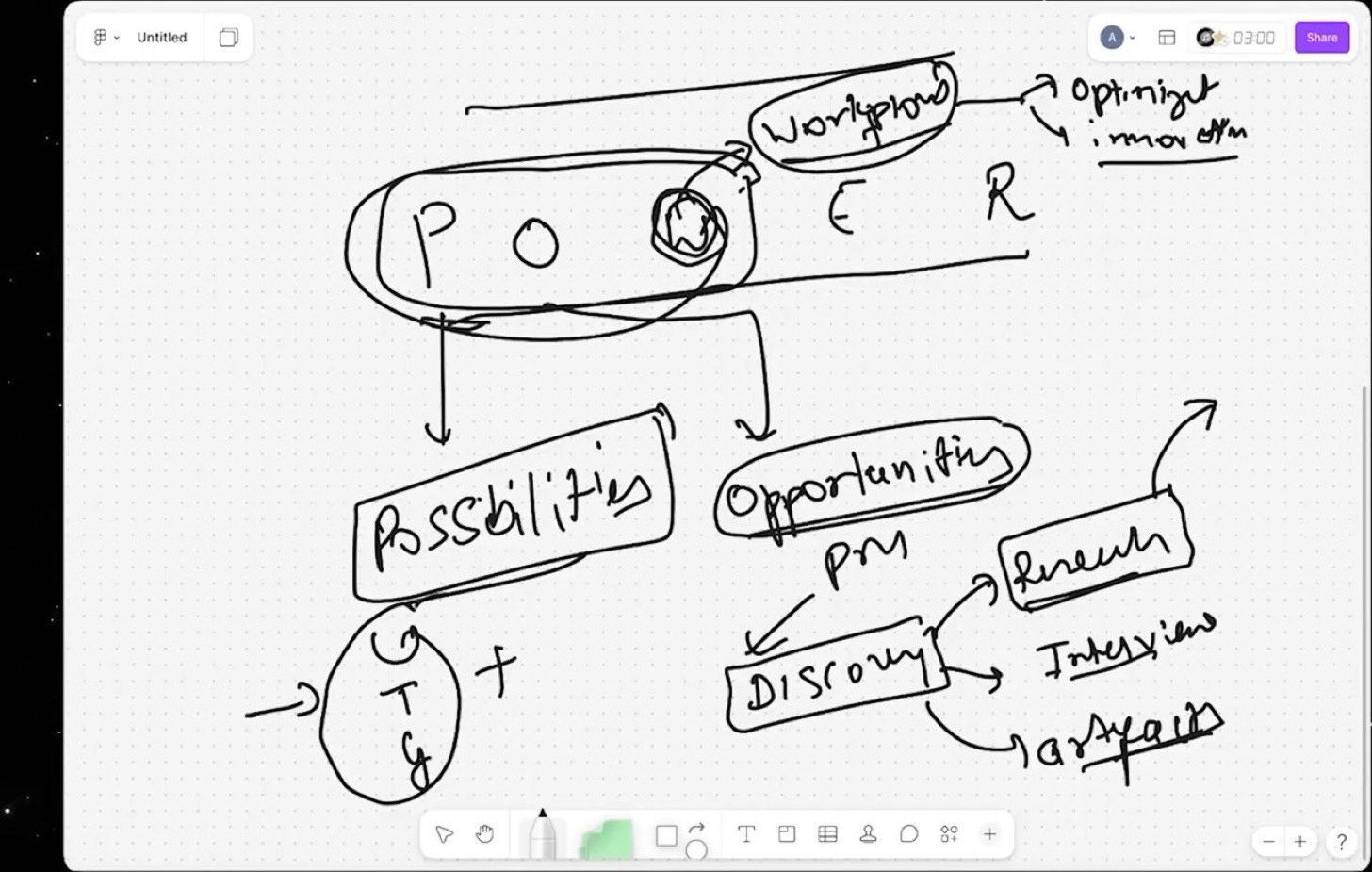
Let’s go deep on each letter.
P - Possibilities
Start from what AI can do. Ankit’s shorthand is UTG:
Understand: read a whole folder of meeting transcripts
Transform: turn those transcripts into one summary
Generate: write the content or the code
Then go see what other people did with it. Your competitors. The industry next door. And his favorite shortcut, the customer stories pages at Anthropic, OpenAI, DeepSeek and Moonshot. Each one is a list of things a real company already made AI do.
Write all of it down. Ankit calls it a possibilities database, and says every company that’s serious about AI should keep one.
O - Opportunities
In possibilities, you looked at the world. In opportunities, you look at your company.
Two rules here:
Never start with one use case. You’ll pick before you’ve seen the whole map, and you’ll usually pick wrong.
Pick by frequency. Build for a rare problem and it never pays back the time it took.
This is the judgment Ankit kept coming back to all episode:
“For you as a product manager, one skill that is very important is about judgment of what problem to pick in order to solve with AI.”
W - Workflows
Ankit says this is the step where PMs need to put the most attention.
“Improve discovery with AI” sounds like a plan. It’s too high-level to build anything from.
You have to go down to the actual steps. Take a roadmap decision. The inputs are:
Support tickets
Reviews on Google Play or G2
Sprint reviews
Leadership meetings about the product
Where does each one go today? Who reads it? What gets dropped? You only find out one way: interview the people who do the work.
Then sort what you find into two buckets:
Optimization: the three-hour weekly task now takes one
Innovation: a process that couldn’t exist before, so nobody ran it
Innovation is where it gets fun.
E - Engineering
Notice something? Three letters in, and not one tool named.
That’s the point.
Only now do you pick: n8n, Make, Zapier, a Gem, a custom GPT, Claude.
Start from a real use case and you get ROI. Start from a tool and you spend your time retrofitting a problem to fit it. Ankit says that’s how the AI slop gets everywhere.
And here’s the stat I keep thinking about. Across those 12,500 job descriptions, the number one skill wasn’t RAG. It wasn’t agents or prompt engineering either.
It was identifying the right use case for AI.
R - Reflection
Ankit wrote the R on the whiteboard but didn’t get to it on the show. HelloPM’s own notes on POWER fill it in: R is for Reflection.
“After the AI does its work, you have to look at what came back, find the gaps, and improve your approach for next time.”
That’s what makes AI work compound instead of starting from zero every time. It’s also where evals come in. My guide to your first eval is the place to start.
3. How to ship a production app with Claude Code
Say POWER worked. You found a problem worth solving. Now you’re at E.
And the internet has a dozen opinions. One thread says Claude Code. Another swears by Codex. Your engineering lead wants n8n. A creator you follow built the whole thing with a Gem.
So most PMs either overbuild or underbuild.
Ankit’s answer is a ladder. Six levels, from a plain prompt at L0 to a production app at L5. Each level fixes a pain in the one below it, and each one costs more to build.
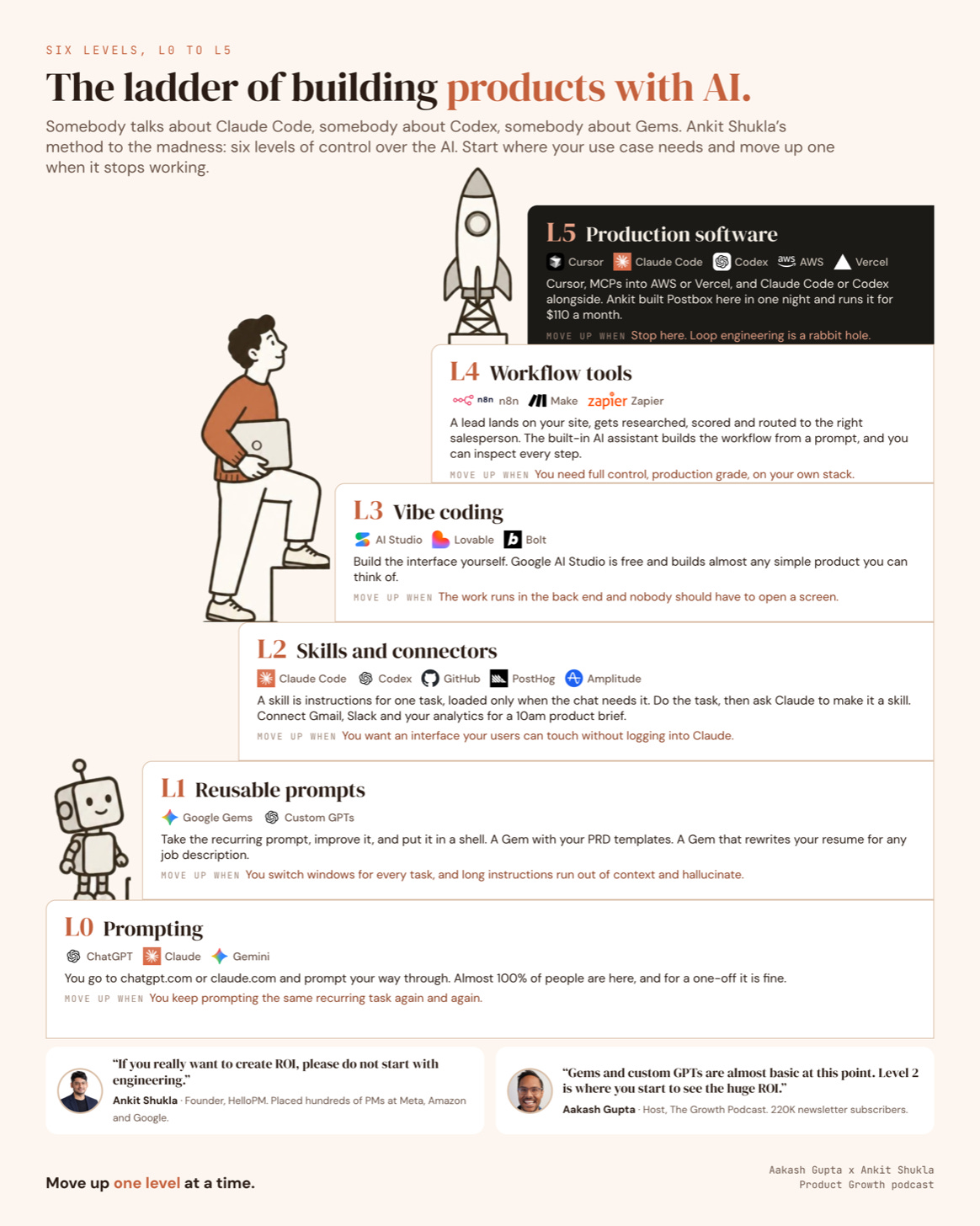
The rule: find the lowest level that does the job, and only climb when it starts to break.
Claude Code or Codex?
Everyone asks Ankit this. So his team tested it.
They built the same four sites (an ecommerce store, a social commerce site, a social network and a gaming platform) with Claude Code, Codex, Cursor and a DeepSeek setup.
Every one of them shipped a working site.
“For 90% of the use cases, it does not matter.”
Stop debating the model. Start building.
Want to go deeper? Ankit built an L5 app the night before we recorded, and walked me through the whole Claude Code transcript in the episode.
4. How to land a product builder role
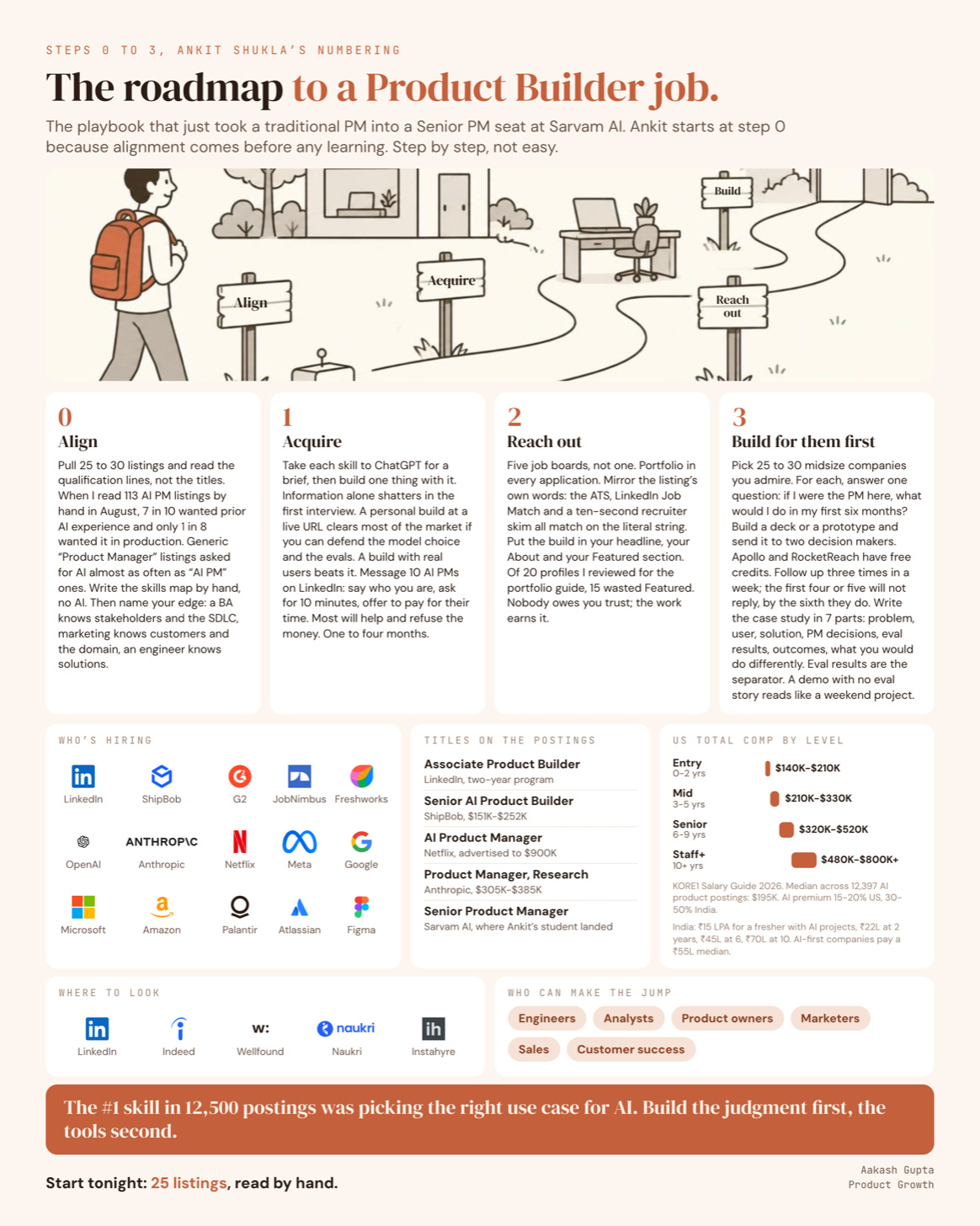
So where do you start? With the same roadmap one of HelloPM’s students just used to land a senior PM role at Sarvam AI (India’s latest unicorn):
Step 0 - Align
You can’t land a job you don’t understand.
So pull 25 to 30 job listings. AI PM roles, or PM roles at AI-native companies. Banks, fintech and health tech count too. They’re all asking for AI now.
Read the qualification lines, not the titles. When I read 113 AI PM listings by hand in August:
7 in 10 wanted prior AI experience
Only 1 in 8 wanted it in production
Plain “Product Manager” listings asked for AI almost as often as “AI PM” ones
Then build your skills map. By hand. Ankit was firm on this one. Reading job descriptions closely is where humans still have the edge.
Last, name your edge. Ankit says nobody with two years of experience has zero:
BA or product owner: stakeholders and the SDLC
Marketing or sales: customers, distribution and usually a domain
Engineer: solutions and technology
Your background is already a head start. Write it down.
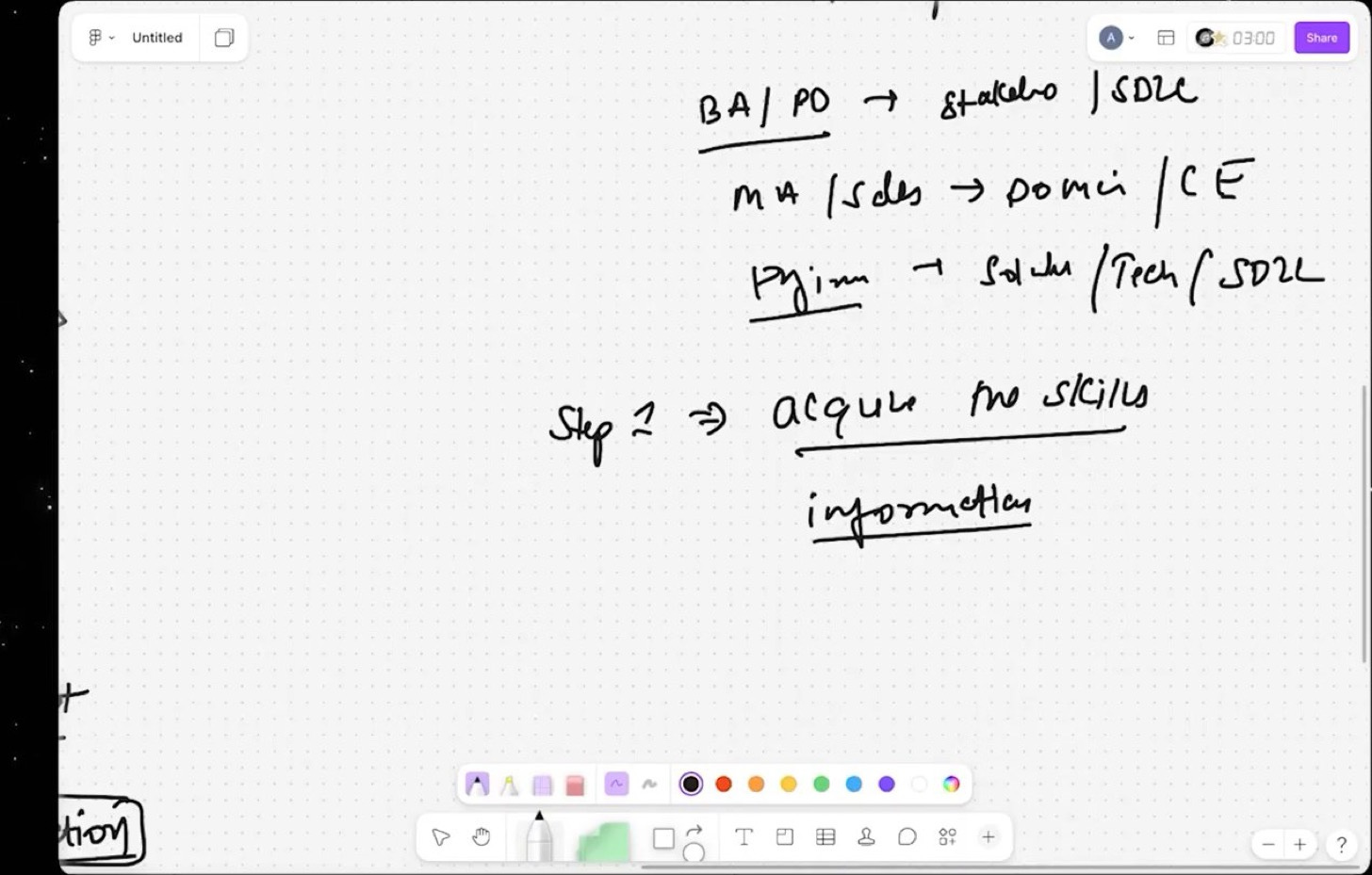
Step 1 - Acquire
Take each skill on your map to ChatGPT or Claude for a brief. Watch the videos. Now you have information.
“Information actually gives you a false sense of confidence that is shattered the moment that you enter the interview.”
You need knowledge. Ankit says it comes from two places.
Build something. Run POWER on a real problem and climb the ladder. A live build you can defend (the model choice, the evals) clears most of the market. A build with real users beats it.
Talk to people in the role. Search LinkedIn for “AI product manager,” filter to People, and send:
Hi, this is who I am. I’m learning AI product management and I find your profile inspiring. Could I take 10 minutes of your time? I’m happy to compensate you for it.
Most will help. Most will turn the money down.
Ankit’s estimate for this step: one to four months.
Step 2 - Reach out
Five job boards, not one. In India, that’s Instahyre, Naukri, Indeed, Wellfound and LinkedIn.
And attach your portfolio to every application.
“People don’t owe you trust. You have to make them trust you.”
Two things I’d add:
Mirror the listing’s words. The ATS, LinkedIn’s Job Match and a ten-second recruiter skim all match on the literal string.
Put the build everywhere. Headline, About, Featured. Of 20 profiles I reviewed for my portfolio guide, 15 wasted Featured.
Step 3 - Build for them first
This is the step that actually gets replies.
Pick 25 to 30 midsize companies you admire
For each one, ask: if I were the PM here, what would I do in my first six months?
Build a deck or a prototype that answers it
Send it to at least two decision makers. Apollo and RocketReach both have free credits
Follow up three times in a week before you call it
Expect silence from the first four or five. Ankit’s blunt about why: your work isn’t good enough yet.
By the fifth, sixth, seventh, it is. That’s when replies start. And when you walk into the interview, you end up talking about your projects instead of hypotheticals.
Then Ace the Interview
There are at least 3 interview rounds you must be ready to master. Let’s decode each:
Fit tests risk
Can they trust you in their domain? Switching industries no longer takes years. A few months of projects in the new domain get you most of the way to credible.
Product sense tests judgment
The same judgment we talked about in section 1. Builder skills get you in the room. This round decides if you stay.
AI depth tests whether you built your projects
Nobody asks about the best-case scenario. They ask what can go off track, and only the person who built it knows. Built a RAG system? Ankit says expect: where does it break, what happens at 100 million documents, what if you swap the model, how did you evaluate it?
For the AI depth round, my evals episode with Aparna Dhinakaran is the best prep I know. My AI PM interview guide covers the rest.
When you rehearse, the best tool is my Job Search OS.
Just remember to practice out loud. Ankit was specific on that.
And that’s all for today. See you in the next episode :)
Where to find Ankit Shukla
PS. Please subscribe on YouTube and follow on Apple and Spotify. It helps!
PS2. I used AI’s assistance to write today’s piece. But I stand by every word.


