
Check out the conversation on Apple, Spotify, and YouTube.
Brought to you by
Mobbin - The internet’s best library of design patterns

Get a full year of Mobbin Pro, along with 8 other AI tools, at bundle.aakashg.com.
Today’s Episode
Billions of people have played Mark Pincus's games. He founded Zynga, and for years I walked past the Zynga building in San Francisco every day.
Mark just published Life at the Speed of Play. The book's subtext is how to launch products people love.
So I asked him to go to the whiteboard and teach his Proven Better New framework from scratch.
I use this framework myself when I think about building products. But I'd guess only 10% of you know it well.
By the end of this post, you will know:
Why every great product starts as a copy
Where the line is between stealing well and getting it wrong
How to sort your roadmap into proven, better and new
🎁 Win a free copy of Mark’s book
I’m giving away 10 copies of Life at the Speed of Play! All you gotta do is watch the episode on YouTube and comment I watched till the end. I’ll reach out to 10 of you.
Want to see an AI agent get built from scratch?
This Wednesday, Oct 28, I’m building one live in Claude Code and explaining MCP in simple language.
Newsletter Deep Dive
How to use Proven/Better/New to Build Better Products
How to tell better from new
When to ship less new
How to test 100 ideas before you build one
1. How to use Proven/Better/New to Build Better Products
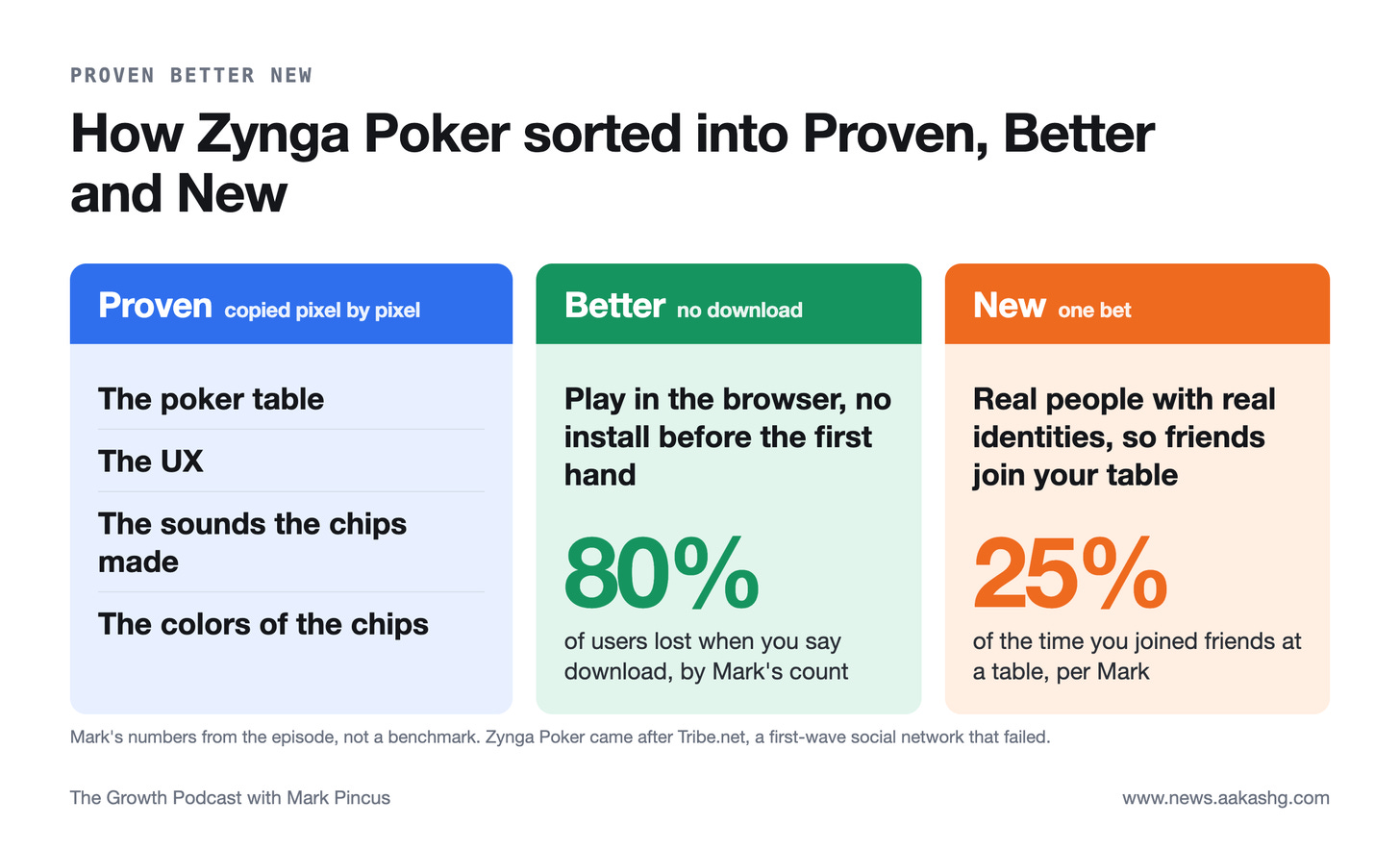
The big online poker sites used to make you download before you play a single hand.
Mark noticed that the moment you ask for a download, you lose at least 80% of your audience. That's his number, not a benchmark.
So he copied the leading poker tables down to the chip colors and removed the download.
Then he added the one new thing: your Facebook and MySpace friends could sit at your table.
Mark's most controversial idea is that copying is okay.
All music, movies, stories and games are derivative. Every artist builds on the artists before them.
But there is a line between taking inspiration and copying blatantly. That line comes down to taste.
Steve Jobs was a master of copying and appreciated it deeply. Bill Gates copied from the same place, Xerox PARC.
Then the two copied each other. Gates was worse at the trick, so it looked like he was just copying Apple.
Your instinct is right 95% of the time. But assume your idea is probably wrong.
Proven Better New lets you act on both at once.
Proven is any part of the experience that already works for this audience on this platform, so you copy it click by click and pixel by pixel.
New is your novel idea and your innovation zone. Your job is to isolate it so your launch measures that idea and nothing else.
If you want the first-session side of copying what works, my Ultimate Guide: Activation (paid) and The Ultimate Guide to Onboarding (paid) go step by step.
2. How to tell better from new
Would 10 out of 10 people who use the proven product today choose it? If they all agree, call it better.
If only you think so, call it new. This test isn't always easy, and most mistakes go in one of two directions.
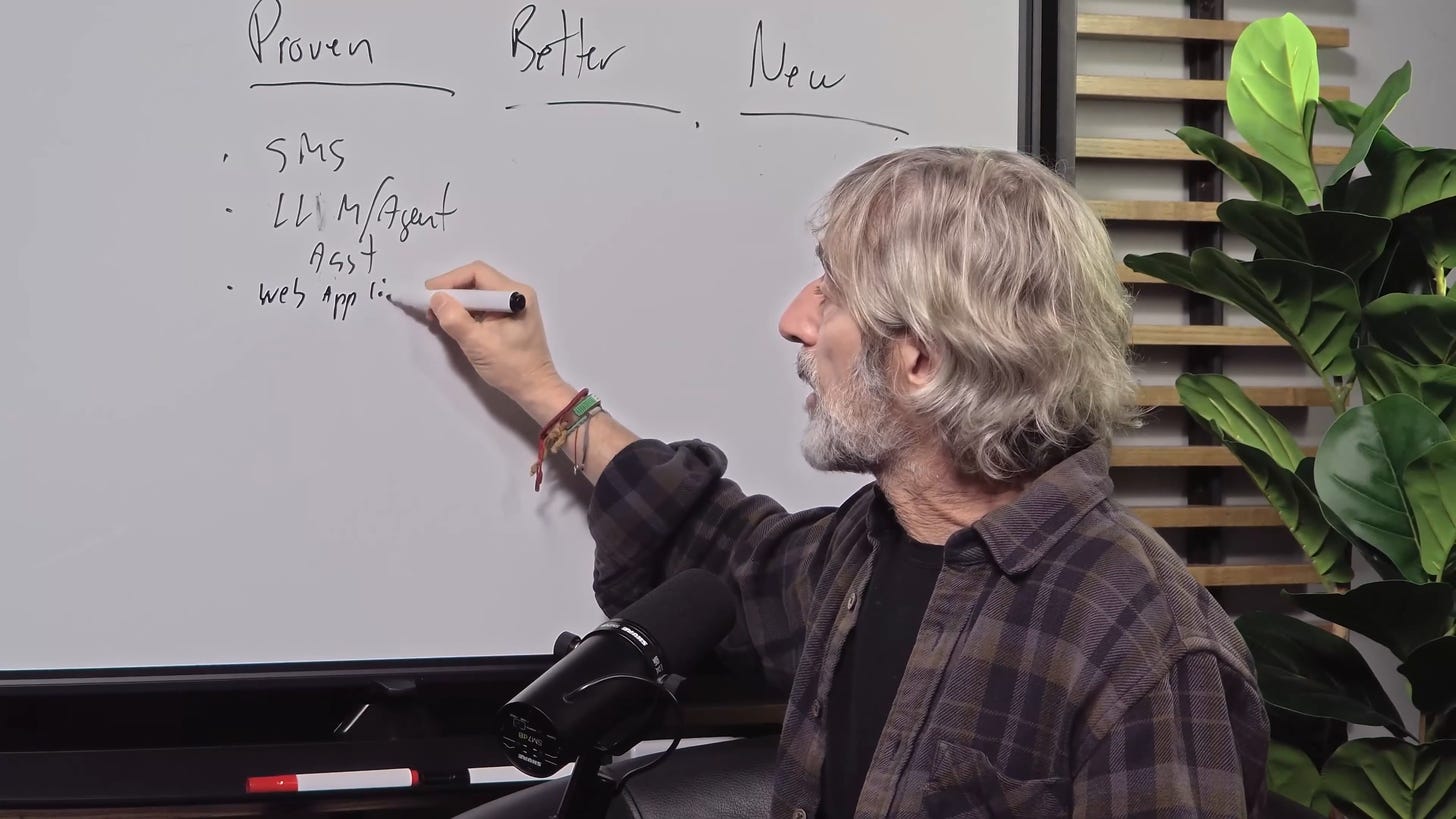
The first is calling your own idea better. Take Mark's family assistant built to compete with Instinct, the AI assistant that works over text. I tested Instinct for AI by Aakash.
Putting the whole family in one thread feels like an obvious improvement to the person building it. Under the test it is new.
Mark left the Better column empty:
The second is calling a removal better. Rejecting something that looks like an issue feels like progress.
But if it already works, removing something proven is a bet like any other. Zynga copied the neighbor bar from FarmTown, where the other player has to accept your request.
It looks like friction. Mark says calling its removal better “would have made our product less viral.”
The loop behind that is in my Ultimate Guide: Growth Loops (paid).
People at Zynga still repeat his mantra that all new fails.
If you expect that from the start, you won't be disappointed or let a failing idea linger too long.
But when new does work, we need to have a reverence for it.
So discount the hope you have for your own new idea. And pay close attention to new that's working out in the market, because that new just became proven.
Consumer AI didn't feel investable to Mark back in June. With Instinct at a $10B valuation, it feels a lot more investable today.
3. When to ship less new
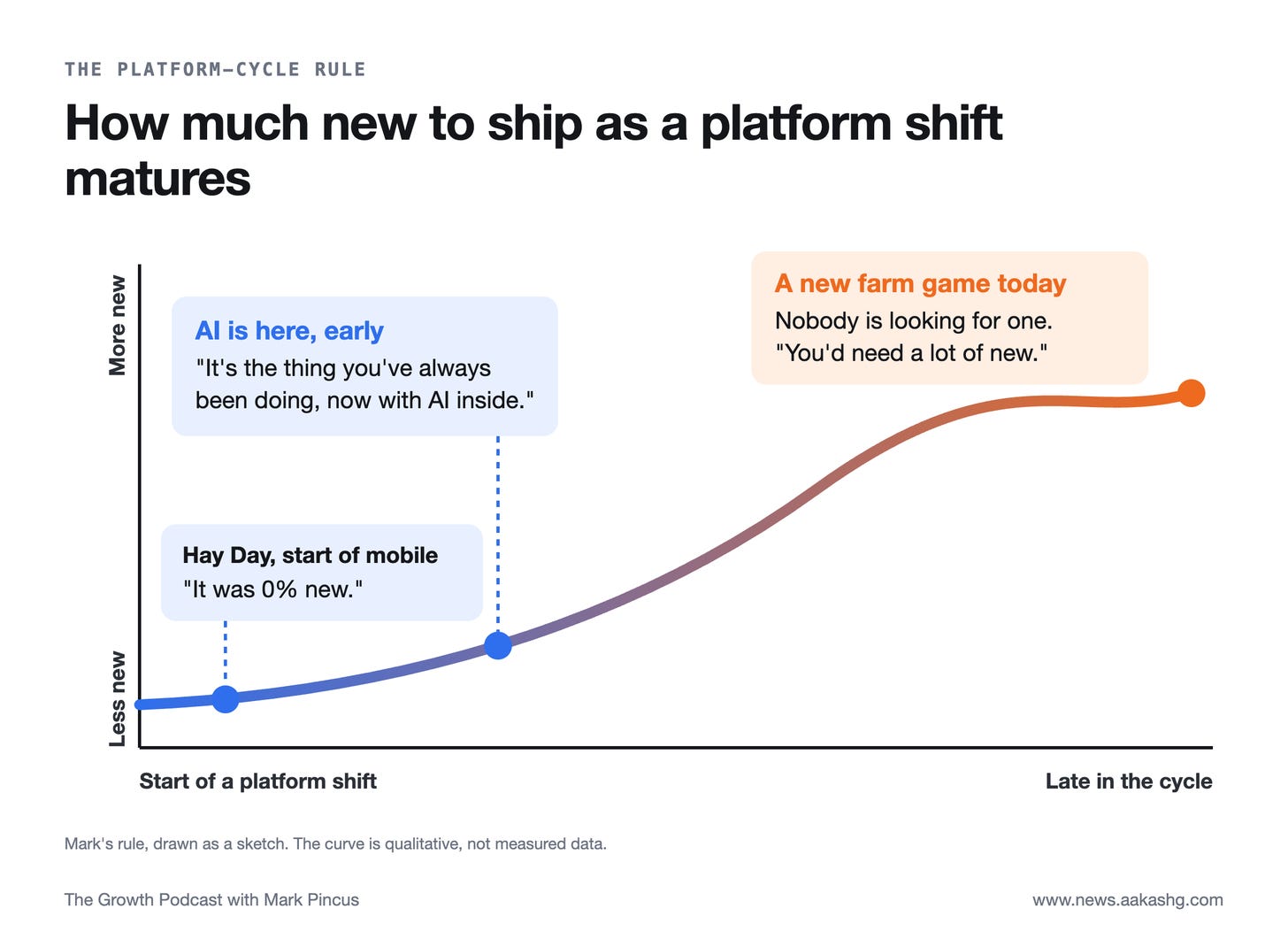
The earlier you are in a platform shift, the less new you should pursue.
Mark's proof is Hay Day. Supercell's game looked like Zynga's FarmVille 2.
In his words, “it was 0% new.” What changed was the better: it loaded faster, it had shorter crop cycle times and it had touch.
Late in a cycle it flips. Nobody wants a new farm game now, and you'd need “a lot of new.”
AI is early. So a lot of low-hanging fruit is always going to be there.
It is best to be disciplined about it and look for where you can be better because of AI.
Write down which part of your AI product is actually new. If it's more than one thing, you're running two experiments in one launch.
My guide to AI strategy is How to Build Product Strategy in the Age of AI (paid).
4. How to test 100 ideas before you build one
AI lets you make an MVP in months instead of a year and a working version in minutes.
Mark thinks that speed is a trap, because it tempts you to skip the top of the funnel and go straight to the whole product.
So you end up failing too slowly.
He had just argued about it with Eric Ries, whose Lean Startup gave us the MVP: “the problem with MVP is the word viable.”
Once you call something viable you start thinking it could be your launch product. I made a similar point in 2022 in “MVP”: the most misused term in tech.
The MVP is the version that tests your most critical assumption. Mark's funnel test goes one step earlier and checks demand before there is a product at all.
I go deeper on scoping in Should your MVP be Embarrassing? (paid).
His proof was a post by Rohan Nayak, CEO of Pocket Entertainment, the company behind Pocket FM.
Pocket FM runs a 90-second video trailer of an audio drama as its ad.
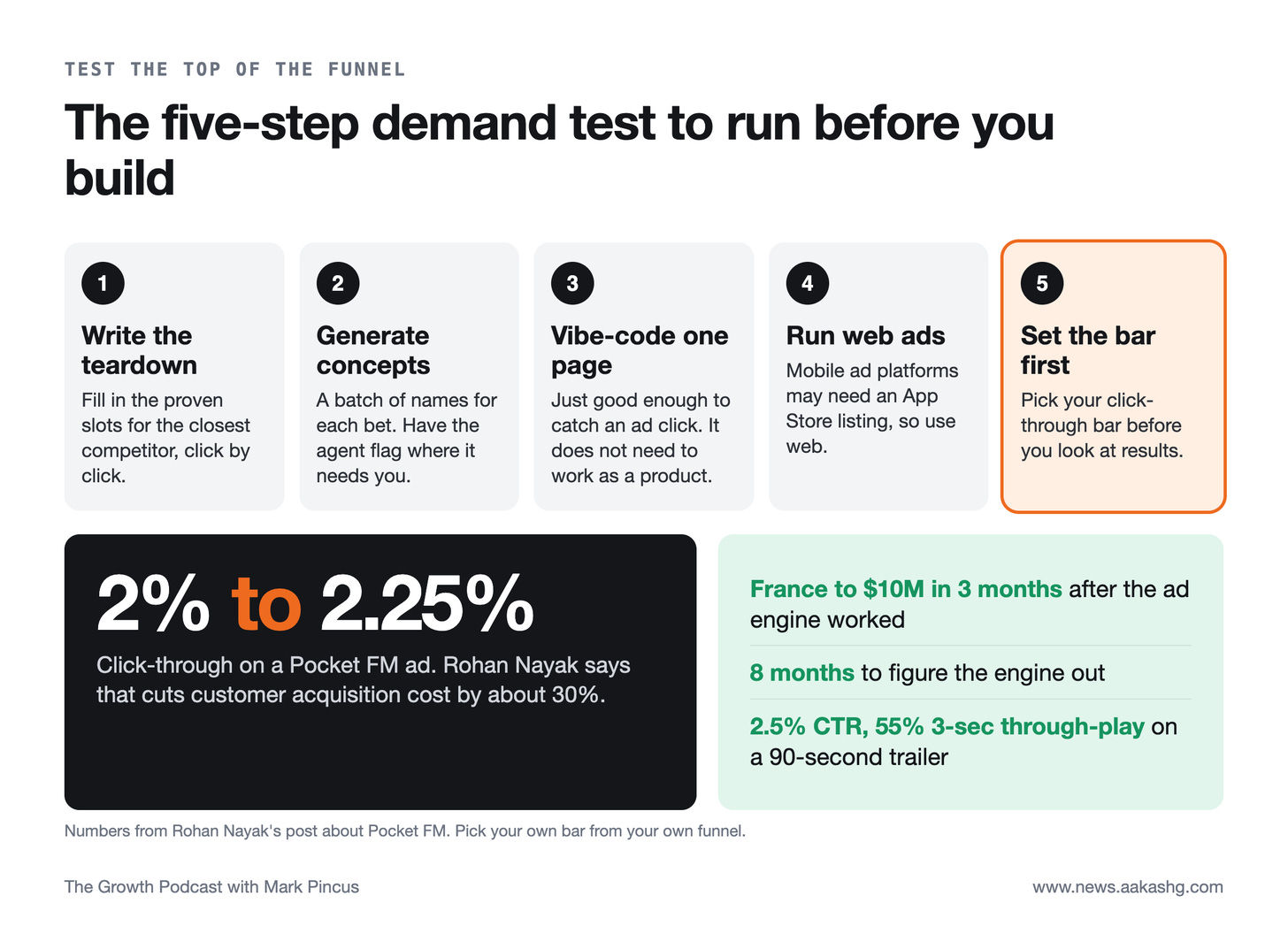
When an ad's click-through rate goes from 2% to 2.25%, customer acquisition cost drops about 30%. Rohan Nayak, Pocket FM
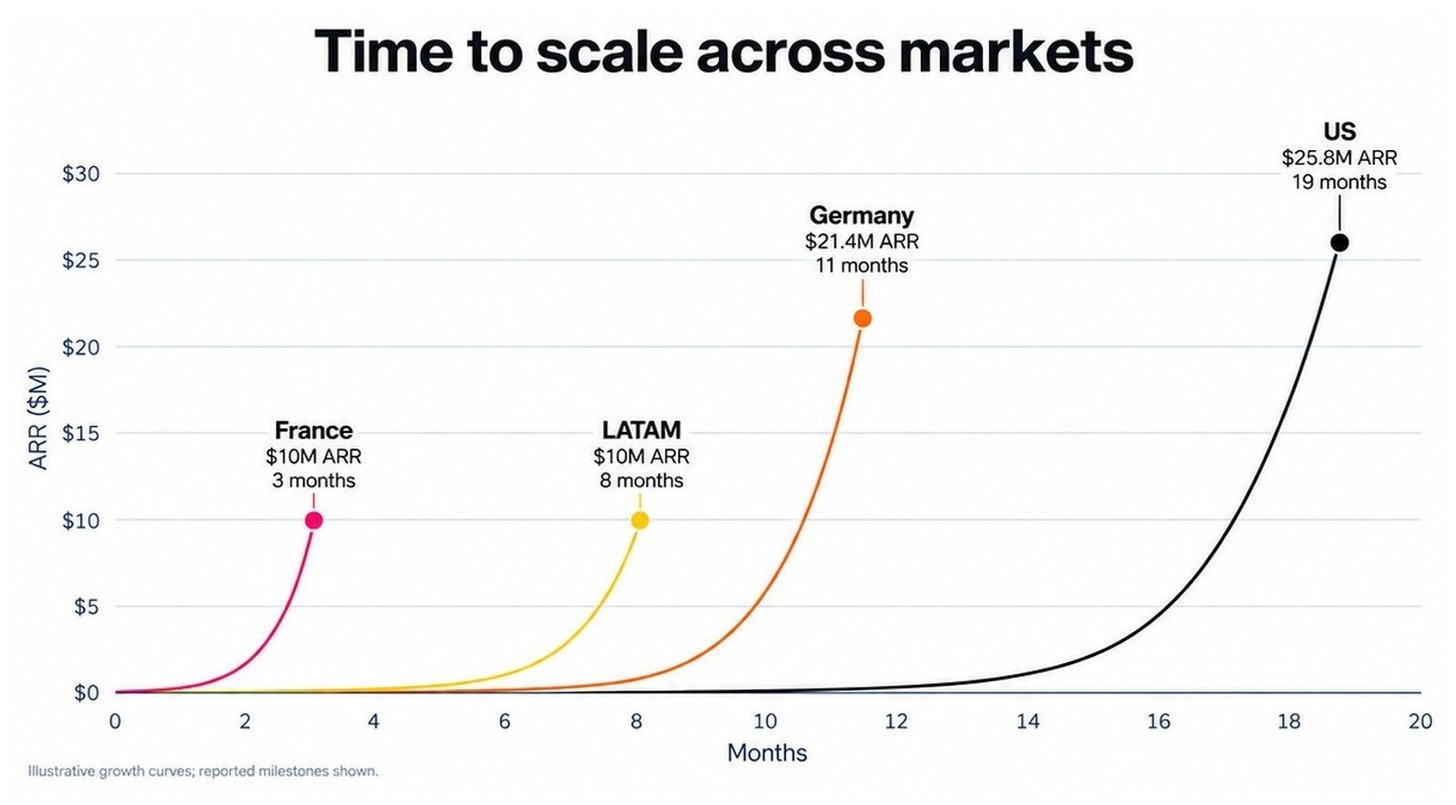
Mark's reading is that once they hit 2.25% in any country, they could grow to $10 million in ARR in three months.
Rohan's own numbers are narrower: France to $10M in 3 months, and 8 months to figure the engine out.
Mark says he could “vibe code something at least good enough to be the website behind an ad” and send an agent into France, Italy and Saudi to see if it gets a 2.25% click-through rate.
Here is how to run it:
Write the teardown. Fill in the proven slots for the closest competitor at click-level detail.
Generate concepts. A batch of names and one-line value props for each bet. Ask the agent to flag where it needs you to brainstorm.
Vibe-code one page that's just good enough to catch an ad click.
Run web ads. Mobile ad platforms may not let you advertise without an App Store listing.
Pick your click-through bar before you look at results. Then check absolute performance against your quality bar and relative performance across variants. Double down on what clears both.
Pocket FM's own benchmarks from Rohan's post are 2.5% CTR and 55% 3-second through-play on a 90-second trailer. Pick yours from your own funnel.
Try this first
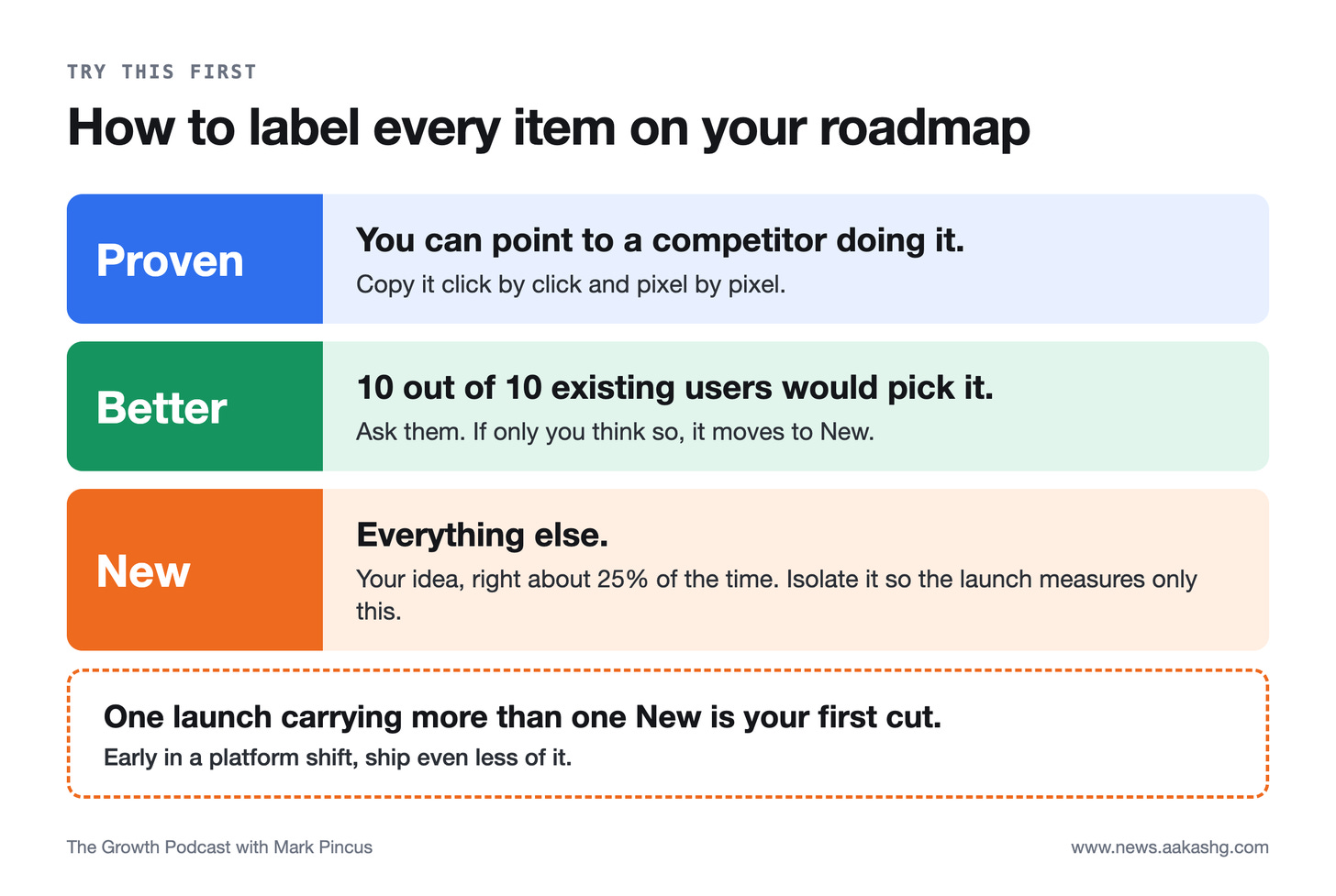
Open your roadmap and write proven, better or new next to every item. Anything you can't point to a competitor doing is new.
If one launch carries more than one new, you've found your first cut.
Where to Find Mark Online
Related Content
The Ultimate Guide to Onboarding (paid): the first clicks of a new user
Ultimate Guide: Activation (paid): getting users to the good stuff
Ultimate Guide: Growth Loops (paid): the loop behind the neighbor bar
How to Build Product Strategy in the Age of AI (paid): what to build as the platform shifts
PS. Please subscribe on YouTube and follow on Apple & Spotify. It helps!


