
Check out the conversation on Apple, Spotify, and YouTube.
Brought to you by
Fingerprint - Identify good and bad visitors with industry-leading accuracy
Ariso - Ship AI agents and features faster, with fewer regressions
Customer.io - Send smarter messages using your product data
Amplitude - The market leader in product analytics
Product Faculty - Get $150 off their #1 AI PM Certification via code AAKASH150
Today’s Episode
Claude Code can be the most powerful system in the world.
I’ve now built you several Operating Systems you can run out of it: for content, for PM, your team, and for your company.
The missing piece was a Growth OS. So today, I present you one. And I haven’t just ported over what works for me.
I’ve brought on James McAulay who worked on growth at ElevenLabs and grew his latest business, Agent Accelerator, to £100K a month in 95 days, without hiring a single FTE.
He’s open-sourced everything. And it works.
Halfway through our recording, James ran a Claude Code skill on my site. A few minutes later it returned posts with no SEO description, long titles, crawlability issues, duplicate content…
(Which I’ve now fixed, with this growth OS).
Free Webinar
The technologies that make a growth OS possible are AI agents and MCP. I’m giving a full masterclass on them for free next Wednesday:
Newsletter Deep Dive
I appreciate all the support you give my work. So here’s a written deep dive if you prefer it:
How the Growth OS Works
How to Set Up Your Growth OS
How to Run Growth Experiments with No Engineer
1. How the Growth OS Works
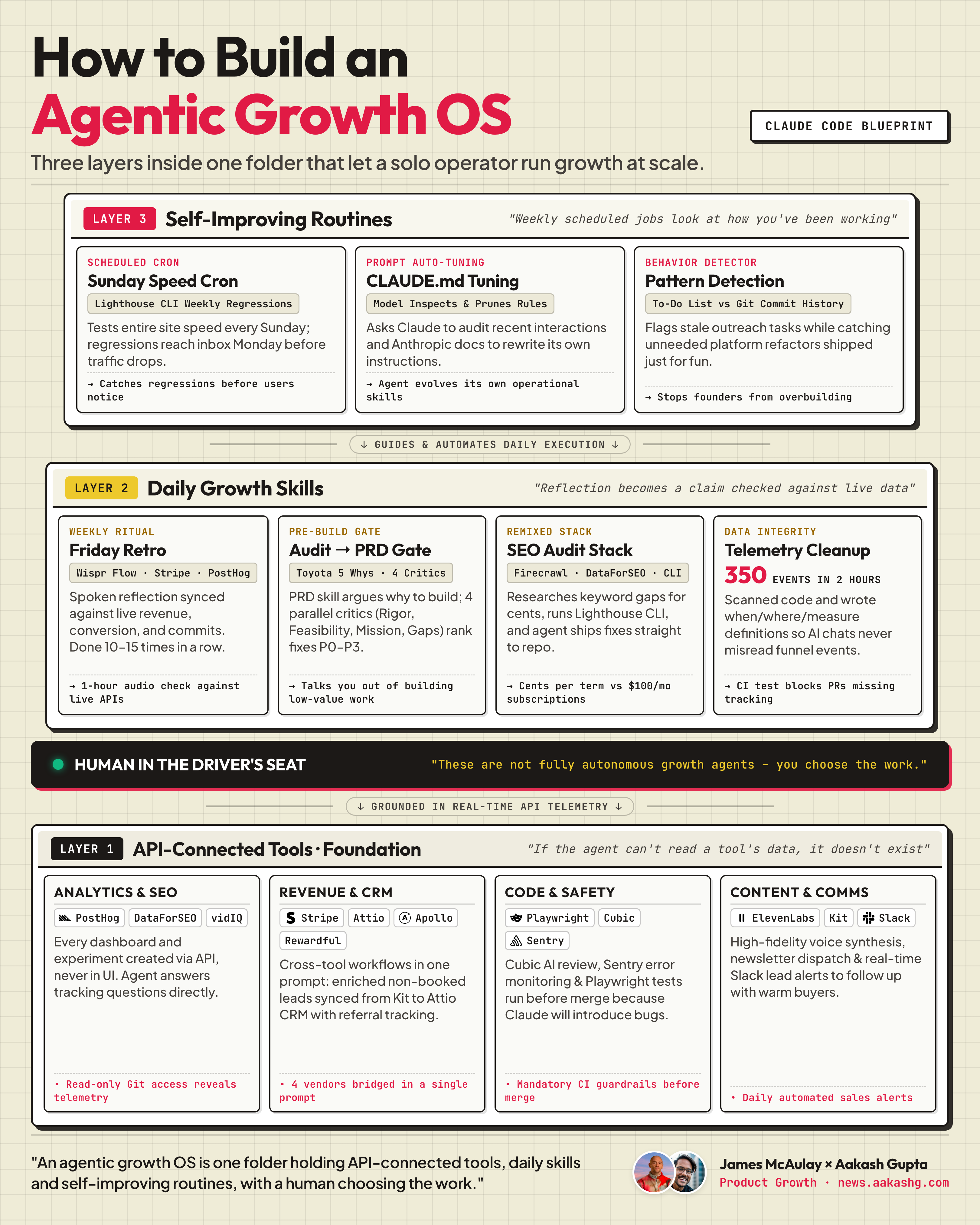
You open Claude Code inside it, and it has three layers: tools with APIs, everyday skills, and routines that improve the setup.
Tools with APIs
James only adopts a tool if it has a good API or CLI, like Stripe, PostHog, Attio, Firecrawl, DataForSEO, vidIQ, Kit, Apollo
Everyday skills
Morning standup, weekly and monthly retros, PRD skill, SEO audit, tone-of-voice, YouTube packaging, competitor scan
Routines that improve the setup
The system improves itself from your usage, as weekly scheduled jobs look at how you work. It even suggests new skills and other connections you might want to add.
The repo is growth-agents on his GitHub. It installs with a couple of commands and runs in Claude Code, Codex, Hermes and OpenClaw.
It’s built for a full-stack growth person or a company’s first growth hire. If you’re a specialist (a product marketer or SEO lead), the onboarding asks about your goals and adjusts the system to your role.
2. How to set up your Growth OS
So you don’t actually need a new folder for this. If you’ve got a second brain already, the folder where all your notes live, just put the OS in there.
Clone the repo and run the install commands from the README. Then open Claude Code. Run the onboarding and Claude goes through everything you’ve already got in there before it asks you a single question.
It’ll ask if you want rapid or full setup. James makes everyone he teaches do the full two hour setup. We did rapid on camera because we were short on time. Try the full one on yours if you can.
What to wire into Claude Code
Connect everything as fast as you can.
The two most important are analytics and Git:
We did Posthog via MPC.
Read-only access to Git is key. Your team might not let you ship code, but it helps you get the right PRs ready.
The OS will help you so never forget PostHog events again. Every event says when it fires, where it fires, and what to measure with it:
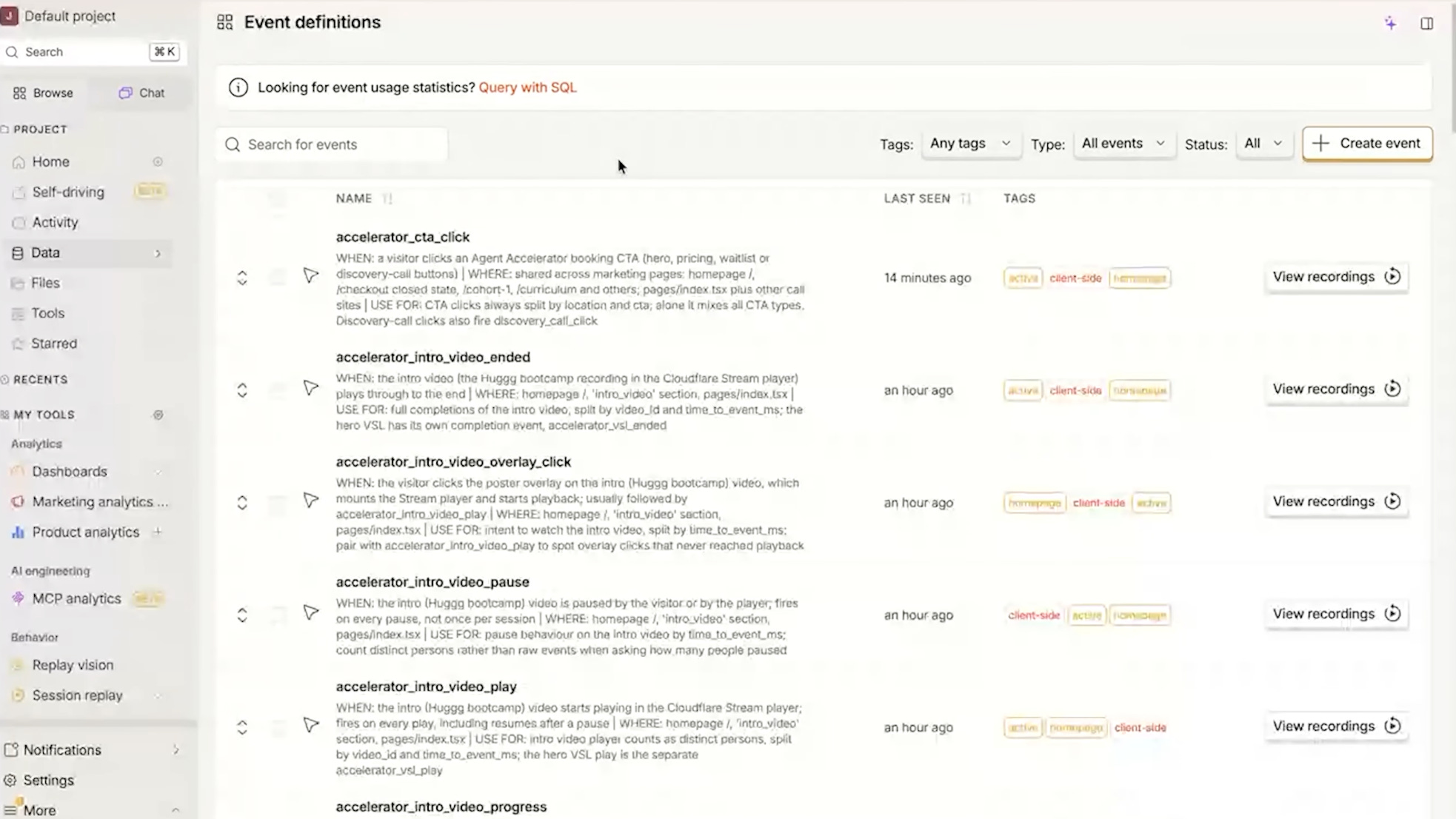
Pre-AI, you’d only see data that clean under a god-tier PM. Now, it comes with the OS.
The core loop: actually learning from experiments
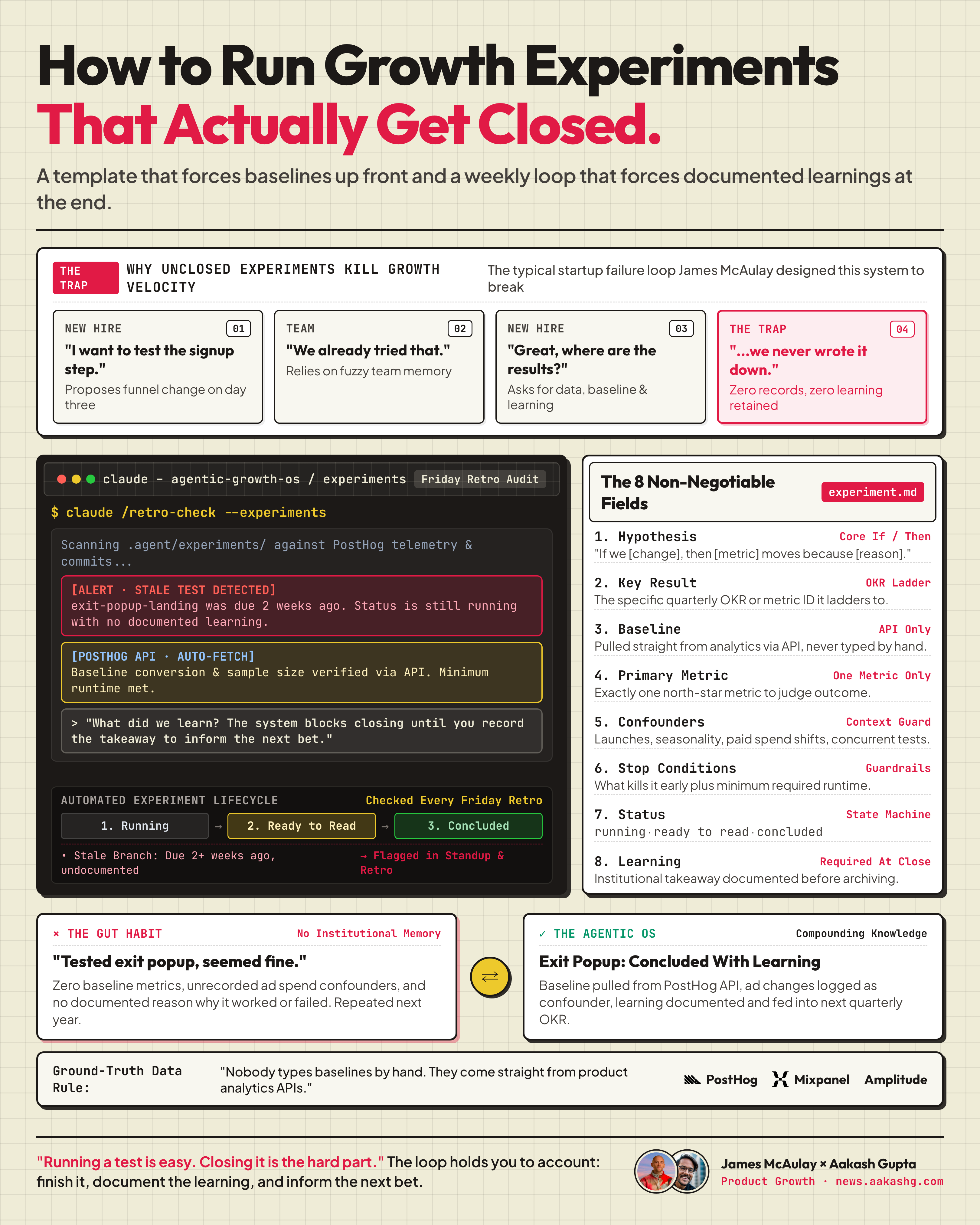
Running a test is easy but concluding it with definitive learnings is a feat unknown to many. I know it may sound harsh but shiny-object syndrome pulls us onto the next big idea, and at year’s end we are left with a pile of PostHog experiments with no recorded learnings.
The OS solves for the exact problem:
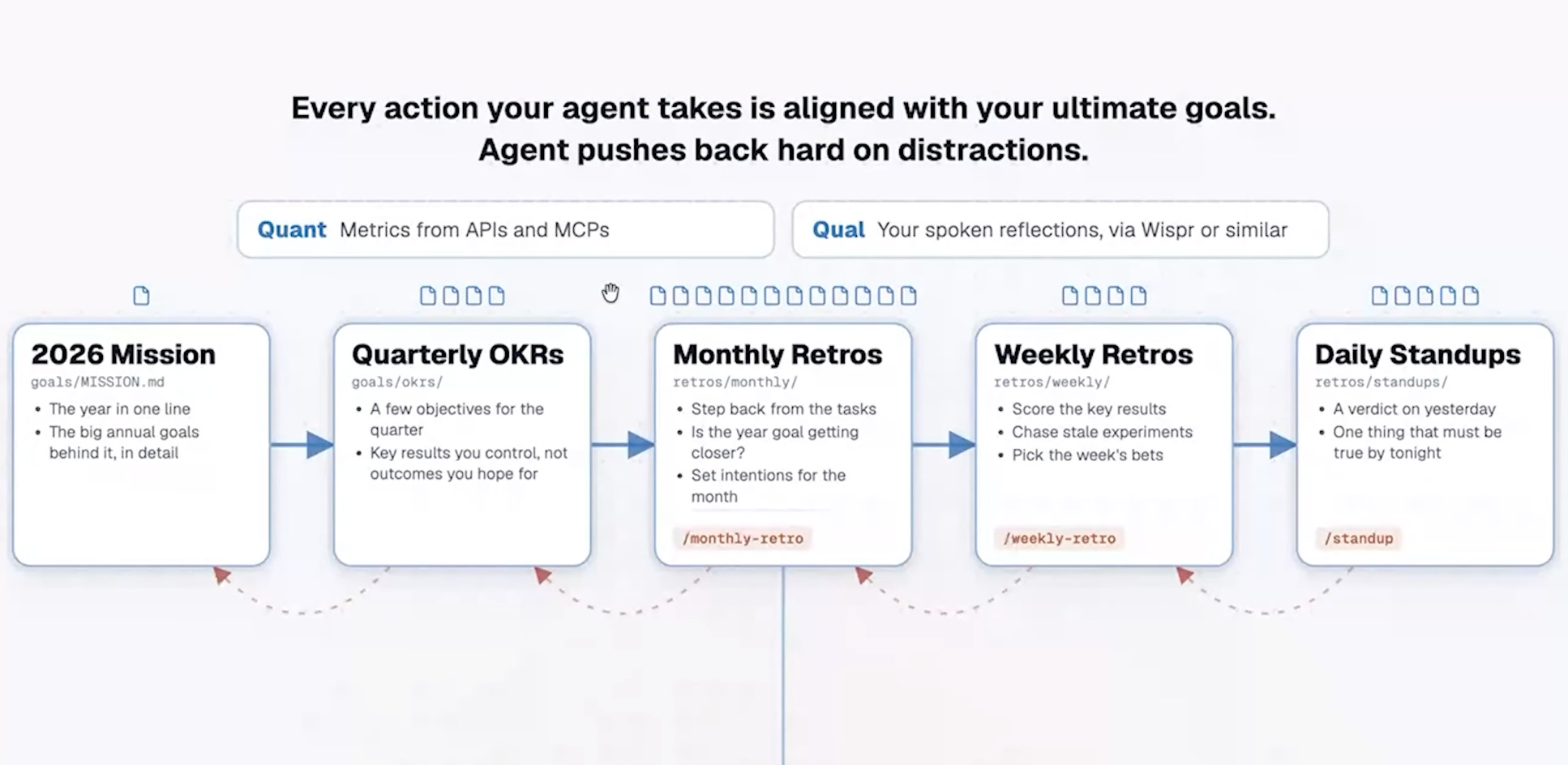
Every experiment gets a file with these fields before anything ships.
A playbook for A/B tests is set up, and it stops you from reading a result early. The weekly retro and the daily standup both read the list of running experiments and tell you when one is ready to review. They also catch stale tests.
Experiments only build on each other when a template forces the baseline and confounders up front and a weekly loop forces the learning at the end.
3. How to run growth experiments with no engineer
The way growth was done before, you’d wait on an engineer before any test could happen. Now growth people can run experiments themselves. That’s how James thinks about it.
We no longer need to wait for engineers to build growth experiments.
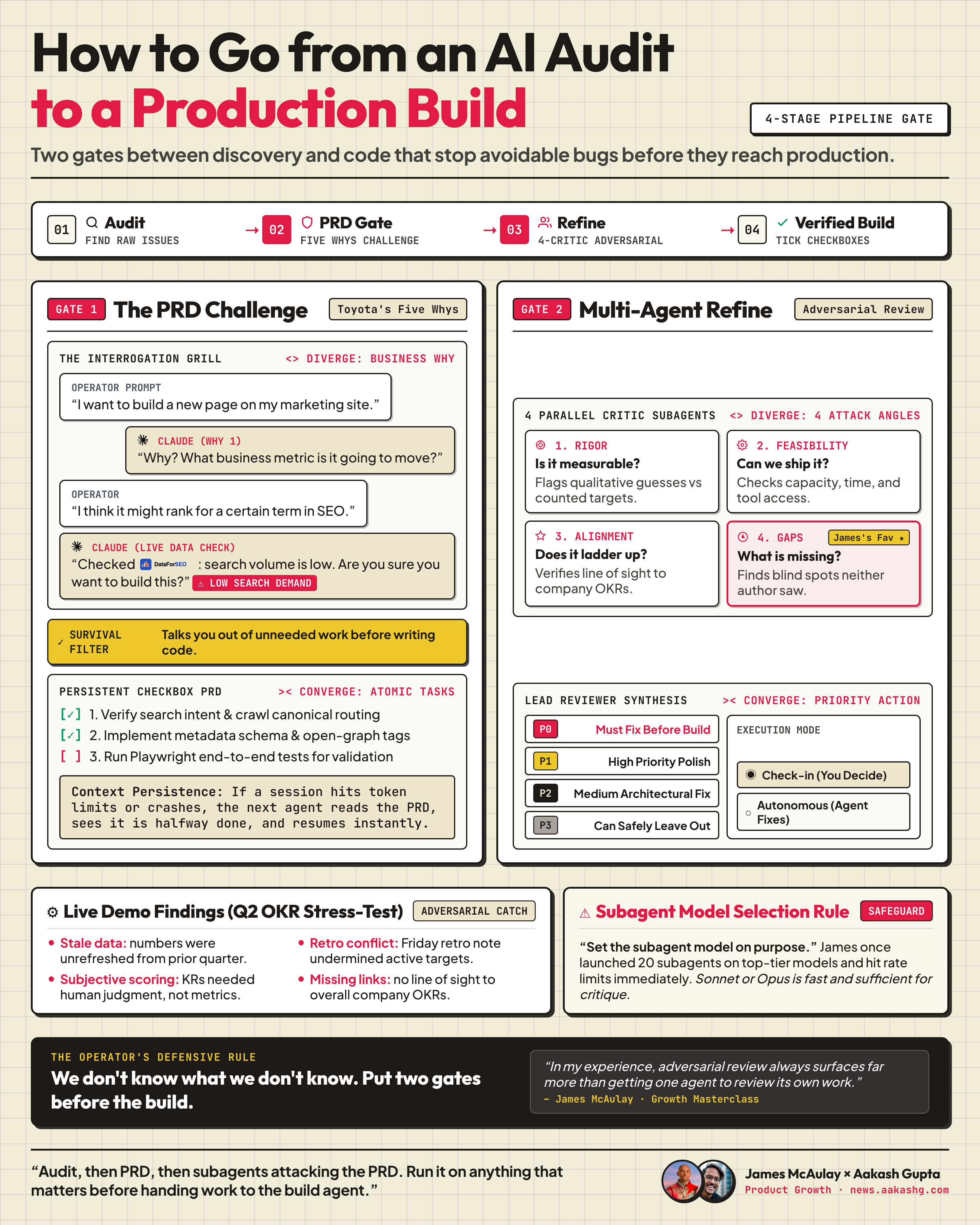
Gate 1 - PRD
Say you want a new page on the marketing site. What the system does is help you have the discipling to write a PRD where you answer key questions like: What metric will it move? So use the PRD skill to write a draft.
Gate 2 - Multi-agent refine
Then refine it with the multi-agent refine skill. This is cool. It launches subagents to critique your PRD, each using a different angle. Then a lead agent creates a master critique and priority list of action items to do.
Then - Ship
THEN ask Claude Code to build your feature.
Example: SEO
Here’s the whole loop in action with SEO.
Start with the SEO audit skill:
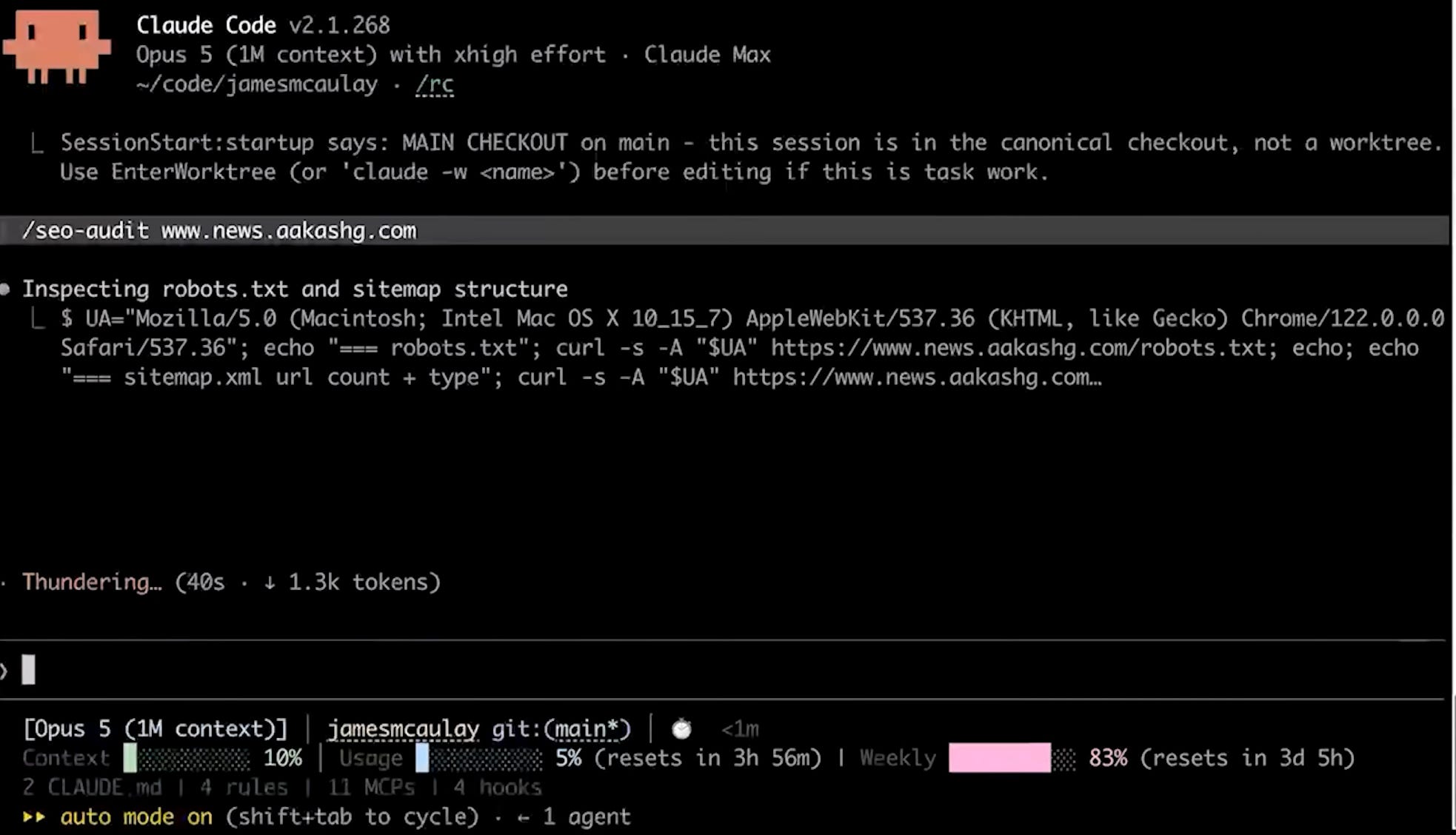
It’s a remix from Corey Haines’s Marketing Skills collection. But James added a few tools that really upgrades them:
Firecrawl which turns any website into Markdown, because when you ask Claude to scrape a site, it often hits Cloudflare blocks or misreads the page. Firecrawl fixes that.
DataForSEO is one of my favorite finds for this episodes. It’s a super cheap SEO API. Once you give Claude Code the key, it can research any term for you, just for a few cents.
The Lighthouse CLI runs Google’s page speed tests from the terminal. Before, you’d open PageSpeed, run the test, export it, save it and hand it to the agent yourself.
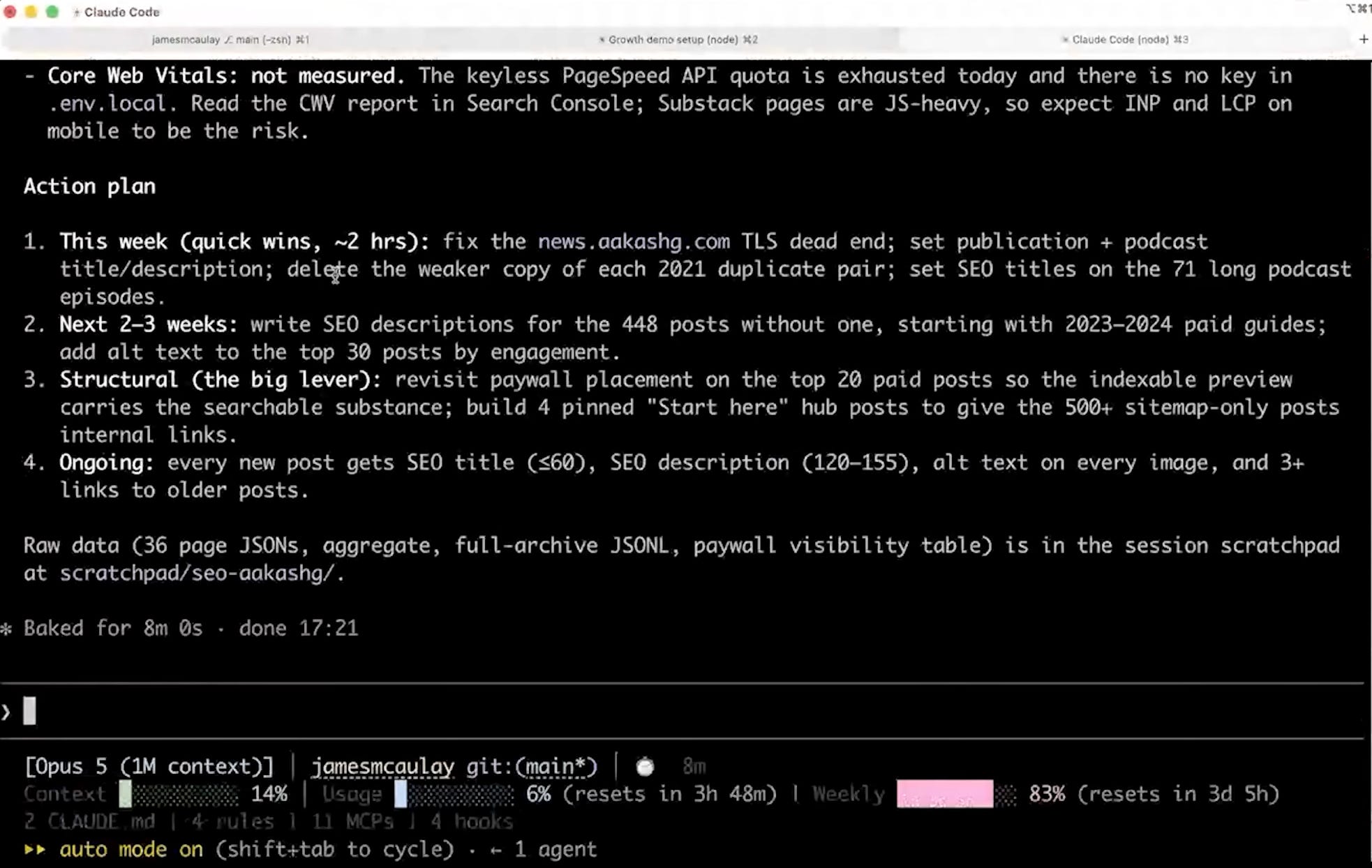
What it found on my site was that my search traffic was about 25K visits in May and has dropped to about 10K.
Then, it can help you ship the changes. I had it execute on this whole action plan:
Try it yourself! It’s pretty magical.
Final Words
How autonomous are growth agents, really?
Is the ‘autonomous’ part overhyped? Mostly, yes. A lot of the people on LinkedIn and X claiming autonomous agents are either burning tokens on low-value work, or running an agent that does most basic stuff.
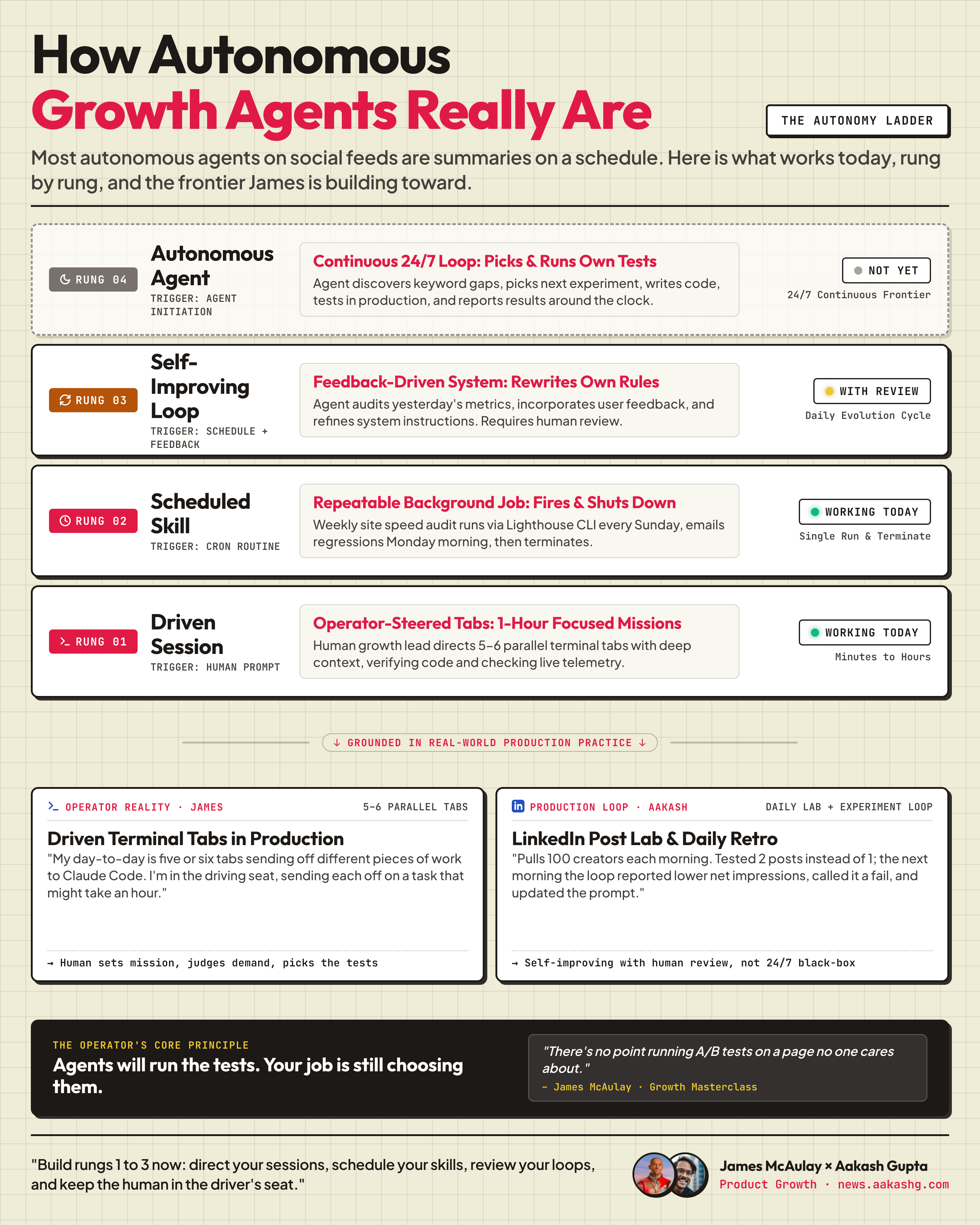
But, on the other hand, people also don’t realize an agent can improve itself. That part is autonomous, and really cool.
So go use the Growth OS, push on its autonomy, but don’t expect it to work without you.
Where to Find James Online
Please, let’s follow him everywhere and hit his businesses with a flood of Aakash’s podcast listeners!
That’s how we’ll keep getting bigger and better guests. Talk soon.
🚀 Land a Better PM Role in Just 12 Weeks!
Find the right roles, upgrade your resume and LinkedIn, build AI skills, ace your interviews, and negotiate a better offer. Get live coaching from PM leaders who’ve hired at Meta, Uber, and Microsoft:
P.S. An annual membership gets you a year of paid plans for my favorite AI tools at bundle.aakashg.com.


