
I had AI pull every open PM listing across 95 company career pages. The median base pay of model PMs was by far the highest:
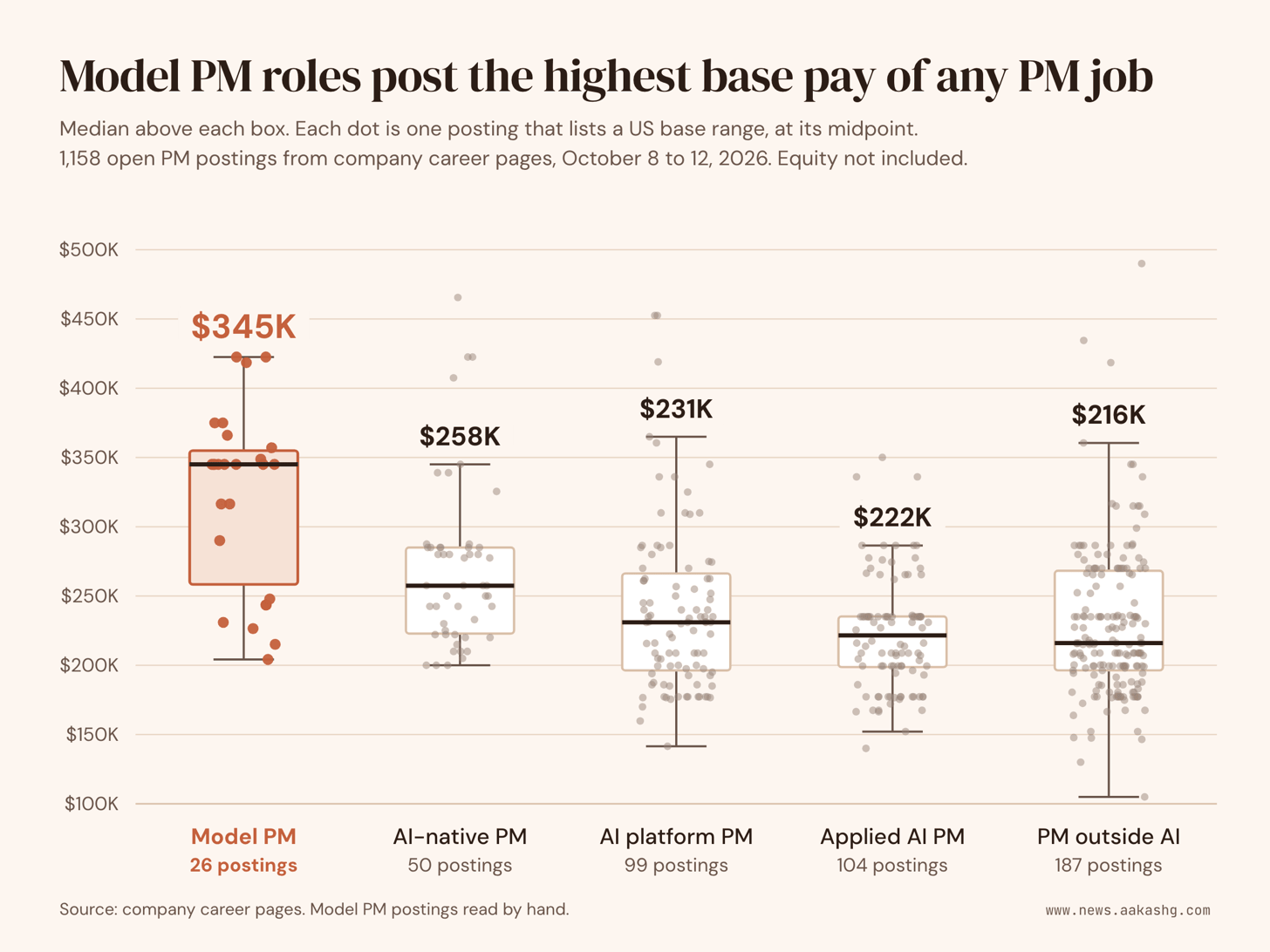
Model PM has become the most lucrative sub-field inside of product management, with a 60% premium over PMs outside AI.
Lest you think this is just a level effect, actually it’s the opposite. The gap is similar at the mid, senior, and staff levels.
But how did it acquire such a hefty premium?
There’s A Skill Shortage
It’s basic economics. The skills are in short supply.
Madhu Guru led product for Gemini and Veo, plus Nano Banana, and he's now a senior director of AI at Meta.
He estimated <75 people globally have the depth needed for this role:
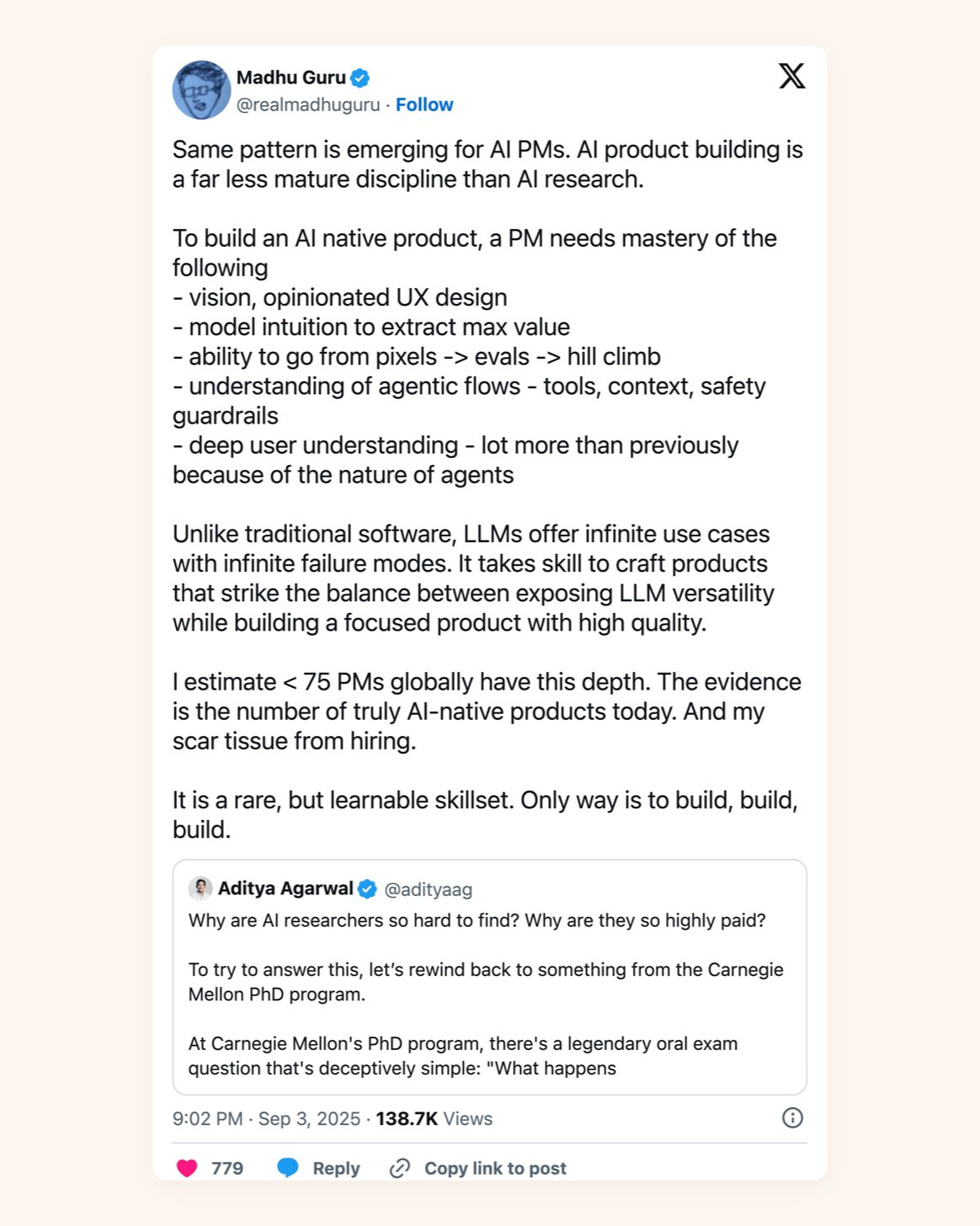
You need a unique combination of model and PM knowhow. This is good news for you, though. With the right work, you can acquire the skillset, and nab a model PM job.
Today’s Post
In today’s post, I’ll give you all the “knowledge” you need to acquire those skills. Then it’s up to you to do the work:
What is a model PM
Analyzing the backgrounds of model PMs
Who is hiring model PMs and what they’re looking for
What the job is actually like in the top labs
Let’s learn the key skills practically
The model PM toolkit
How to get the job
PSST… I’m Speaking at a Free Conference!
I’m speaking at a FREE conference. I’ll be giving a talk on the “The Rise of the Full Stack Product Builder”:
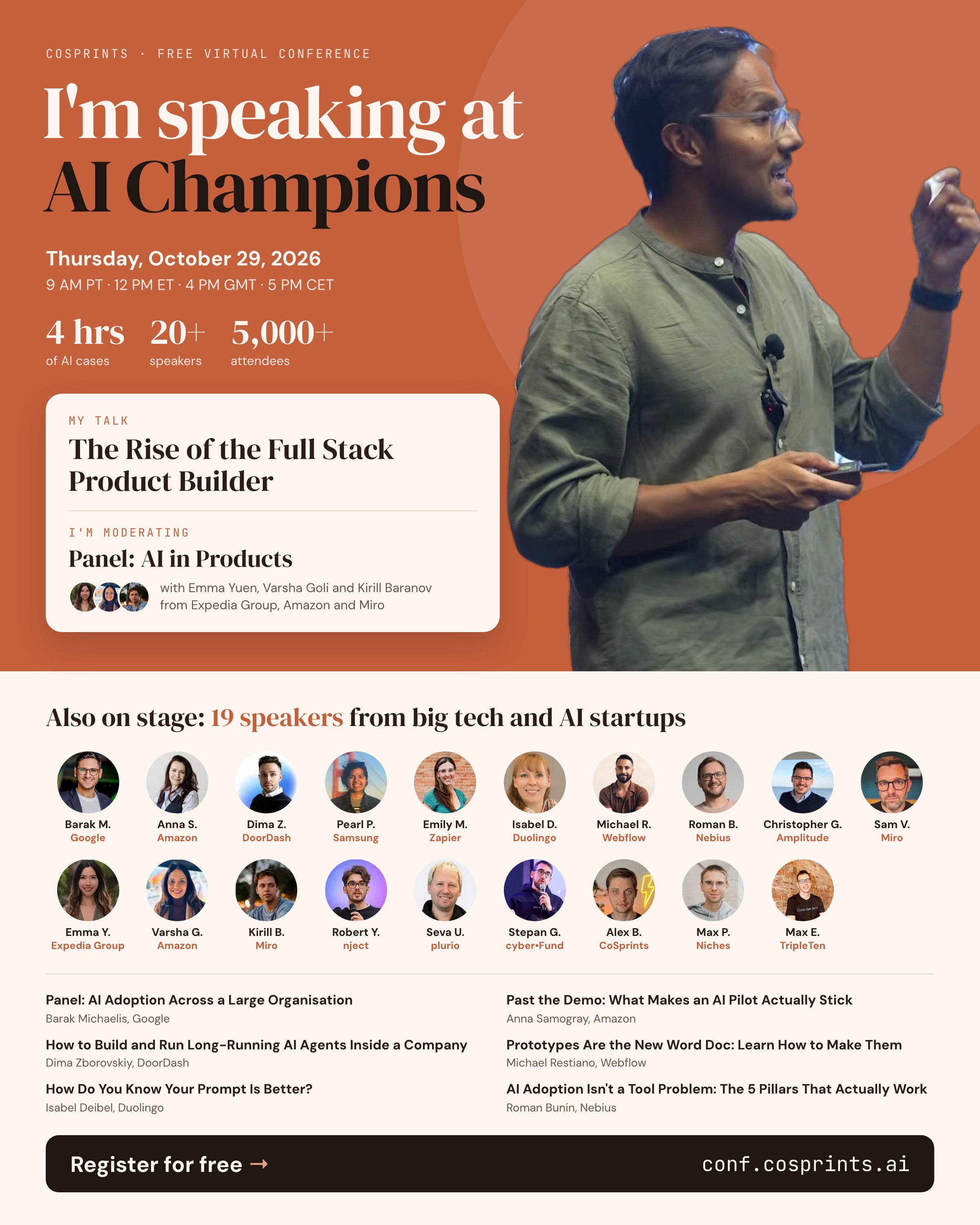
I’m also moderating the product panel:
1. What is a Model PM
AI PM is a broad term. And under it, it holds at least 4 different types of PM jobs:
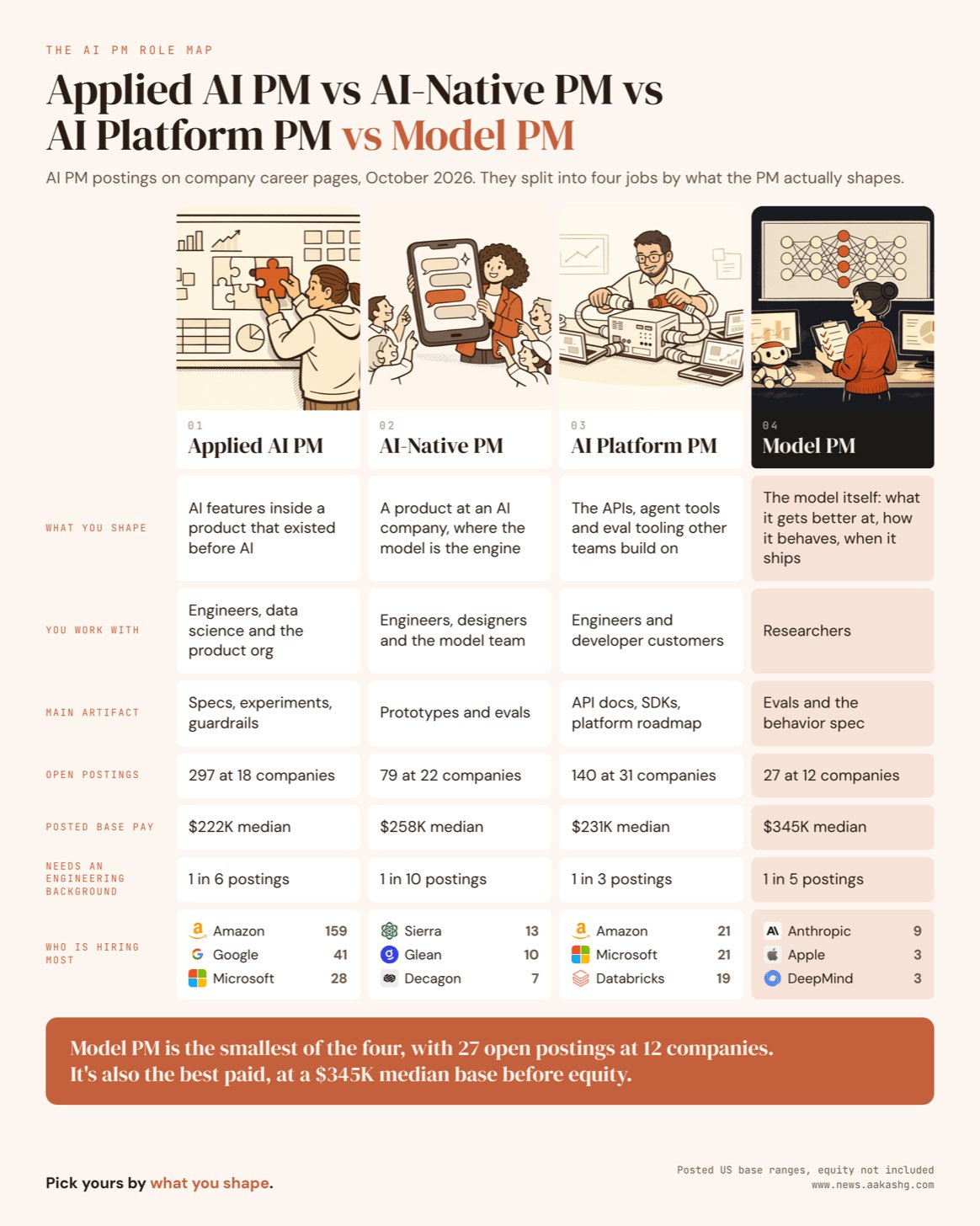
Model PMs are the PMs actually building the models. They sit alongside the model research team which is mainly AI researchers and engineers.
They need to be able to win respect from engineers who may have billion dollar pay packages (rumored for folks like Nat Friedman and Andrej Karpathy)!
This means they can’t lose the thread in a conversation on pre-training v post-training or gradient descent vs deep learning. They are not only tracking those terms but using them correctly themselves.
AI Platform PMs are also building AI tools, but not models. They are building APIs, agent tools, eval tools that other teams build on.
AI-Native PMs are building products where a model is the engine. They are at AI companies like Sierra, Glean, and Decagon.
Applied AI PMs are building AI features inside a product that existed before AI. This is the biggest bucket by far, and they are at companies like Freshworks and Amazon.
2. Analyzing the Backgrounds of Model PMs
Let’s look at a real model PM, Barkley Dai:
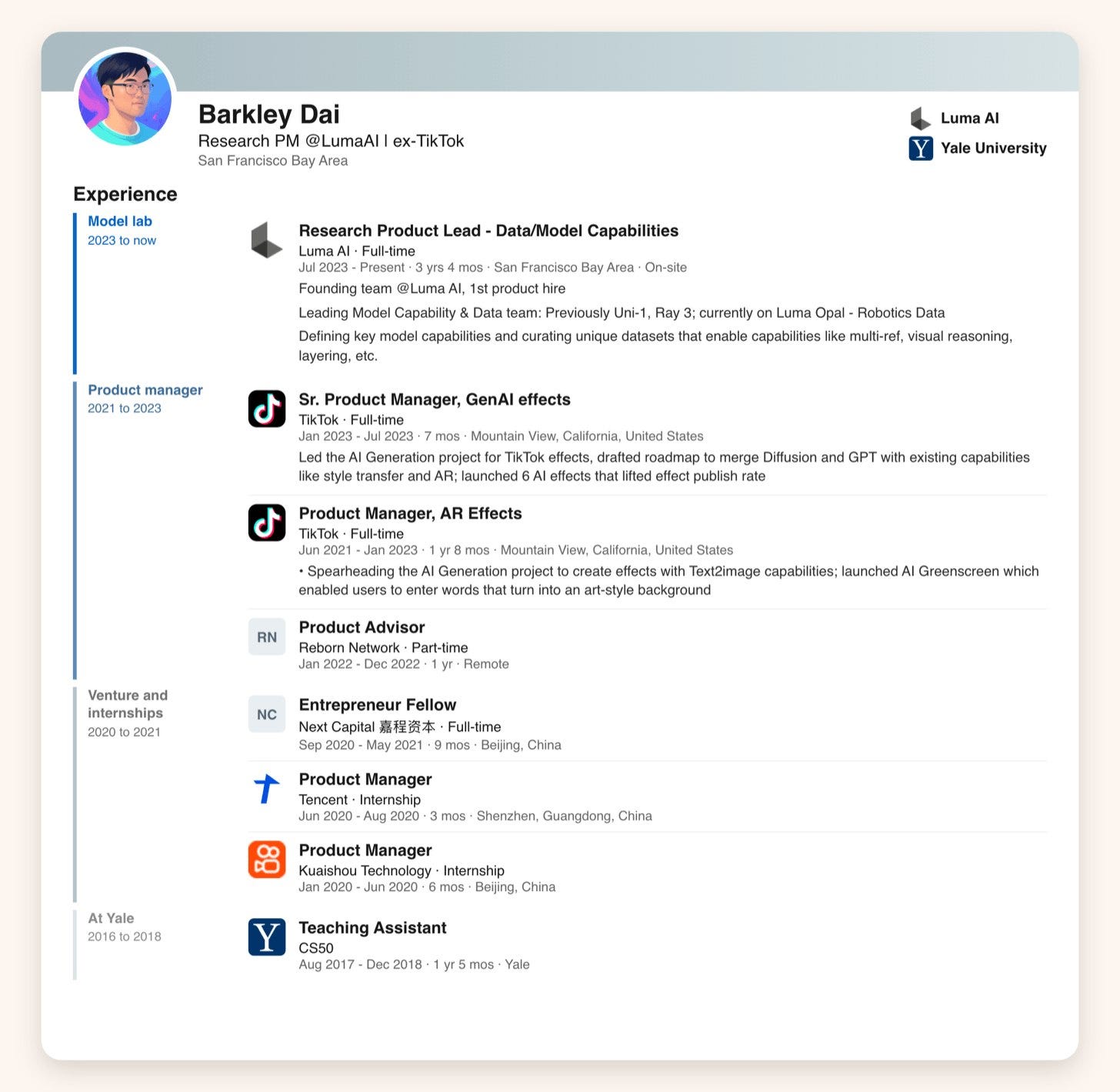
Barkley works at Luma AI, which, valued at $4B, has one of the best video models. He broke in after working AR and GenAI at Tiktok, and before that being a PM at Tencent and Kuaishou. And before that, he went to Yale.
That’s a typical path into model PM: tier 1 University → $100B market cap (Kuaishou) → $500B market cap (Tencent) → $500B valuation (Bytedance) → Model PM.
Notice that he doesn’t have a Ph.D. He wasn’t an engineer. He studied computer science at Yale, and he’s had a PM career since then. Three and a half years before breaking in as the 1st product hire at Luma.
And he progressively moved closer to models at each step. At TikTok, he started in AR. Then, he moved into GenAI effects (AI feature). Then he started in Luma on Growth projects. Then, he got closer to the models.
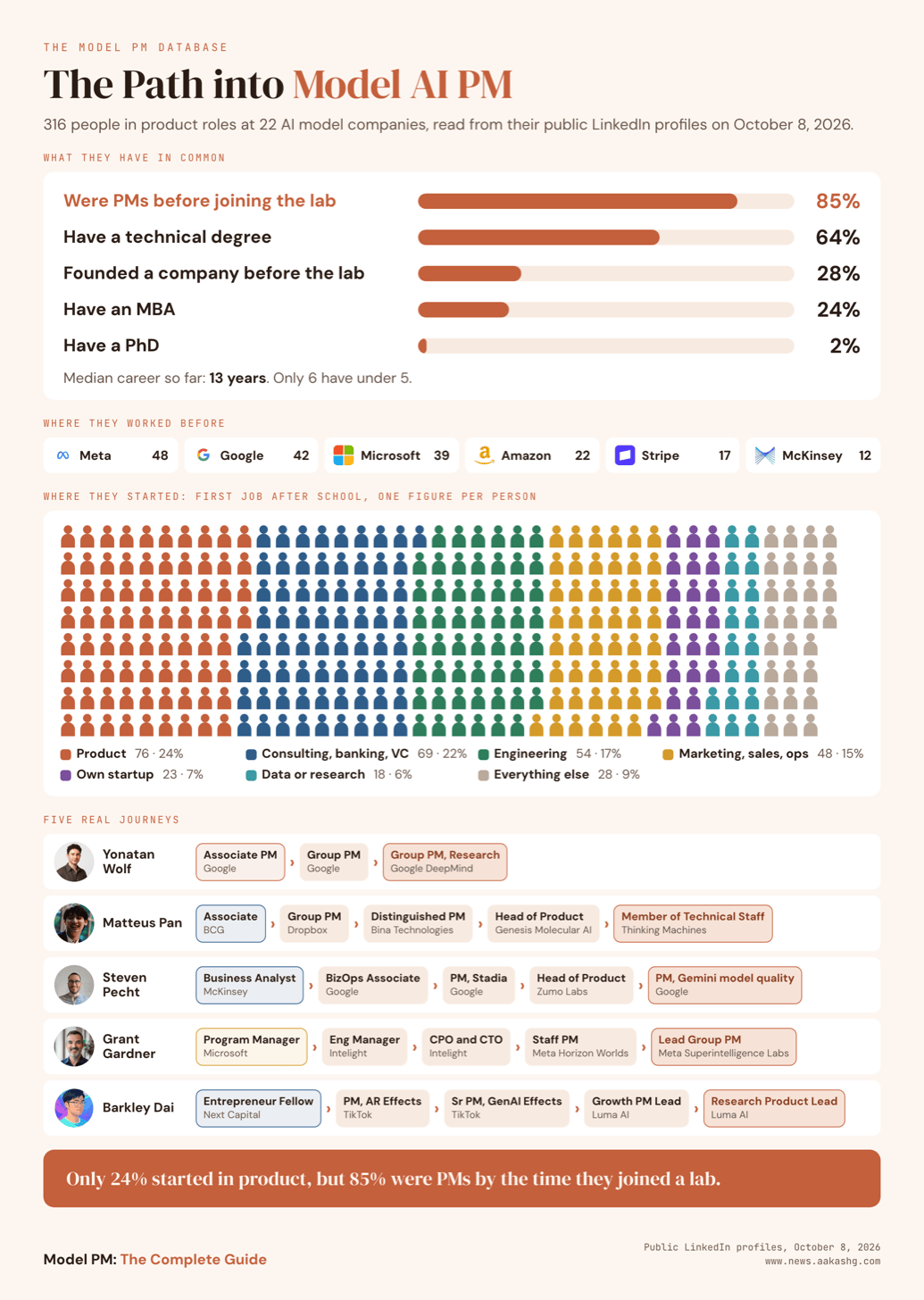
That is a very common path for PMs to break in, though it’s not the only one. I went through all 316 model PMs on LinkedIn and here’s what I learned:
There’s a lot to unpack here.
Let’s give each insight some space.
Let’s start with the 5 headline stats at the top and walk through what we learn from each:
85% of model PMs were PMs before. Model PM is a sub-specialty of PM. It’s not a separate field altogether. You go on needing PM chops, not just model chops.
64% of model PMs have a technical degree. Model PMs are on average technical. That’s because, even if they aren’t engineering themselves, they spend their day with researchers and engineers more than say a consumer UX PM. At the same time, one third of model PMs don’t have a technical degree. So it’s not a requirement.
28% of model PMs were founders. This seems to be one of the most reliable signals to a lab that you’re not just a PM, but a builder. But it’s not everyone!
24% have an MBA. Having an MBA can be a signal that you might make a good PM, but it’s clearly not a requirement.
Only 2% have a Ph.D. This one really stuck out to me. I expected many more model PMs to be former researchers, but that’s not the case at all.
Second, there’s a really broad mix of backgrounds of where people landed after college.
PM is by far the largest at 24%, and, surprisingly data or research is the smallest at 6%! There’s a healthy mix of other backgrounds represented, as well: 22% in Consulting / VC, 17% engineering, 15% marketing/sales/ ops, and 7% their own startup.
Third, the real path is going to be unique to you:
Yonatan Wolf was an APM through GPM at Google. Then he became a model PM at… Google.
Matteus Pan was an associate at BCG, then a GPM at Dropbox, then a head of product. Then he became an MTS at Thinking Machines.
Steven Pecht went from McKinsey to BizOps at Google, to PM at Google, to Head of Product outside Google, and then back to Google as a Model PM.
Grant Gardner spent time as an Eng Manager, then CPO/CTO, then was a Staff PM at Meta Horizon before joining Meta Superintelligence Labs.
You can write your own story into the field, and that’s what we’ll help you do through the rest of the piece.
For paid subscribers, I share the whole database of all 316 model PMs below.