
I was chatting with a cohort member who just completed AI PM interviews at Nvidia (just crossed $5T market cap) and Glean (an AI company valued at $7.2B).
They ran into the same round at both companies:
“Both had technical round where they asked me about my AI depth. How transformers work, that kind of thing.”
So then I went looking online for resources on the topic.
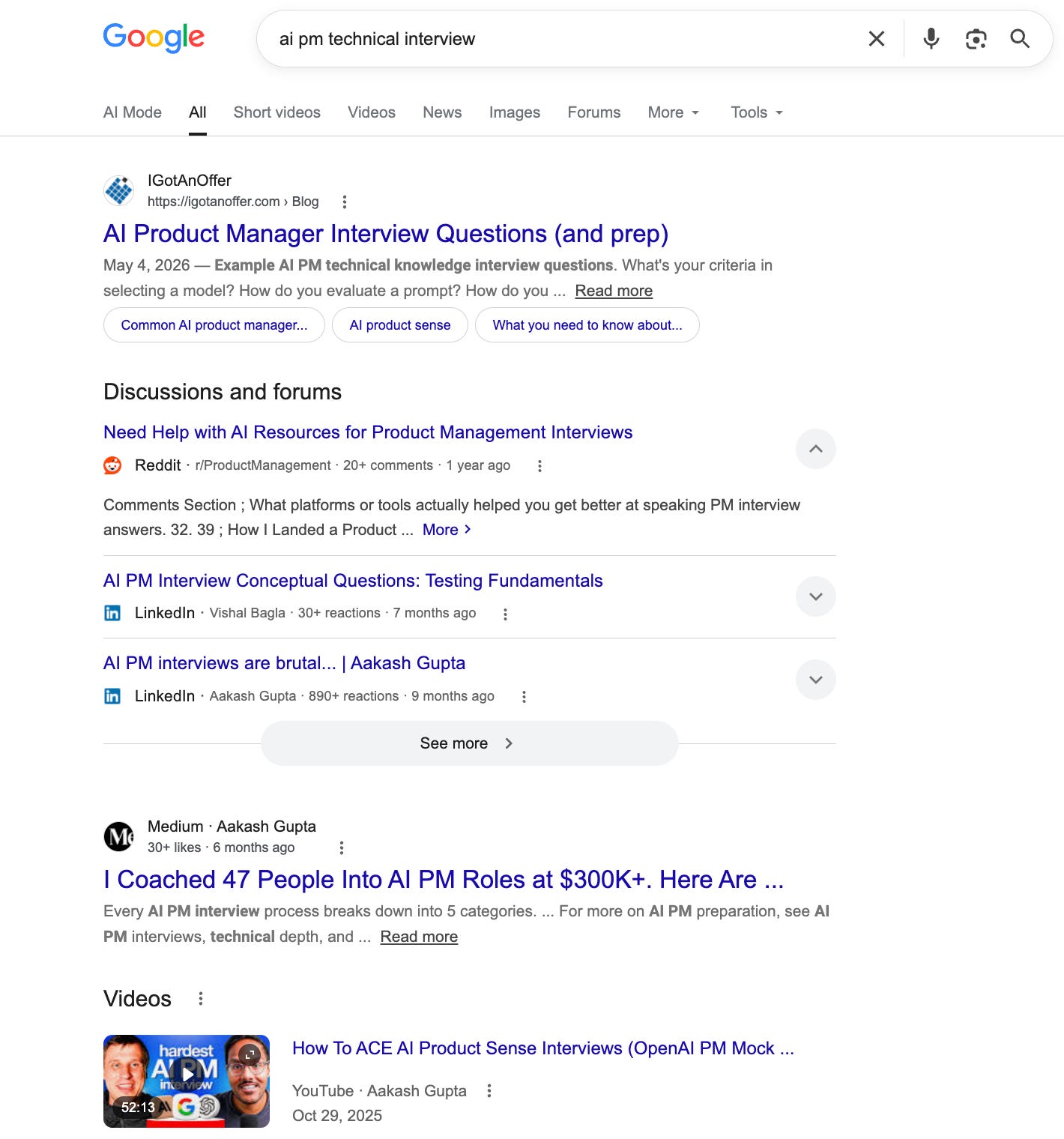
To my surprise, I didn’t find anything:
So then I went about the process of creating the guide for you: learning the questions they ask, solidifying the topics you need to learn, and understanding what a winning answer is.
Today’s post is the result of the last 2 months of research.
Today’s Post
The technical questions PMs are actually asked
🔒 The technical concepts PMs need to know
🔒 What a winning answer is
🔒 AI tools to practice
Two quick notes before we get into today’s post
Getting AI PM Interviews
While today’s newsletter is about cracking the technical rounds of AI PM interviews, if you’re still stuck on getting interviews, join my free webinar tomorrow morning, 9AM pacific:
Our Coaching
If you want to go further than this newsletter on technical topics, you should consider the AI PM course Prasad and I teach with guest instructor Ankit Virmani:
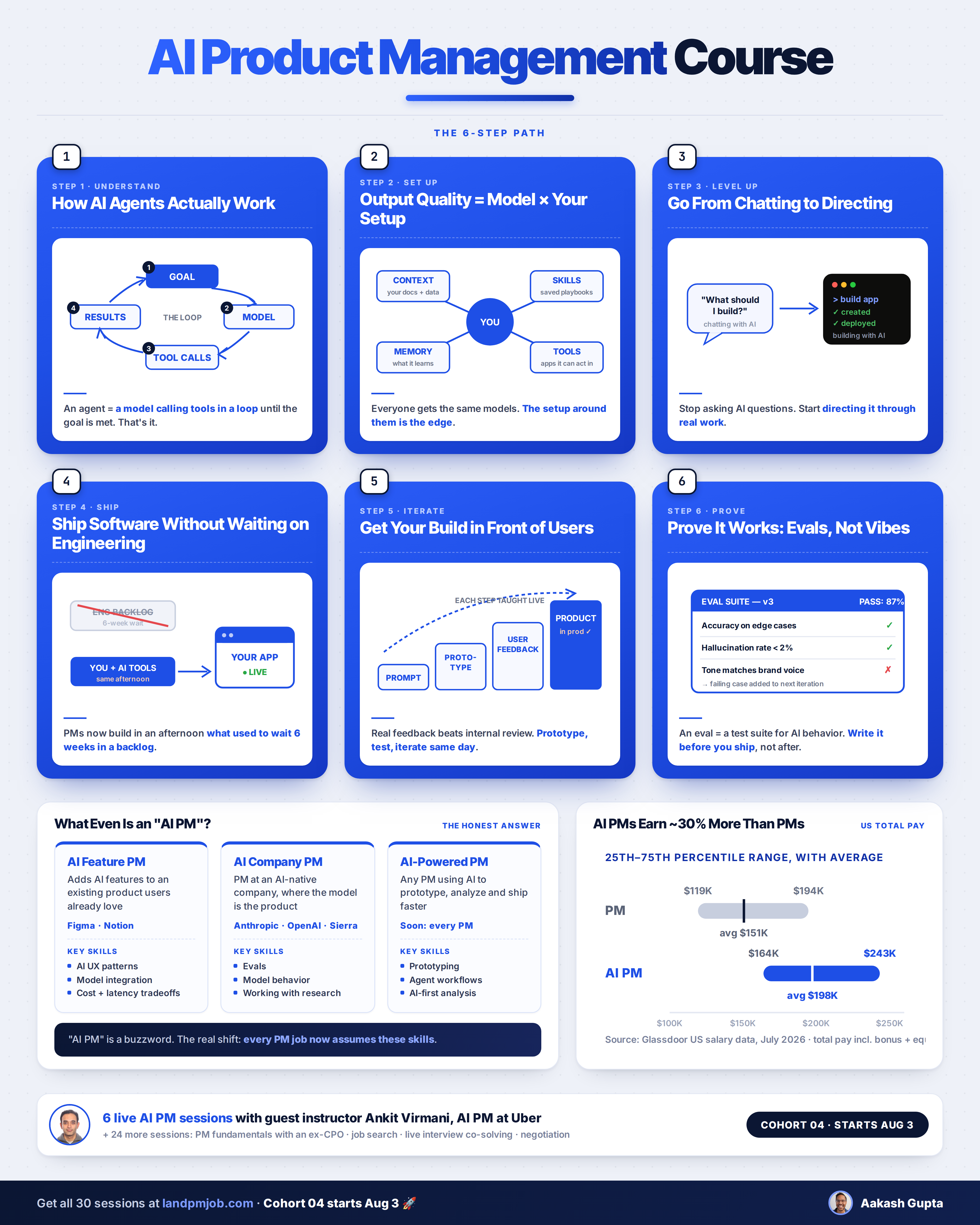
The next cohort starts on August 3rd. Join us:
1. The Technical Questions PMs are Actually Asked
12,397 AI product jobs were posted in the US in the first 6 months of 2026.
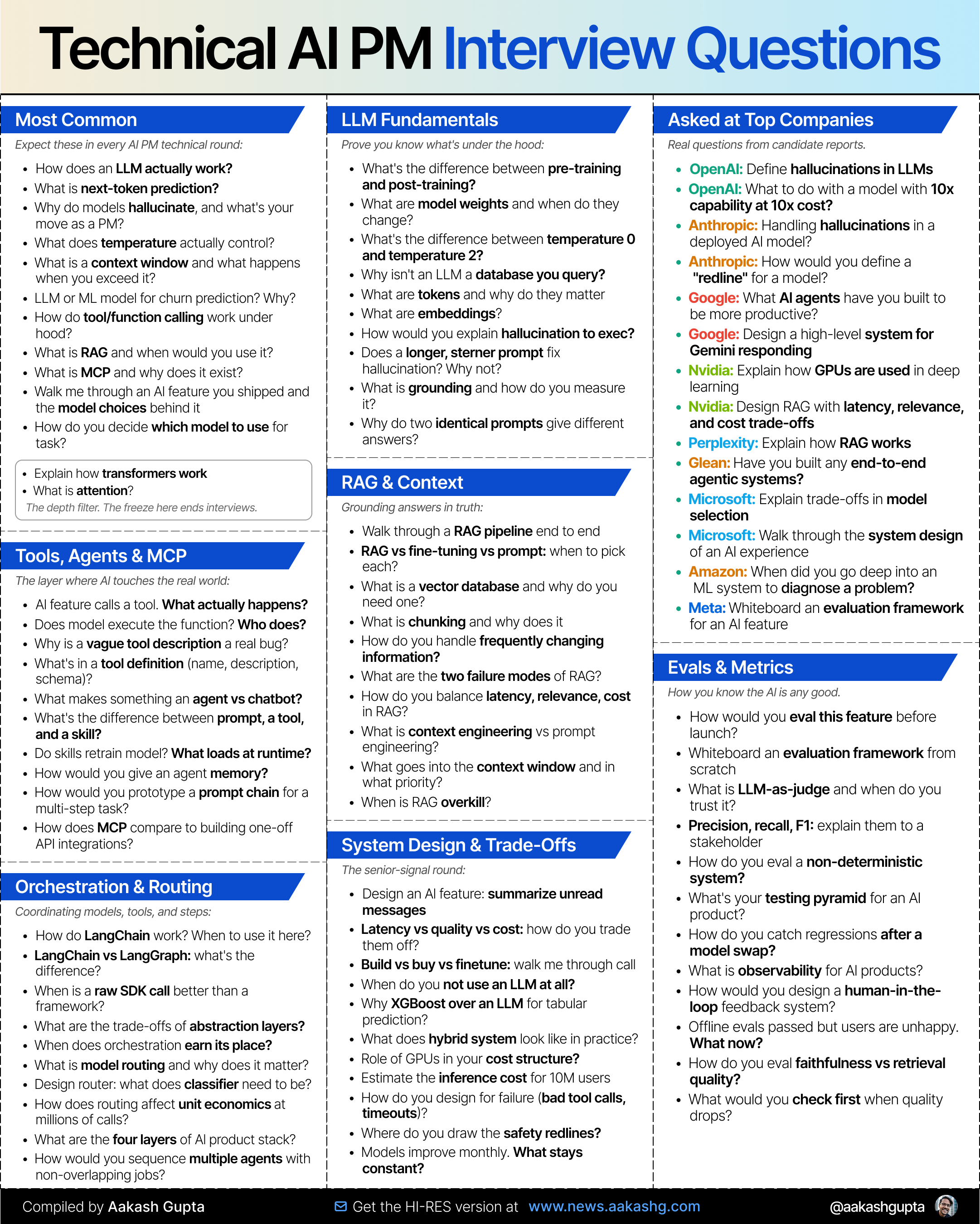
That’s a lot of jobs, and that means there’s a lot of variability. Here’s the lowdown on reports of real questions from real companies:
OpenAI: Define hallucinations in LLMs, You have a model with 10x the capability at 10x the cost. What do you do with it?
Anthropic: How would you handle hallucinations in a generative AI model deployed to users?, How would you define a “redline” for a model capability?
Google DeepMind: What AI agents have you built to make yourself more productive?, Design a high-level system for Gemini responding to a user query
Nvidia: Explain how GPUs are used in deep learning applications, Design a RAG system on Nvidia infrastructure with latency, relevance, and cost trade-offs
Perplexity: Explain how RAG works
Glean: Have you built any end-to-end agentic systems?
Microsoft: Explain trade-offs in model selection, Walk me through the system design of an AI-powered experience
Amazon: Tell me about a time you had to go several layers deep into an ML system or AI infrastructure to diagnose and solve a problem
Meta: Whiteboard an evaluation framework, plus human-in-the-loop feedback systems and prompt chain prototyping
I’ve combined those reports into an infographic for you to practice with:
👇 Now that you understand the questions, it’s time to learn the core concepts.
Then, I’ll cover how to structure the learnings into winning answers. And end with some AI tools to practice (worth the cost of the subscription themself).
This post was written entirely by hand:

And leverages insider knowledge from my coaching 150+ candidates over the past year.