
For all the talk about AI, PM interviews haven’t changed that much:
And cases might be AI-tinged: AI product design, AI product sense, and AI system design
The fundamental skillset you use to succeed in these interviews is mostly the same.
That breaks when it comes to Vibe Coding interviews.
In these interviews, you often have to complete an entire product sense or product design round, along with vibe coding during it.
To get through so much fast is very tough.
And there’s not a good mock interview on YouTube about it:
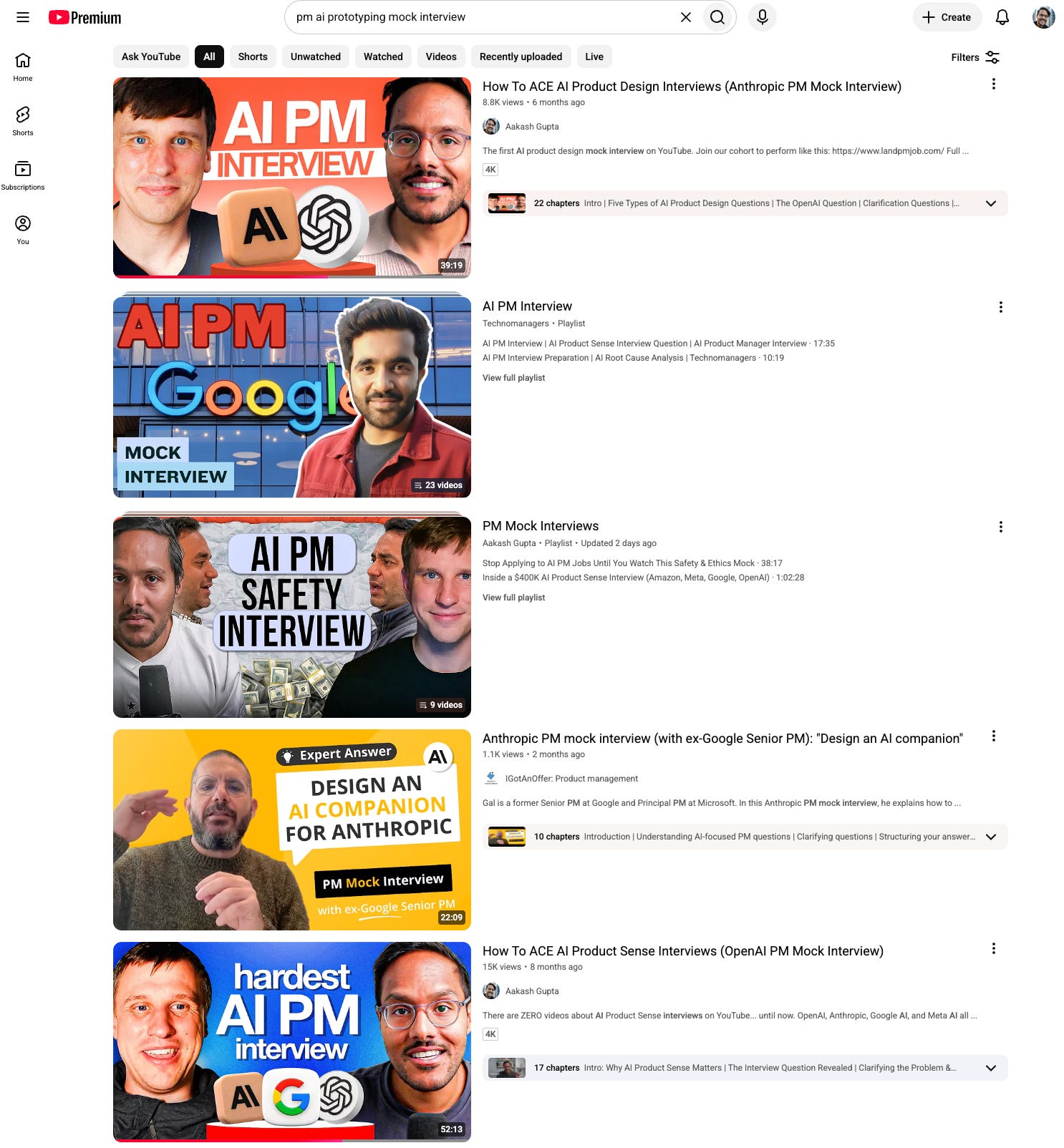
So today, I’m releasing the first mock, and going deep on how to succeed.
Today’s Post
Watch the mock:
And here’s the deep dive. This is a successor piece to my guide on the round last year, updated for what I’ve learned the past year coaching 160+ students through my cohort:
Who’s actually using the vibe coding round now
What real hiring managers are saying about what they look for
Breaking down my mock: what I did well and what I could’ve done better
Putting it all together into a repeatable framework to take into these rounds
The vibe coding round PM harness: a toolkit you can take to your next interview
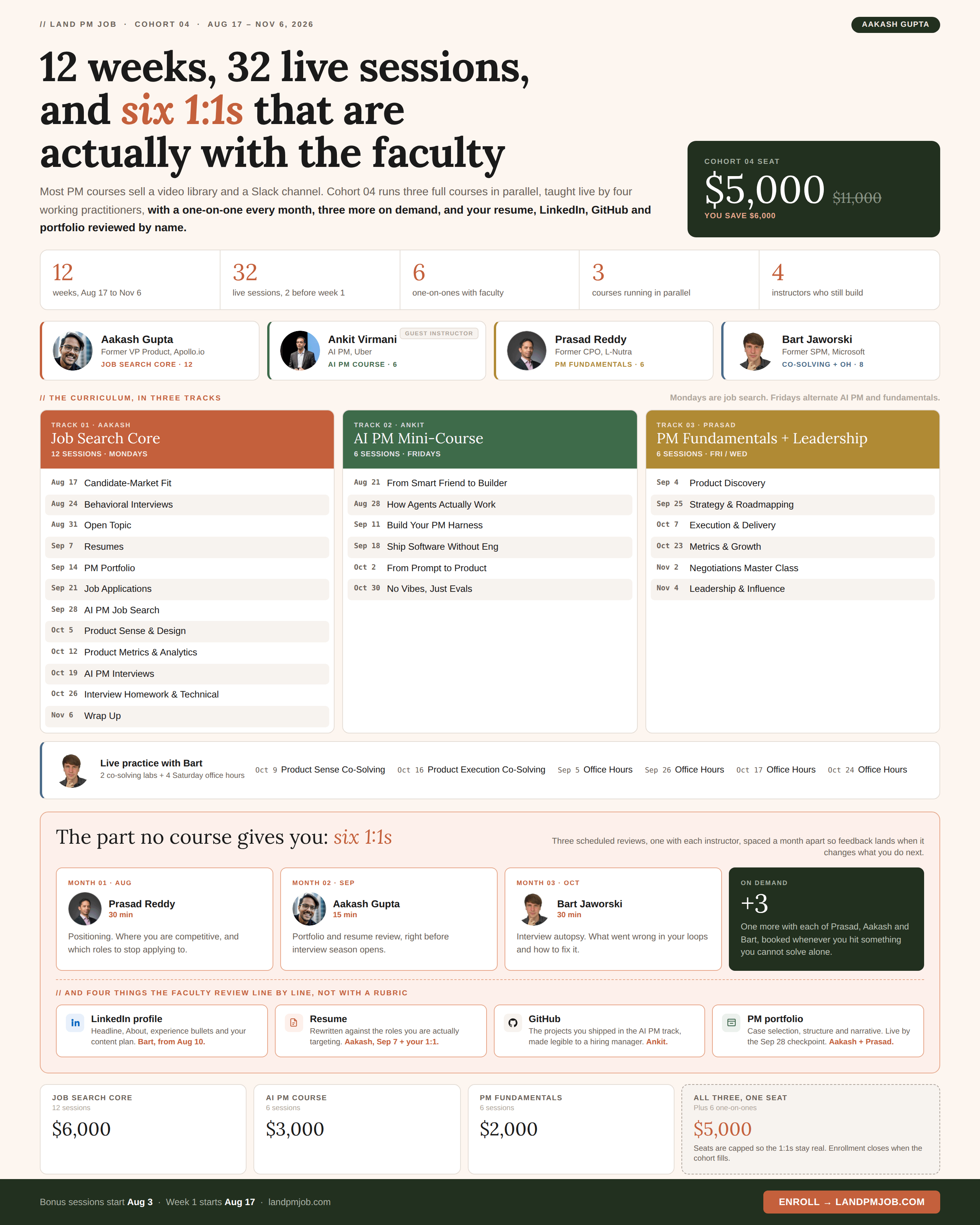
Speaking of the cohort, my interviewer in this video was Ankit Virmani, the guest instructor for the AI PM course in our upcoming cohort.
Join us for a free webinar on the fundamentals of AI tomorrow:
And apply to get our live coaching, resume review, and more in the cohort:
Now into today’s piece…
1. Who’s Using the Vibe Coding Round
The first question I had when writing this was: who is actually using this right now?
There’s shockingly little good, verified information on the internet. The best stuff is frustratingly from anons on places like Reddit and Blind.
It’s not completely trustworthy. But here’s what the internet breadcrumbs reveal:
Lovable launched in November 2024 and kicked off the AI prototyping trend
Vibe coding the term was invented in February 2025 by Andrej Karpathy
A PM reported a vibe coding round at Google in July 2025, though it was disputed
In February 2026, a PM reported Meta changed its PM process to add a Product Sense with AI round with 30 mins product sense followed by 30 mins vibe coding, however Glassdoor reports don’t always mention vibe coding
In February 2026, a PM reported a vibe coding round at Adobe
In March 2026, A PM reported a vibe coding round at Microsoft
In the same thread, a commenter confirmed a Google vibe coding round
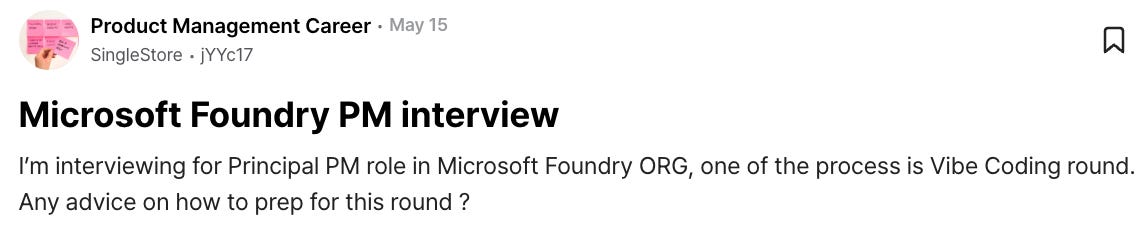
Most recently in May 2026, another PM reported a vibe coding round at Microsoft
In short:
The internet breadcrumbs show the expansion of this interview is accelerating from first movers last year to more AI companies like Adobe, Microsoft, and Meta earlier this year.
Of course, I went deeper than the internet. I asked my cohort members where they’ve seen the interview.
They shared:
United States: candidates faced it at Figma, Shopify, v0, Perplexity, and NBCUniversal
India: candidates faced it at Paytm, Flipkart, and Zomato
Europe: candidates faced it at Airwallex, Bolt, and Kraken
On my podcast, product leaders at Airtable, Laurel, and Freshworks (episode out in August) have also reported it as an area they test for.
Putting it all together:
The round is common at AI-native or heavily AI-pivoted companies, in AI PM roles. It is more common at bigger companies in the US and India.
This follows the general trend I’ve seen with case interviews (like product sense): they’re concentrated at the big, public companies. Smaller companies focus more on behavioral questions.
And the AI piece is natural: the more AI-native a company, the more likely to test it.
2. What Real Hiring Managers are Saying They Look For
I’ve had several of these hiring managers on my podcast. Here’s a few anecdotes of what they shared:
I do ask people to screen share. What I found is it is so easy to say, I'm AI-native, we do a bunch of stuff with AI, but as soon as you really peek under the hood, you're like, actually I think you're what I call level one... Getting to see that live on screen is really interesting because otherwise it's really easy to just say, this is what I do, and you've pulled it from LinkedIn.
—Jiaona Zhang, CPO at Laurel AI
I think just jumping straight into vibe coding something is not what I'm looking for in a PM right now... Ideas are so important. Knowing what to build is so important. So if the first thing you do is jump straight into execution mode, that would worry me.
—Jaclyn Konzelmann, Director of PM at Google AI
You also have an AI round as well now, where you’re asked to code your idea. So, in product sense, whatever idea I would have come up with, they’re like, could you pull up Cursor or your favorite IDE, and let’s start coding. And through the coding they are able to see how I think through, like, why did I choose this option versus this other option... am I just taking the first thing that the AI tells me as, this is great, and wrapping it up, or am I looking through things to say, okay this is good, but what about this edge case... how am I coaching and shepherding my AI to work with me to get it to where I want.
—Jyothi Nookula, Sr Dir of PM at DataRobot
I’ve also been talking to hiring manager for my upcoming book on the AI PM interview.
Putting all the first-hand research together, here’s how you can think about the rubric areas you want to demonstrate in the interview:
🔒 The rest of this post is for paid subscribers only. You get the full rubric, mock breakdown, framework, and my vibe coding interviews harness (worth >$50) that you can bring into interviews to excel.