
Aman Goyal just went through an AI PM job search successfully. You know what question he didn’t get? Product design.
Design a pencil for the blind.
How would you create a dating app for Facebook?
These questions used to be the bread and butter of PM interviews. He didn’t get asked a single one. Instead, he did face one round several times: AI system design.
I’ve covered AI product sense, product design, success metrics, and behavioral interviews. Today, I cover AI system design.
Why Now
Companies want to know if you can architect an intelligent system end to end. Not wireframes. Not feature lists. Data pipelines. Model selection trade-offs. Orchestration layers. Agent architectures. Failure modes.
And the stakes are absurd.
At OpenAI, stock-based compensation averages $1.5 million per employee per year. Google and Meta are competing with equally aggressive equity packages for AI talent. Senior AI PM roles at these companies pay $500K-$800K+ in total compensation, with staff-level and above clearing $1M when equity is included.
But here’s the gap that blows my mind. There are hundreds of guides on product sense interviews. Same for system design. But AI system design for PMs? Zero resources exist.
That’s wild. Because many of the top AI companies are now asking it.
So I built the guide myself.
Today’s Post
This is the first and only comprehensive PM AI system design interview guide on the internet:
What they evaluate
The DASME framework
Practice AI tools + mock takeaways
Company-by-company breakdowns
Anti-patterns to avoid and how to fix them
64-question practice bank + 2 worked examples
Want live coaching through the AI PM job search? Apply for my Land PM Job cohort. Next Cohort starts May 4. Both of the prior cohorts sold out, so secure your seat.
I’m giving a free webinar on getting AI PM interviews next week. Join us.
1. What They Evaluate
This is not an engineering system design interview.
You are not being compared against software engineers. You don’t need to whiteboard load balancers or discuss database sharding algorithms.
But you absolutely need to go deeper than a standard product design answer.
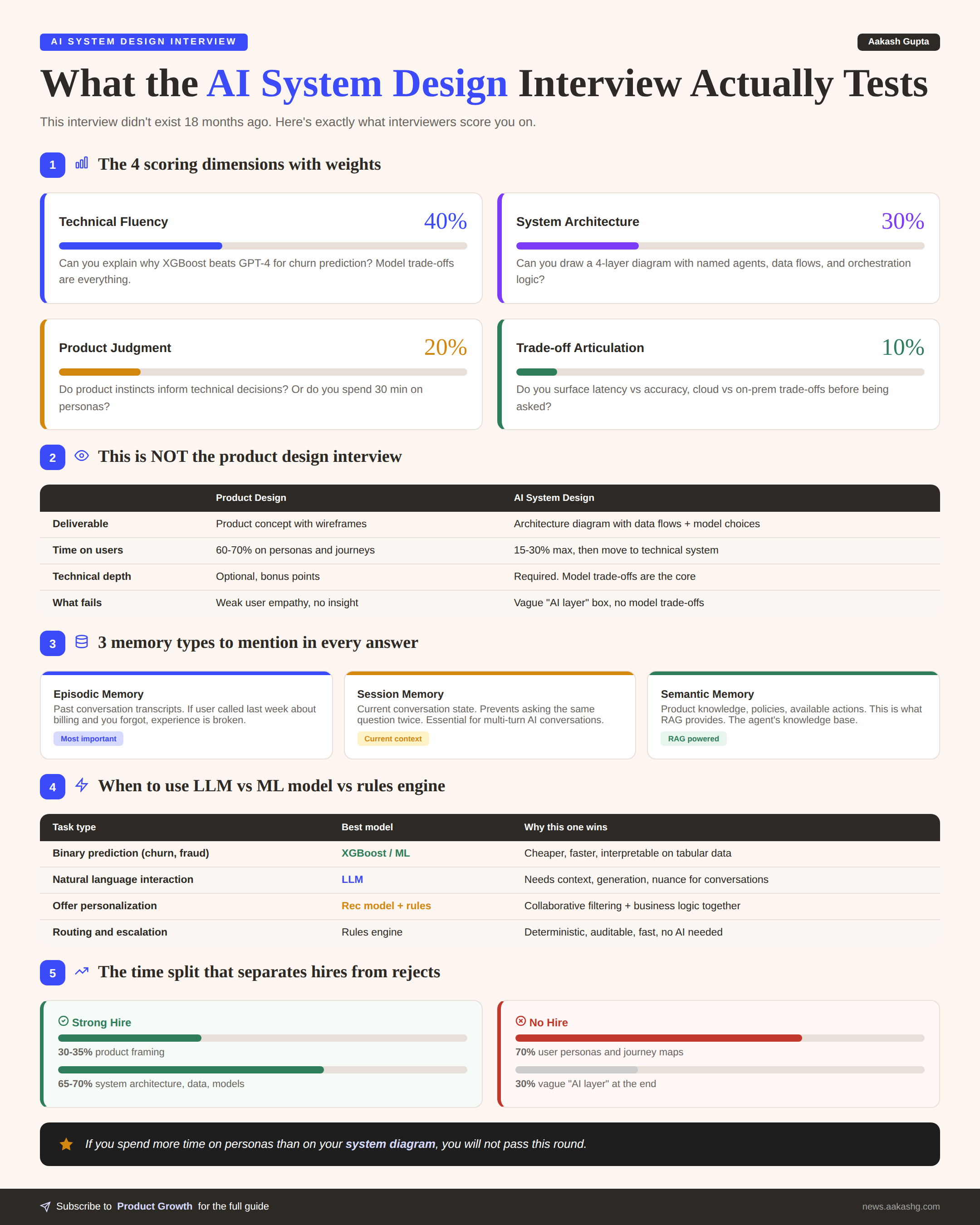
Technical Fluency - 30-40% of the score
Can you speak intelligently about model selection? Do you know when to use an LLM versus a traditional ML model? Can you articulate why an XGBoost classifier might be better than GPT-4 for churn prediction?
This is the dimension where most PM candidates fail. Not because they need to write code. But because they freeze when the interviewer asks “are you going to use an LLM or an ML model for this?”
One candidate I coached told me the interviewer asked about F1 scores. She said she’d have to check. Interview was over in their minds.
System Architecture Thinking - 25-30%
Can you draw a coherent diagram showing how data flows through the system? Can you identify the distinct components and explain how they connect?
Product Judgment Within Technical Constraints - 20-25%
Your user segmentation and pain point analysis still matter. But they need to serve the system design, not replace it.
Trade-off Articulation - 10-15%
Can you proactively surface trade-offs without being asked? Latency versus accuracy. Cloud versus on-premise. LLM versus ML model. The best candidates name these trade-offs before the interviewer has to prompt them.
How it differs from other cases
In a product design or product sense interview, you focus on users, pain points, solutions, and success metrics. The deliverable is a product concept.
In an AI system design interview, you still start with users and pain points. But the deliverable is an architecture diagram showing data flows, model choices, agent roles, orchestration patterns, and failure handling. You spend 60% of your time on the technical system.
The candidates who get rejected treat it like a product design question. They spend 30 minutes on user personas and pain points, then sketch a vague “AI layer” at the end.
The ratio should be flipped. 30-40% product framing. 60-70% system architecture.
Quote me on this: “If you spend more time on personas than on your system diagram, you will not pass this round.”
🔒 The rest of this post is for paid subscribers only. You’ll get -
The DASME framework with architecture diagrams, model selection table, and exact time allocations
3 practice tools I built to help you prepare (Claude Skill, Custom GPT, Gemini Gem)
How 5 top AI companies ask this question differently
7 anti-patterns with exact fixes
64 practice questions with category guidance and 2 full worked examples (search/retrieval and content moderation)