
Have you seen this tweet?

Man, does that sound brutal (even if it's a joke). And one of the most brutal parts has to be getting down-leveled at Amazon, because that costs a lot.
I looked up the latest data on Levels.fyi. Going from Director to Principal PM costs about $303K a year at the median: $753K against $450K. That's a 67% jump on a Principal PM's pay.
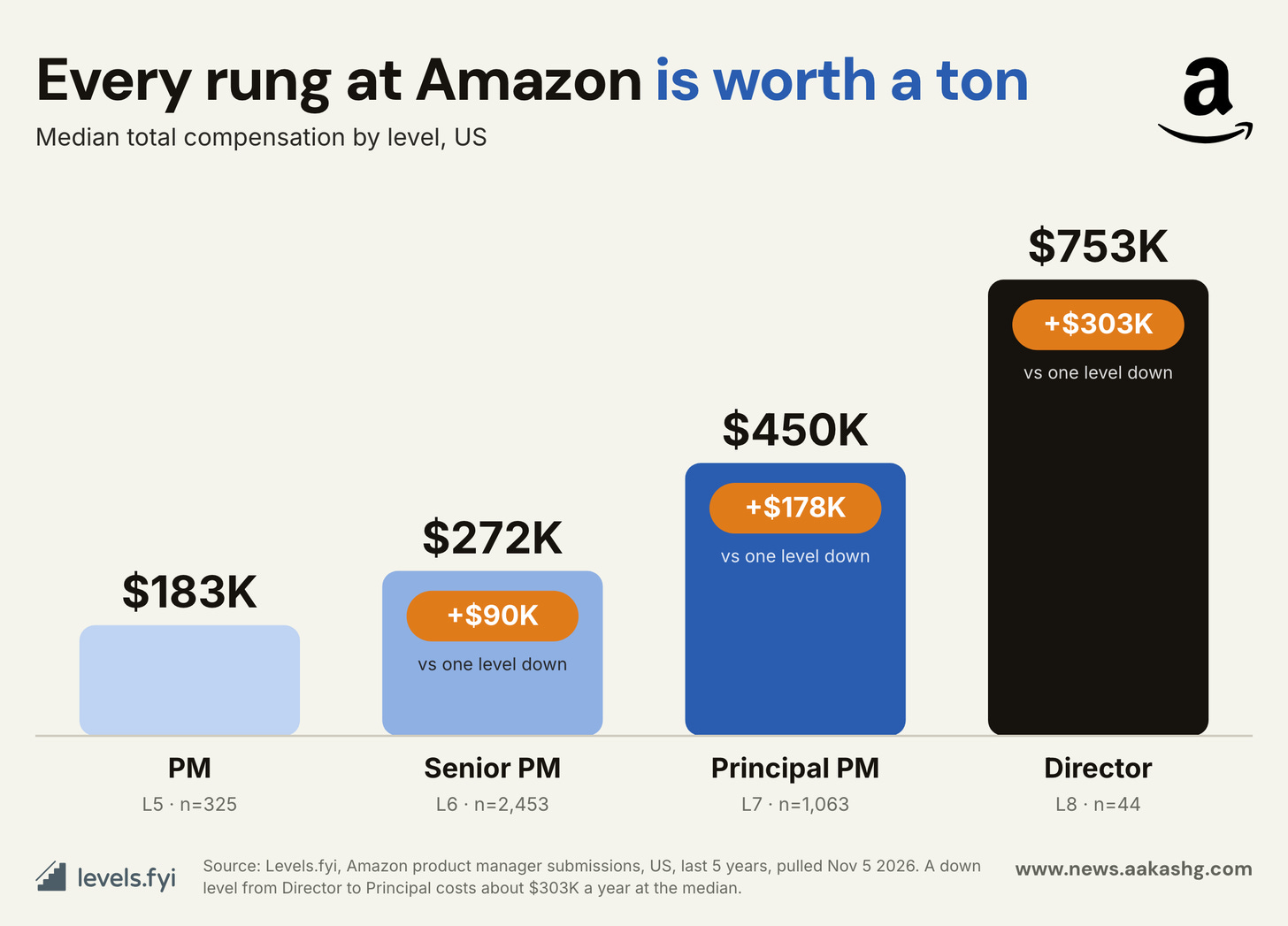
That shows just how much a level costs Amazon, and you. They want to make sure they get the ROI, and if they don't believe you'll deliver it on that expensive salary, they won't offer it to you.
Now here's the problem. You don't negotiate your level. Your level is set by how you perform in your interviews.
I searched the web high and low for good guidance on how to interview at the right level, and couldn't find any. So that's the point of today's deep dive.
The video version
I interviewed a former CPO with 25+ years of experience, Prasad Reddy, one of the instructors in my Land a PM Job cohort, about this.
Our next cohort starts Monday with my breakdown of the Job Search OS. So join us.
Today's Deep Dive
This guide takes everything from that interview, plus the lessons from coaching 160+ students over the past 12 months, all the research I could find online, and my own 30+ Director and VP interviews over the last 10 years:
How PM interviews change as you climb the ladder
The 10 toughest questions, and complete scripts to answer each
How to show leadership outside the Q&A questions
Your AI practice toolkit
1. How PM interviews change as you climb the ladder
For today's newsletter, I built what I think is the deepest meta-dataset of compensation and interview questions ever put together. Here's what's in it:
1,406 sourced interview reports (100+ questions at every level), from Glassdoor, Blind, Reddit, recruiters, podcasts, my book interviews and 160+ student debriefs
1,257 pay records from Levels.fyi, Pave, Glassdoor, Carta, H-1B filings and SEC proxy statements
How much you're paid
So here's what the data shows. It has everything from Levels.fyi, Pave, Glassdoor and Carta:
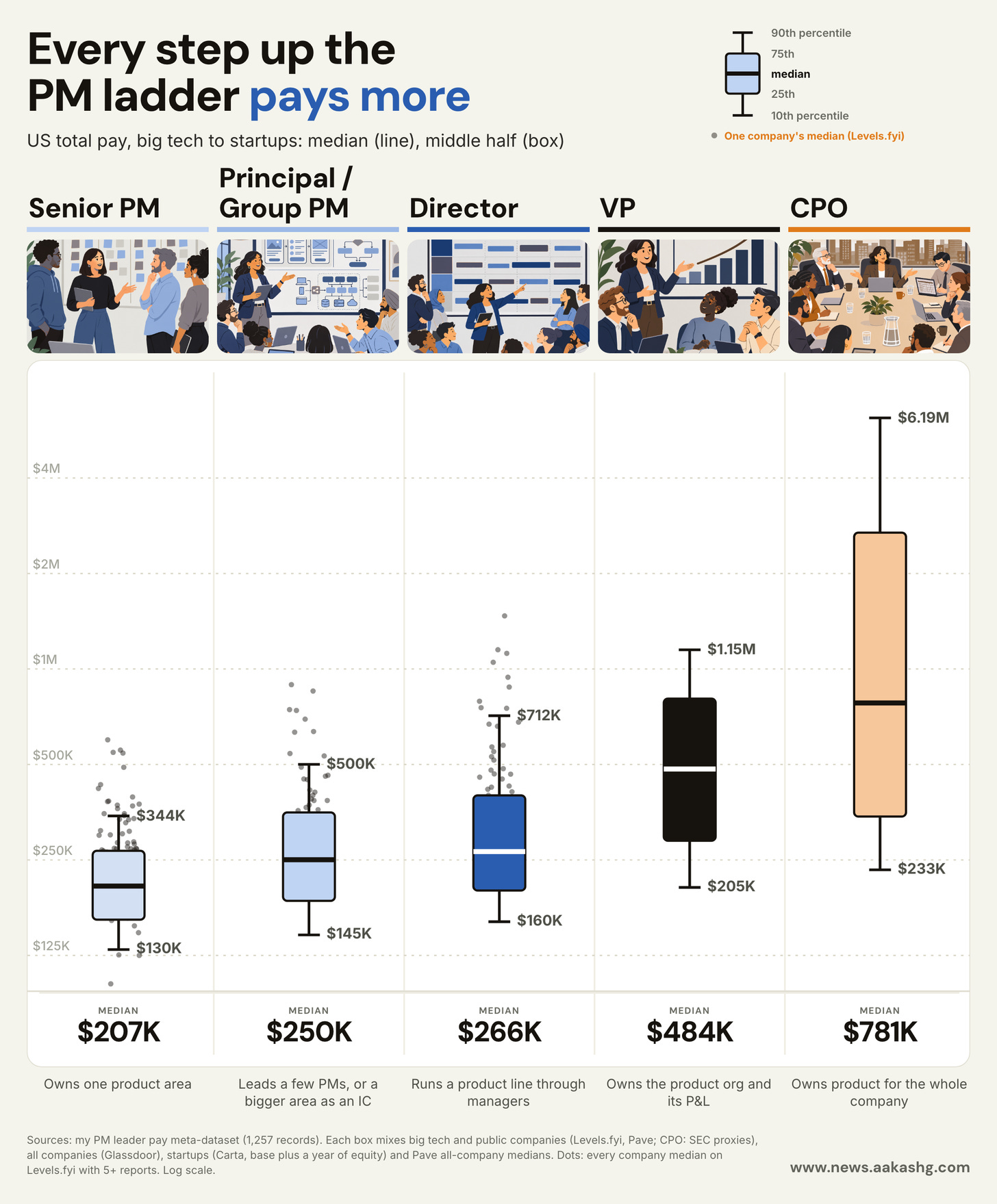
The median Senior PM makes $207K. The median CPO makes $781K (3.8x). So you stand to gain quite a bit as you move up the ladder.
Interestingly, that 67% Principal-to-Director bump we saw at Amazon doesn't hold at the median.
Amazon is unusual: its Directors get $478K a year in stock at the median, versus $228K for a Principal PM.
Here's the median jump by level, across companies that have both:
Senior PM to Principal or Group PM: +47%
Principal or Group PM to Director: +33%
Director to VP: +68%
VP to CPO: +102%
As you can see, it's a lot of money. Point being, you want to get the max level.
Even when you look at the bands, every 10th percentile is higher at each level, and so is every 90th percentile.
What the questions are
I sorted all 641 questions into eight categories:
Product judgment (33%) covers what you built, killed or would change, like "Tell me about the product or feature you killed."
People (21%) covers hiring, firing and growing a team, like "When was the last time you fired someone?"
Strategy (13%) covers where the product should go, and why, like "What is your business case for adding AI functionality?"
Execution (10%) isn't junior execution. It's focused on shipping across teams, like "How do you prioritize work across a multi-product portfolio?"
Stakeholders (9%) covers the CEO, the board and your peers, like "Tell me about a time you disagreed with your CEO."
Your story (9%) covers your career and why this job, like "Tell me about yourself."
The business (3%) covers the P&L, like "Walk me through the P&L of your last product."
Change and culture (2%) covers reorgs, layoffs and the culture you build, like "Tell me about how you have led through a reorg."
Where the questions shift by level
Those percentages above are blended across all product leadership levels. Here's how the question distributions vary by level:
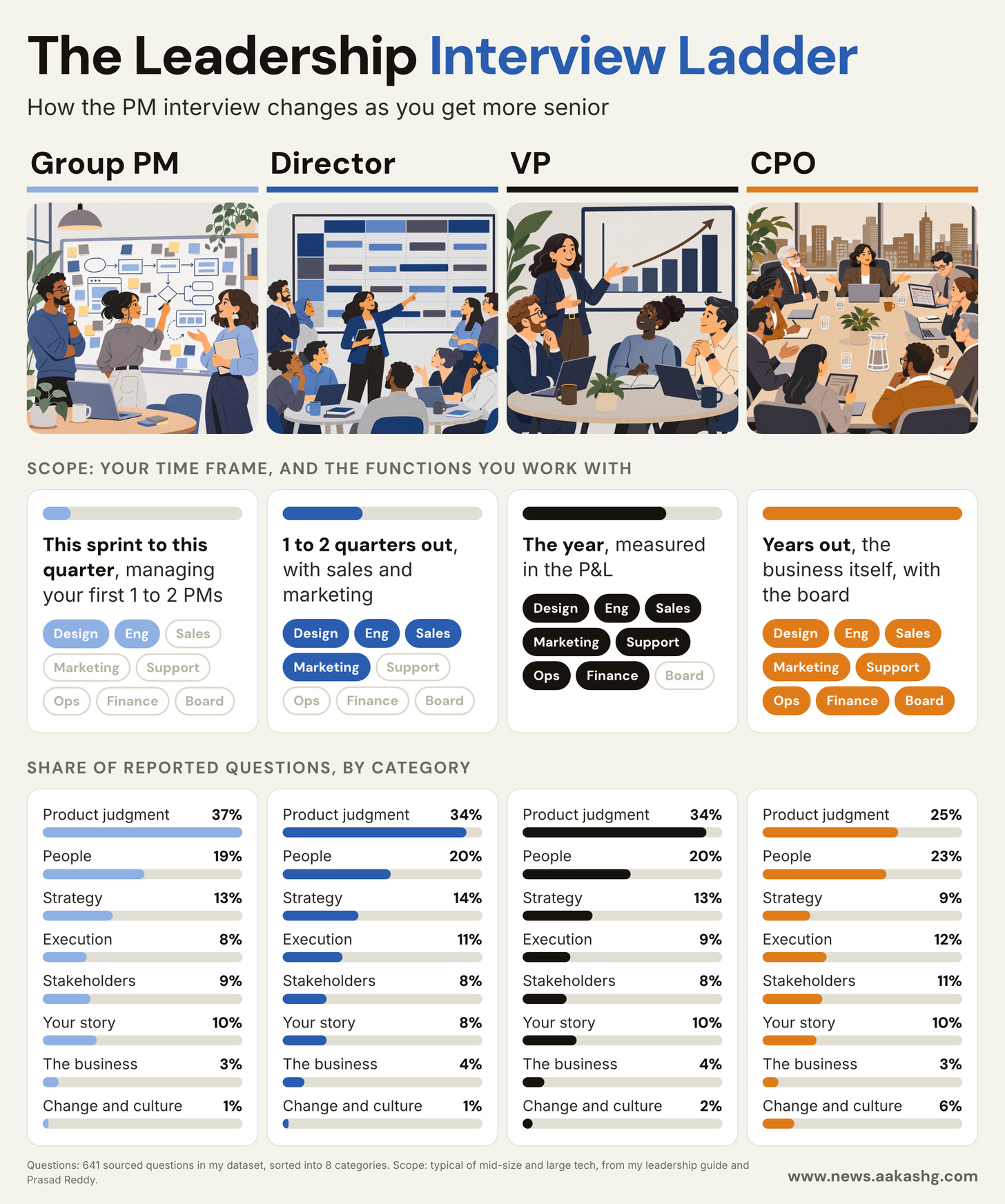
Really, the distribution doesn't shift much. But it's still worth looking at the places it does.
Product judgment and strategy contract from 37% and 13% at Group PM to 25% and 9% at CPO. That's because three other things grow:
People goes from 19% to 23%.
Execution goes from 8% to 12%, because there are a lot of questions around the multi-product portfolio.
Change and culture goes from 1% to 6%, because at CPO you're the one running reorgs and layoffs, and setting the culture.
So really, you should expect to see more questions like "When was the last time you fired someone?" and "How do you prioritize work across a multi-product portfolio?"
Or even "Describe the hardest decision you have executed that affected people's livelihoods."
How the format changes
Of course, the format also changes. At Group PM, we still see plenty of people getting product cases and PM 101 questions. By Director, that case round thins out.
At the VP and CPO stage, we see the biggest variation, so averages tell you the least. Some places might have 5 rounds for VP. Others, like Apollo, where I became a VP, had 11.
And at this level, a bunch of rounds aren't Q&A at all. Here are the 6 you'll most likely face, which we cover in depth in section 3:
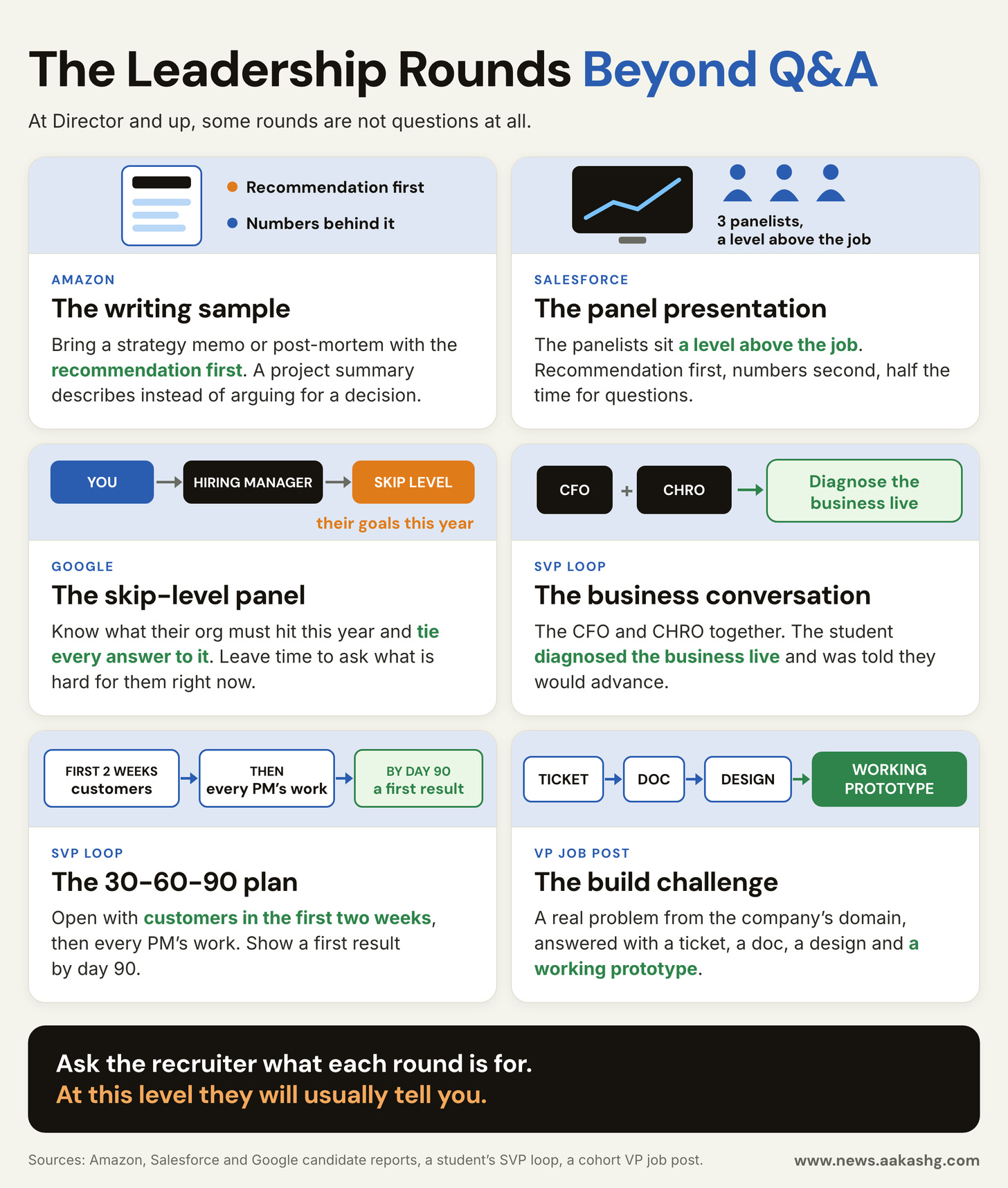
When you become a VP, it's very likely you'll also add a CEO round. 16 of 46 VP and CPO loop reports (35%) mention one, against 2 of 143 at Director.
Disagreeing with your CEO is the answer I see fall apart most, at a median of 5 out of 10. We'll fix that below.
The rest of this article is for paid subscribers only, and I think it's worth your money. Here's what you get:
The 10 toughest questions, with a full example answer for each
The 6 rounds that aren't Q&A, plus real loops from Amazon, Meta, Google, Salesforce and a PE-backed company
The 86-question bank, plus 555 more in the extended file
Both datasets for your Job Search OS: 1,406 interview reports and 1,257 pay records
The leadership coach skill and the printable Altitude Checklist
Annual subscribers also get access to my bundle, and founding subscribers also get my PM OS, Job Search OS and graph library.