
If there’s one thing AI is not coming for, it’s the core of the PM job:
Managing stakeholders.
Today we’re talking about one of the most classical skills in PM and product leadership.
I want to show you how to see this classical skill differently.
This is What You Don’t Want

Story Time
When I was VP of Product at Apollo.io (recently valued at $2.5B), one PM on the team was great at moving the metrics.

But there was a problem that started to bubble up through feedback channels about his work:
A designer questioned whether he was bringing the right ideas. I took it as healthy disagreement.
Then the CEO made a comment on his product area: “I don’t have visibility into what’s going on there.” It made me do a double take. Did he just make a dig at this PM?
It seemed like the designer and CEO respected this guy’s metrics moving. So I didn’t look too much into it.
But I kept getting small signals. Then I realized:
This guy may have been an 8.75/10 on moving metrics, but he was something like a 6/10 on managing stakeholders.
So, I spent some extra time with him on the area.
If I’m honest, things didn’t really turn around much for 2 quarters. But 3 quarters in, the compounding really started to kick off.
The CEO was mentioning his area’s success at a leadership offsite. The design team was praising his product area.
And that crystallized this learning for me:
PM is a people AND a product job.
So I want to share some thoughts on how to do this better.
The Best Stuff
I’ve spent the past week reading up on this topic in prep for this post, and what I found is that the PM literature isn’t the best place for thoughts here.
There’s some good stuff, surely, but the best insights I got were from 2 timeless books:
Never Split the Difference by Chris Voss
Influence Without Authority by Allan Cohen and David Bradford
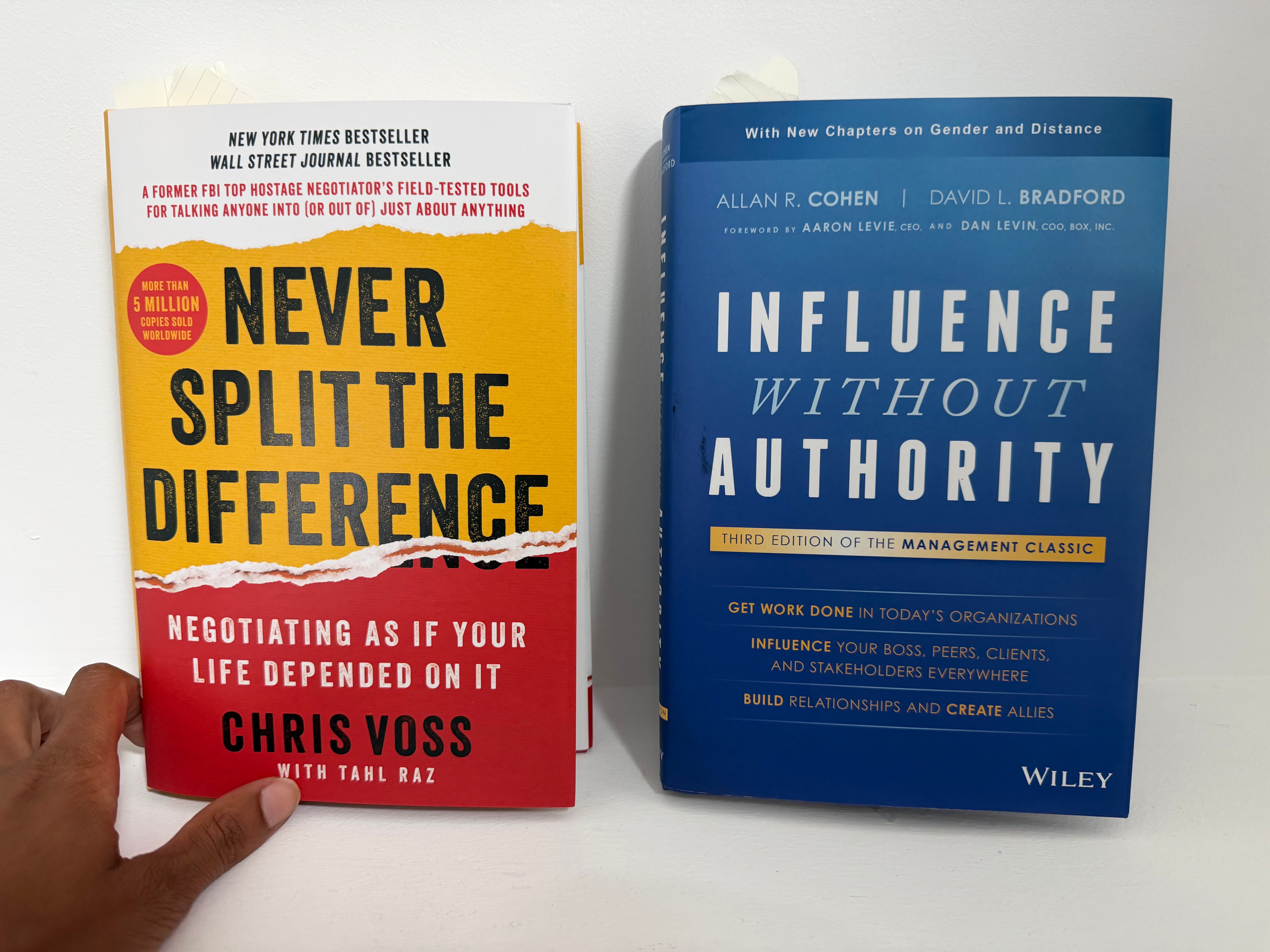
So I’m bringing you some of the best of what those resources, and my own experience, have to offer to this critical PM skill.
Today’s Deep Dive
Here’s what we’ll cover today:
Stakeholder mapping
Move up the pyramid of trust
How the human brain works in relationships
How to create buy-in so your good ideas aren’t killed
As Cohen and Bradford say:
Would anyone argue with these simple ideas? Of course not.
And yet, in the workplace with our colleagues, when it matters most for our professional success, so many of us fail to keep these ideas in mind or to use them as the foundation of our actions.
1. Stakeholder mapping
Remember that PM at Apollo.io? One of the first things we did was to do a stakeholder mapping exercise.
You see, the org chart doesn’t tell you everything. In reality, some random staff engineer and sales SME really mattered:
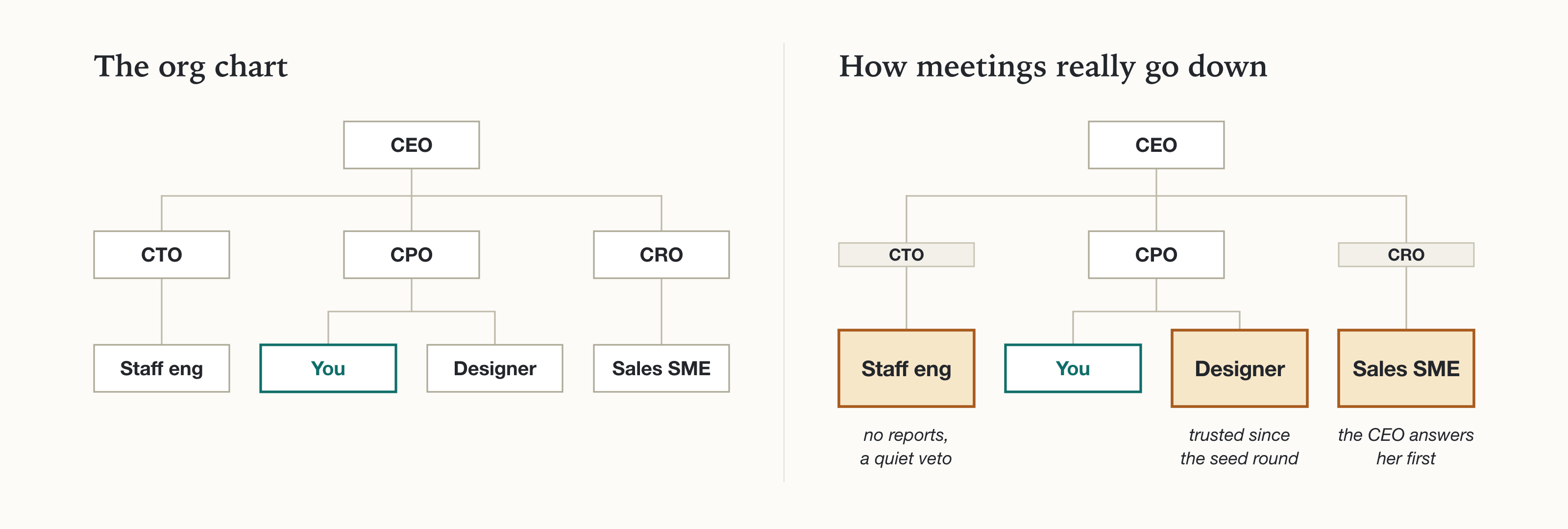
So, instead of relying on the org chart, what we did is to create a map of the actual situation. And that’s what you should do.
Just the exercise of building a map helps. Choose whatever format you like.
Ours looked something like this:
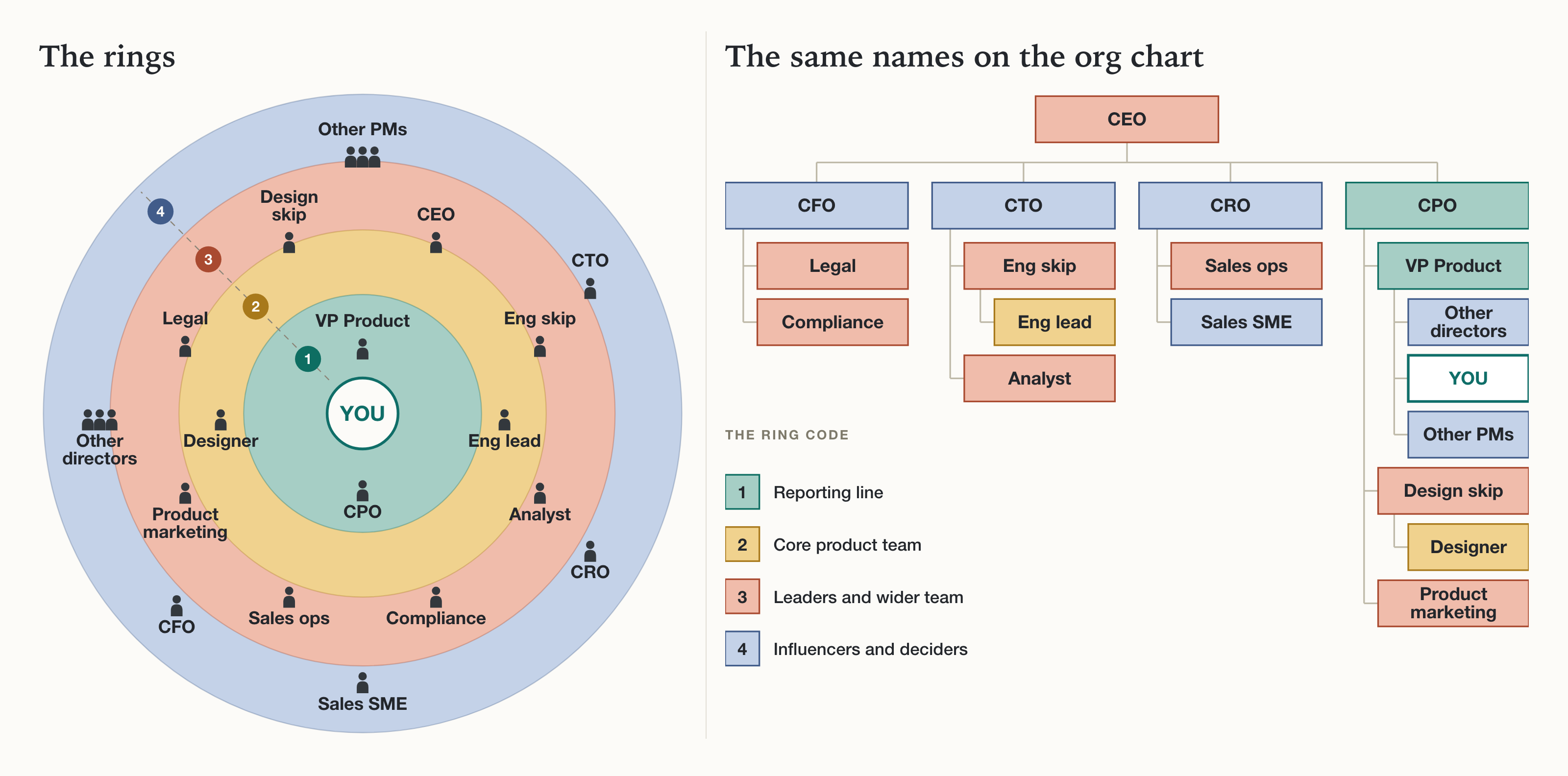
Starting from the inside:
In the innermost circle, we focused on his reporting line: me the VP of PM, plus our CPO.
Then we looked at the core product team including his designer and engineering manager.
Then we defined his third layer as 2 parts:
Leaders - Design Skip, Engineering Skip, CEO
Larger Product Team - Analyst, Legal, Compliance, Product Marketing, Sales Ops
Finally, we identified the influencers that matter:
PM Org - Other Directors of Product, Other PMs
Decision-Makers - SME in Sales who knows everything, CRO, CTO, CFO
Choose your own categorization that applies to your role (though it will likely be pretty similar to this).
Once you’ve mapped out everyone, you want to understand the current state of your trust equation. For that, we need to introduce a new framework…
2. The pyramid of trust
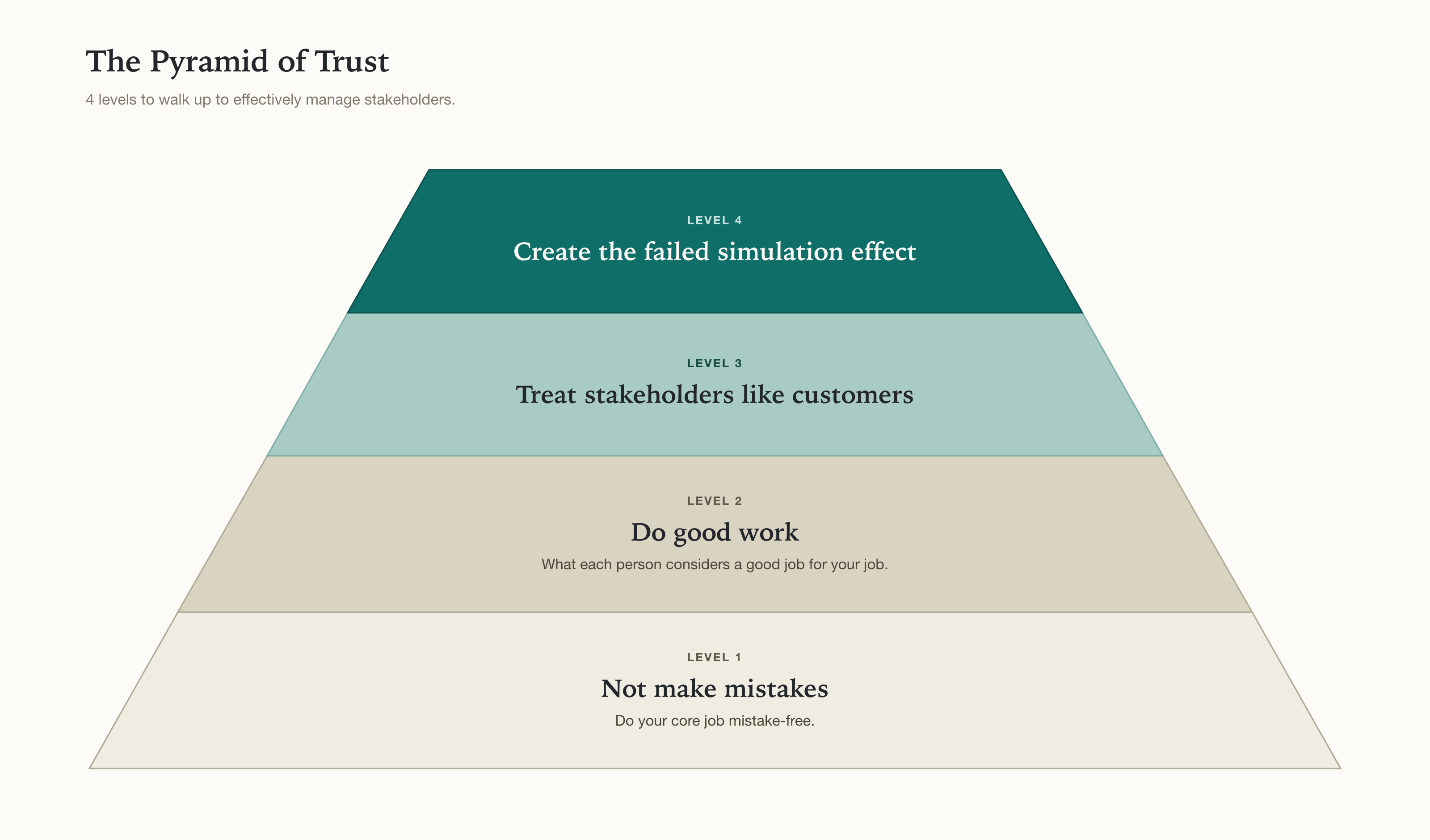
Level 1 - Not make mistakes
No matter how senior we get in our career, sometimes the work day can get the best of us. When we…
Show up to meetings unprepared
Ship AI slop in our communications
Or don’t do the work expected of us on time
We start the game of respect and trust behind the starting line.
The first level to building trust back is to do your core job mistake-free. If you want to sway someone with your analytical findings, they should have trust in your track record of shipping that in the past.
In practice, what this often means is getting good at saying no to doing too much, so that what you do, you can do well.
It’s sometimes easy to forget that every meeting you attend, every email you receive, is basically an interview. Did you show up to the interview present? Did you respond to the communication on time?
Simply building out the systems to avoid making simple mistakes on these tasks gets you a long way on the trust pyramid. Many people aren’t hitting this basic bar.
A useful exercise is to audit yourself for people in your stakeholder map. What mistakes have you made in the recent past with them?
Now, commit to a plan to not let that happen in the future.
Just the exercise of identifying mistakes together with my Apollo.io PM led to so many wins for us. This level really is the important first step of reflection.
Level 2 - Do good work
The next level up from not making mistakes is doing a good job at what each of those individuals on your stakeholder map considers is a good job for your job.
It’s worth thinking about that. What is the sum total of the exposure this person gets of my work?
For a director of design in another part of the org, it might just be product reviews and all-hands.
For your designer, it may be everything including product trio meetings.
There’s this funny lack of overlap between the actual work you do and the exposure people get to it:
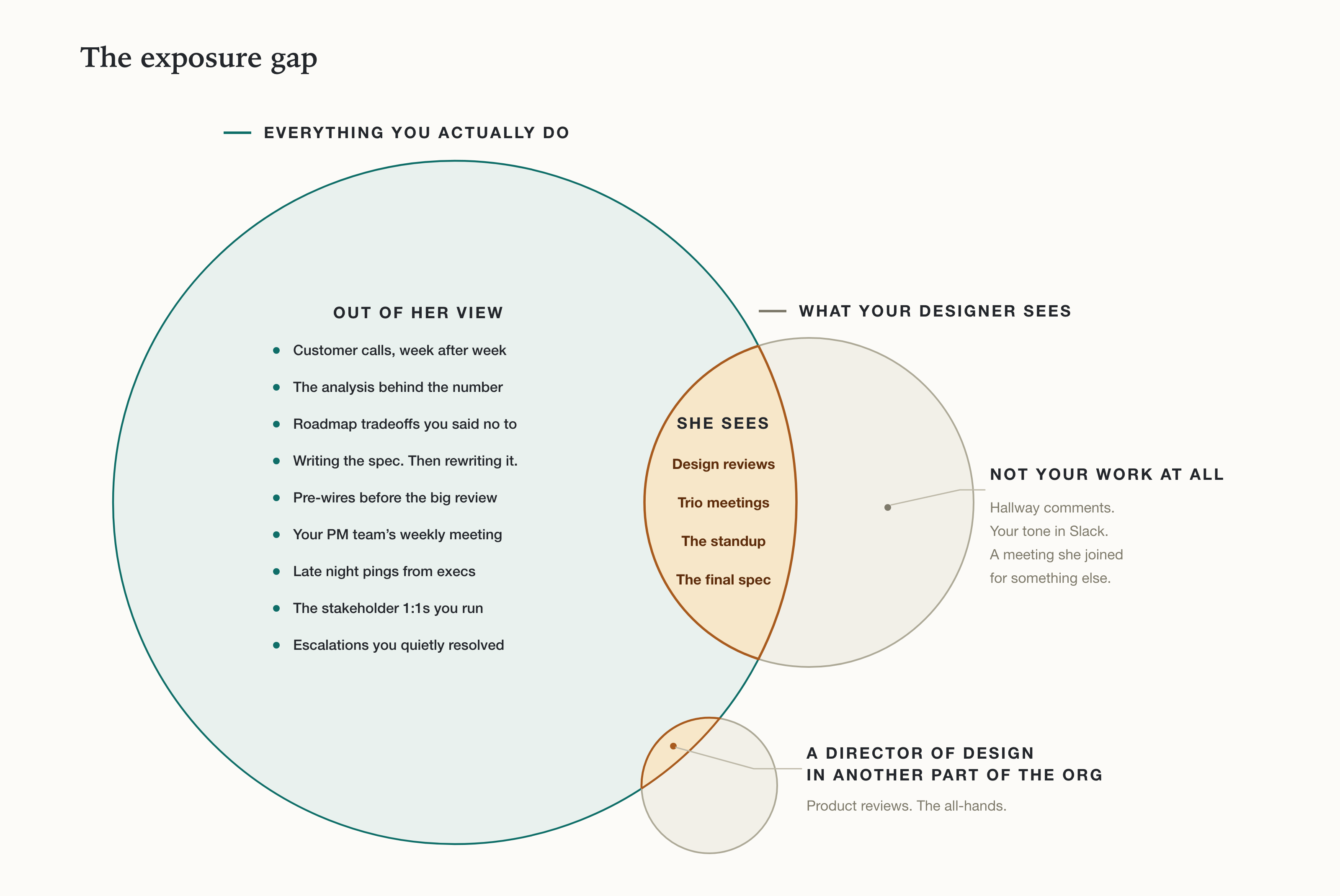
Even your designer, who’s in the trenches with you day in and day out probably doesn’t see: your product team meetings, all your customer calls, the late night pings from execs, the extra meetings with product marketing and legal, plus a bunch more of the other things you do.
It’s not that you have to tell them, “oh look at all this work I’ve done.” But it’s worth thinking about: of the exposure they have to my work, have I given them a complete picture of what they want?
The exercise here is to go person by person and think about your last quarter of interactions with them.
Over the next quarter, how are you going to fill the gaps where people should get more of your positive impact, but don’t have it?
When we did this with my PM at Apollo.io, here’s some of what we found:
His designer expected him to be really close to the customer, and there wasn’t a place the designer learned about the PM’s customer interactions
The CEO mainly heard from PMs via OKR reviews and all-hands meetings, and the person hadn’t presented at all-hands
Then we systematically went about plugging those gaps:
We added a slack bot that posted his weekly discovery call takeaways to their trio channel when he submitted them on Dovetail
He presented his next big win at the all-hands meeting, going through the formal process with BizOps to get listed as a topic
That’s really the power of this exercise. You previously maybe didn’t have a reason to prioritize a Dovetail Slackbot or speaking at all hands.
But after going through this exercise, you do.
At this point, I should say: Doing level 1 + 2 is really enough for many good PMs. Levels 3 and 4 are not always necessary.
But, they represent the “advanced” levels of stakeholder management.
Level 3 - Treat stakeholders like customers
As PMs, we are trained in discovery.
So it’s worth running that same customer skillset on your stakeholders.
The basis of it all is to ask them really good questions and then listen.
As Chris Voss says:
The centerpiece of this book is called Tactical Empathy. This is listening as a martial art, balancing the subtle behaviors of emotional intelligence and the assertive skills of influence, to gain access to the mind of another person.
So to gain access to the mind of a stakeholder, ask questions like:
To the Sales SME that holds the keys to the CEO’s heart about your big rock feature for next quarter: do you think this product solves the core problem we need to?
To your design partner: what did you think of the PM artifacts you saw from me last quarter, and how can I improve them next quarter?
You want to show tactical empathy with the questions you ask, so you can really hear their answers and follow up with tangible work after. Here’s a bank of more:
Each question in the bank is powered by one of two techniques from Voss:
The calibrated question. It starts with “how” or “what” and hands the other person the problem.
Labeling. You say what they said labelled, then you stop talking. People correct you or confirm you, so you can learn where they actually are.
These are the most powerful questions.
Now, don’t go too far with this. Treat your stakeholders like customers to the extent it makes sense. Understand their needs, take tangible steps to address them. Like when our customers make unreasonable demands, be able to have a backbone with stakeholders as well.
That’s why the customer analogy works really well. It encourages you to go deep on this area, but not too deep that you lose your soul (because you feel like you are just doing things to appease stakeholders).
Level 4 - Create the failed simulation effect
Cal Newport has this very powerful framework called “The Failed Simulation Effect,” and your colleagues are running it on you.
Basically, everything they see from you they’re asking:
Could I do the same thing? How much better is what they’re showing me than what I could build myself?
A failed simulation is when they couldn’t see themselves making something as good as you have. A failed simulation, then, makes you the right person (because you have the most expertise) to be doing that job.
This is especially tricky with PM in the AI era, where anyone can create a long document with lots of charts. The old PM tricks don’t work anymore. And it just has to be that when they see your roadmap, your PRDs, your feature results writeups, they should think:
Wow, this is better than I can do!
When you are able to create that failed simulation effect, then you’ll truly win more trust to do more.
And this is the top of the trust pyramid. You aren’t making mistakes, you’re doing good work, you’re meeting stakeholder needs like customers, and they can’t seem to figure out how you do it all so well.
Then you can really solve hazy stakeholder problems.
3. How the human brain works in relationships
Now that we’ve done the highly tactical stuff around stakeholder mapping, understanding gaps, and plugging them with a pyramid of trust, let’s get psychological.
As Chris Voss said:
In my short stay I realized that without a deep understanding of human psychology, without the acceptance that we are all crazy, irrational, impulsive, emotionally driven animals, all the raw intelligence and mathematical logic in the world is little help in the fraught, shifting interplay of two people negotiating.
There are things about how the human brain works in relationships that are worth advanced study for people hoping to improve their stakeholder management.