
Boris Cherny’s first pull request at Anthropic got rejected.
Not because the code was bad. Because he wrote it by hand.
His ramp buddy told him to use Clyde, the janky internal predecessor to Claude Code. Boris spent half a day figuring out the tool. Then it one-shotted a working PR.
That was September 2024.
By December, Opus 4.5 wrote 100% of his code. He didn’t edit a single line manually. He uninstalled his IDE.
Today Boris ships 20-30 PRs a day running 5 parallel Claude instances. His team built Cowork, a full product for non-engineers, in about 10 days. They prototyped agent teams for months, trying hundreds of versions before shipping.
Meanwhile, most PM teams are still spending 2 weeks getting a spec through review for a feature that could be prototyped, tested, and killed in an afternoon.
The gap between these two realities is compounding every week.
And the skill that separates PMs on either side of that gap is what I’m calling taste at speed: the ability to evaluate working software fast, kill most of it, and ship the survivors.
I’ve been thinking about this since my LinkedIn post on Boris went viral (215K+ impressions):
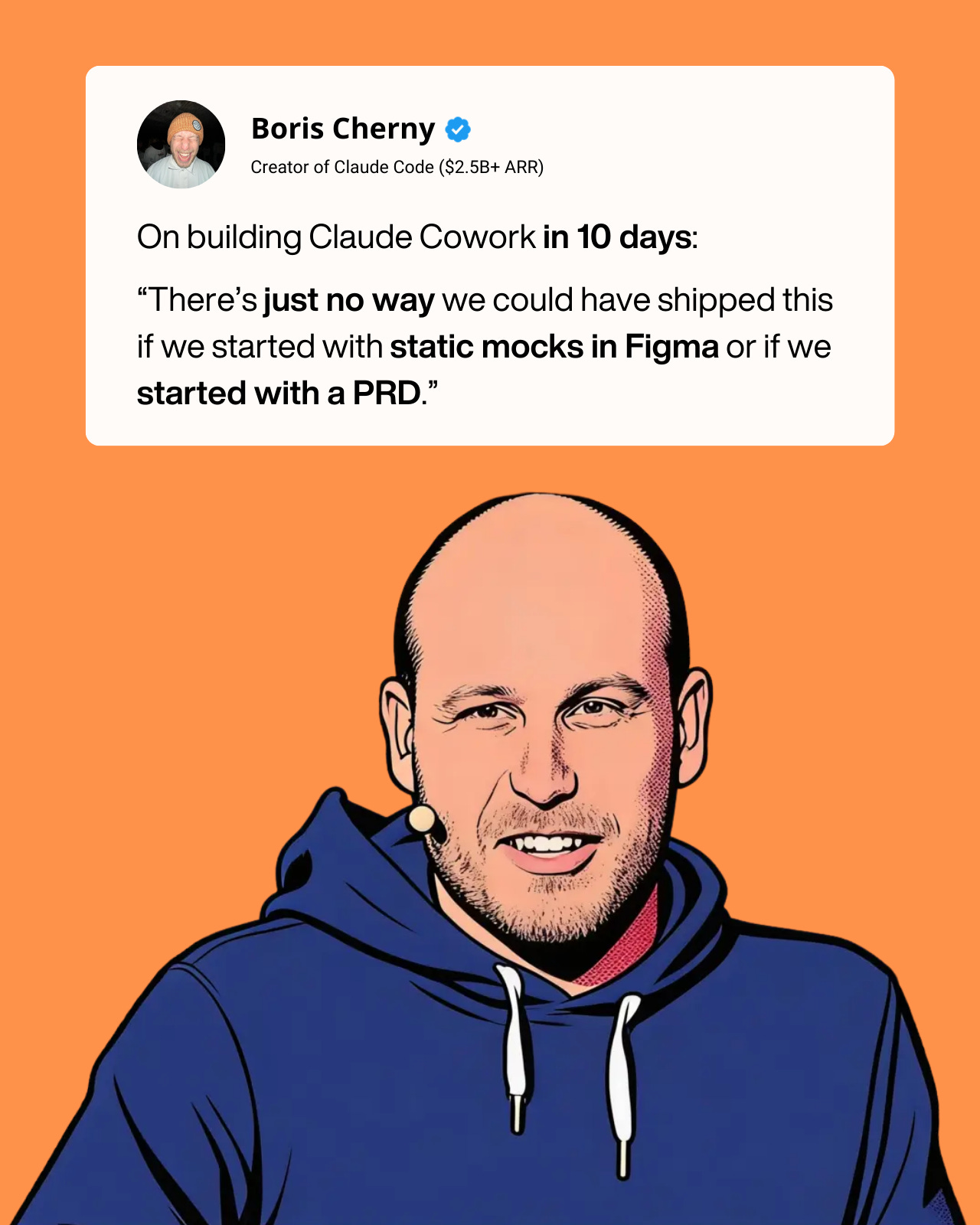
The response told me something. This topic hit a nerve.
PMs know the ground is shifting. They just don’t know what to do about it.
Today, I’m going deep.
Today’s Post
I’ve written the web’s first guide to Taste at Speed:
Why Taste at Speed Is the Defining PM Skill
How the Best Teams Actually Ship Now
The Taste at Speed Framework
How to Build This Skill
Where the PRD Fits Now
Real-World Teardown
Plus 4 downloadable tools: a Prototype Evaluation Scorecard, a Skill-Building Roadmap, a Prototype-First PRD Template, and a Divergent Prototyping Prompt Template.
1. Why Taste at Speed Is the Defining PM Skill
Boris shared an analogy recently that I haven’t been able to stop thinking about.
In the 1400s, less than 1% of Europe’s population was literate. There was a class of scribes who spent years in training. They were employed by kings and lords who were themselves often illiterate.
Then the printing press came along. The cost of printed material dropped 100x over the next 30-50 years. The quantity went up 10,000x over the next century.
“If you think about what happened to the scribes, they ceased to become scribes, but now there’s a category of writers and authors. These people now exist. And the reason they exist is because the market for literature just expanded a ton.”
Now think about this through the lens of product teams.
Software engineers are today’s scribes. PMs are the kings who “employed” them, often unable to write the code themselves.
The disconnect between “what I want built” and “who can build it” is the fundamental coordination problem that PRDs, design reviews, sprint planning, and every alignment meeting existed to solve.
When building costs near zero, that coordination layer compresses. The bottleneck moves from “can we build it” to “should we ship it.”
PRDs existed because building was expensive and you needed sign-off before committing resources. When a prototype takes 45 minutes instead of 6 weeks, nobody needs a document to authorize exploration.
They need someone who can look at working software and say “this one, not that one” in real time.
If anything, the spec now comes after the prototype.
This is taste at speed.
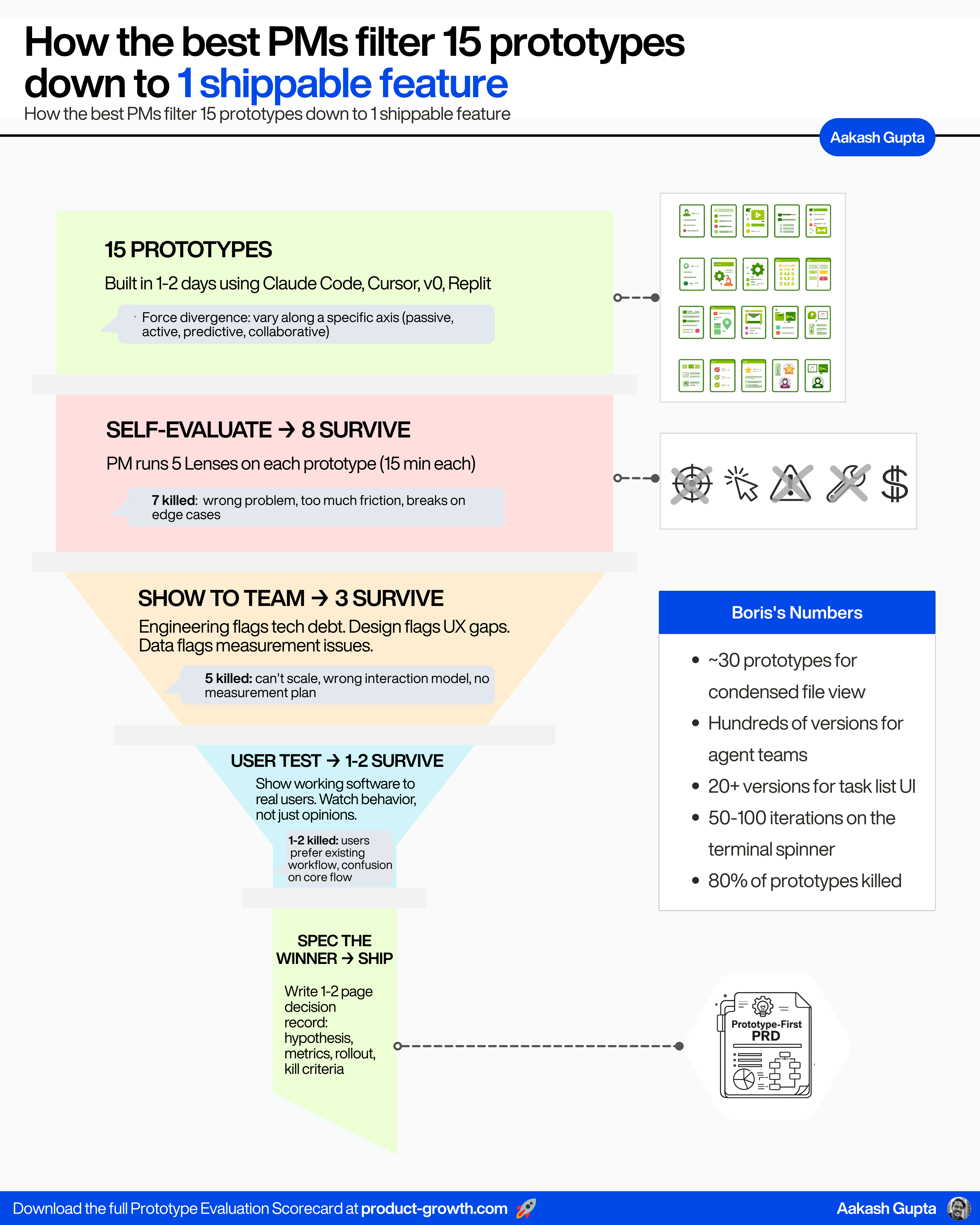
And it’s a filtering function, not an acceleration function. The 80% kill rate is the whole point.
“Half my ideas are bad and you just have to try stuff. You try a thing, you give it to users, you talk to users, you learn, and then eventually you might end up at a good idea. Sometimes you don’t.”
Without taste, speed just means you build the wrong thing faster. That’s a feature factory on steroids.
I think the best articulation of why judgment becomes the long-term moat is Shreyas Doshi’s recent piece on product sense. His logic: AI tools will commoditize. When everyone has roughly equivalent AI capabilities, the only differentiator is the human judgment applied on top of AI outputs. He breaks that into five skills: empathy, simulation, strategic thinking, taste, and creative execution.
Taste at speed activates all five simultaneously. You’re staring at working software and running empathy (does this solve the real problem?), simulation (what breaks at scale?), strategy (does this fit where we’re going?), taste (is this the best of the options?), and creative execution (can I see a version 2x better?) all at once.
Why Speed Compounds
The speed component matters because it creates a flywheel.
A PM who evaluates 15 prototypes a week builds judgment faster than a PM who reviews one spec a month. After 6 months, that volume of pattern-matching reps creates a taste gap that keeps widening.
The experience gap becomes a taste gap.
The taste gap becomes a career gap.
And it compounds every single week.
2. How the Best Teams Actually Ship Now
Let me walk through exactly how the Claude Code team operates.
The Old Model vs. The New Model
The traditional flow was linear:
Idea → PRD → Design → Eng builds → QA → Ship (8-12 weeks)
The AI-era flow is cyclical:
Idea → 5 prototypes → Evaluate → Kill 4 → Spec the survivor → Ship (1-2 weeks)
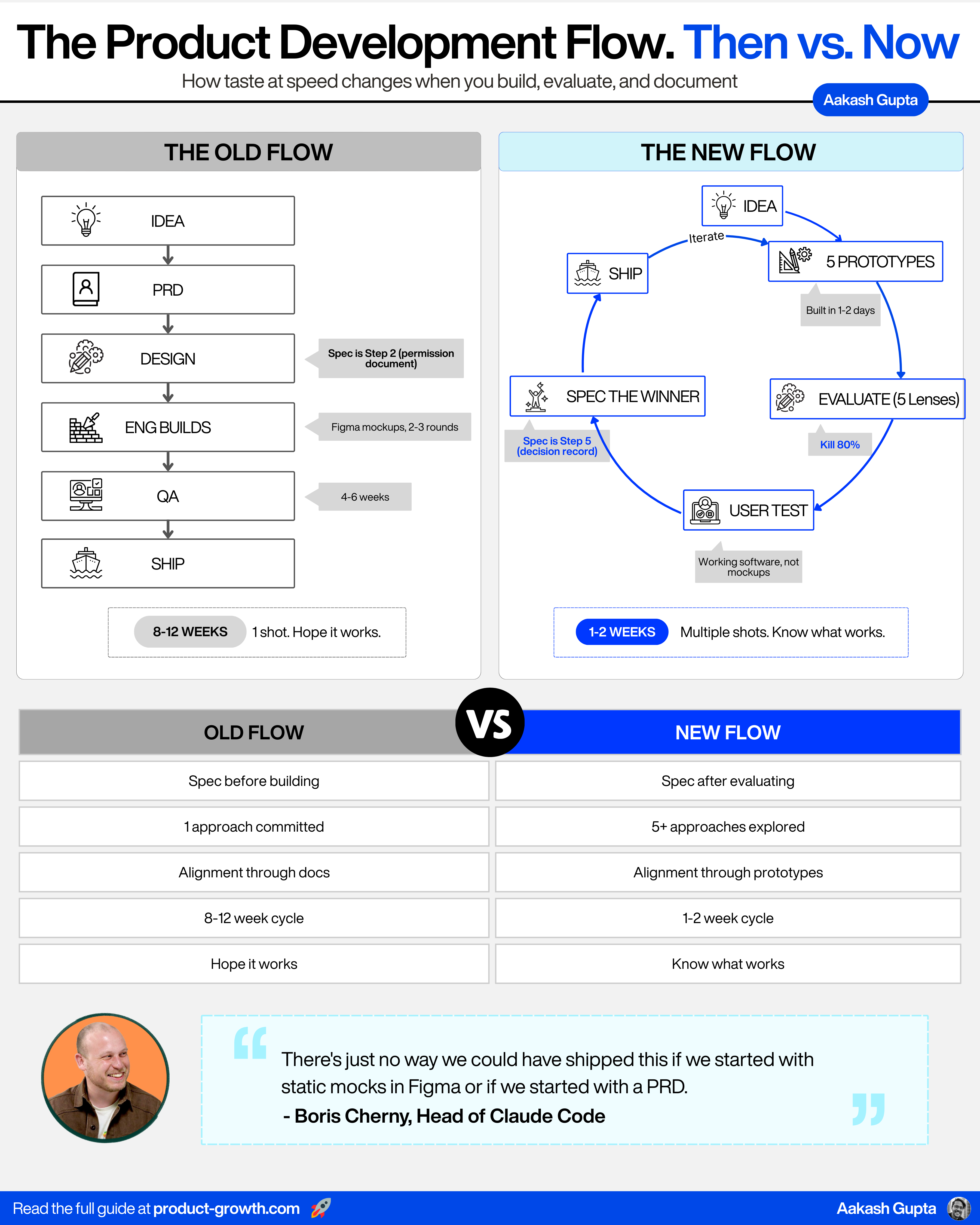
The spec didn’t disappear. It moved from step 2 to step 6.
It comes after you know what you’re building instead of before.
How Boris Actually Works
Five terminal tabs. Each one has a parallel checkout of the repository. He starts Claude Code in plan mode in each one. Round-robins between them.
Goes back and forth on the plan until it’s right. Then with Opus 4.6, the implementation one-shots almost every time.
He also starts agents from his phone every morning before he’s at his desk. A third of his code might come from the iOS app.
He was candid about plan mode’s shelf life:
“Plan mode probably has a limited lifespan. Maybe in a month, no more need for plan mode.”
That’s wild to hear from the guy who built it. But it tracks with his core philosophy: don’t build for the model of today. Build for the model 6 months from now.
“All of Claude Code has just been written and rewritten and rewritten over and over and over. There is no part of Claude Code that was around 6 months ago.”
The numbers are real:
Claude Code writes ~80% of code at Anthropic on average
Boris writes 100% of his with Claude Code
He ships 10-30 PRs daily, every day
Opus introduced maybe 2 bugs in an entire month of coding. He estimates he would have introduced ~20 writing by hand.
Productivity per engineer has increased 200% since Claude Code launched, even as Anthropic has tripled in headcount
To put that in context, Boris ran code quality at Meta. A 2% productivity gain there was “a year of work by hundreds of people.”
The Team Culture
Everyone at Anthropic has the same title: Member of Technical Staff. PMs code. Data scientists code. Designers code. The finance guy codes.
This happened organically. Boris walked into the office one day and saw a data scientist with Claude Code up on his monitor. Using it to run SQL queries with ASCII visualizations in the terminal.
Boris asked if he was dogfooding.
“No, I’m using it to run queries.”
The next week, the entire row of data scientists had Claude Code running. Then half the sales team. Then the finance team. Boris calls this latent demand, and he thinks it’s the single most important principle in product.
“You can never get people to do something they do not yet do. The thing you can do is find the intent that they have and then steer it to let them better capitalize on that intent.”
No PRDs on the Claude Code team. Cat Woo, who runs product, is extremely technical. The culture is “better send a PR.”
And the prototyping volume is staggering:
Agent teams: “probably hundreds of versions” before shipping
Condensed file view: ~30 prototypes, then a month of internal dogfooding
Terminal spinner: “probably 50 maybe 100 iterations, and 80% of those didn’t ship”
Plugins: built by Daisy running swarms over a weekend. She told the swarm to build plugins, come up with a spec, make an Asana board, split into tasks. It spawned a couple hundred agents. They made 100 tasks. Then they implemented it. “That’s pretty much the version of plugins that we shipped.”
Code Review Isn’t Dead
This isn’t a free-for-all.
Every PR at Anthropic is code-reviewed by Claude Code first, catching about 80% of bugs. Then a human engineer does the second pass. There are type checkers, linters, and the build runs. Claude Code even tests itself by launching itself in a subprocess.
Boris still automates lint rules in real time. Early in his career at Meta, he kept a spreadsheet: every time he left a code review comment about a recurring pattern, he tallied it. When a row hit 3-4 instances, he wrote a lint rule. Now he does the same thing but faster: he tags Claude directly on a coworker’s PR and asks it to write the lint rule.
“The more general model will always outperform the more specific model. We have a framed copy of the bitter lesson on the wall where the Claude Code team sits.”
There’s always an engineer approving the change before anything goes to production.
The Honest Caveat
I want to be straight about why this works at Anthropic specifically:
Small, senior team where everyone shares deep context
The product IS the AI tool they’re building with
Boris built his taste over 15+ years shipping at Meta scale. He was one of the most prolific code authors and code reviewers at Instagram.
Extraordinary hiring density. Dario’s own words: “You want a relatively small set of people where almost everyone you hire is really, really good.”
The prototype-first evaluation loop, the discipline of trying dozens or hundreds of versions, the culture of showing instead of writing, the code review automation layer. All of that translates to other companies.
But most teams aren’t 100% senior generalists at an AI company building their own AI tool. The no-PRD approach requires a team small enough to align through conversation and prototypes. So the full Anthropic playbook won’t work everywhere yet.
But here’s my take: this is where most fast-moving teams will be within 18 months. The tools are getting accessible enough. Cowork is Anthropic’s bet on bringing this to non-engineers. v0, Cursor, Replit, and Lovable are all pushing in the same direction.
The question isn’t if this workflow becomes standard. It’s when.
And Boris thinks coding is already largely solved.
“I think by the end of the year, everyone’s going to be a product manager and everyone codes. The title software engineer is going to start to go away. It’s just going to be replaced by builder.”
The PMs who start building these reps now will have a massive head start.
🔒 The rest of this post is for paid subscribers. I’m going deep on the Taste at Speed Framework (5 Lenses), how to build this skill regardless of your starting point, where the PRD fits now, and a full real-world teardown showing good vs. bad prototype evaluation side by side. Plus 4 downloadable templates.