
The Slack and Dropbox playbook is dead.
Everyone copied it for 10 years. Now it doesn’t work anymore.
But here’s the problem. Most PLG content still teaches the 2018 playbook.
They tell you to add a free trial, add viral loops, focus on activation. That was enough in 2018.
Now? Canva 260 million monthly active users and $3.5 billion ARR growing 40%+ per year. Figma IPO'd and crossed $1 billion in annual revenue run rate. Attio raised $116 million total and is 4x-ing ARR by building the AI-native CRM.
The gap between companies using the old playbook and the new one is massive.
I gave a keynote at Mind The Product where I broke down the complete evolution of PLG. People paid thousands of dollars to see this live:
In today’s newsletter, I’m sharing the entire 7-layer framework here with real examples you can steal (and adding in updates from the talk).
Today’s post:
I’ve studied hundreds of PLG companies over the last 5 years. Published 20+ deep dives on Notion, Figma, Cursor... Before I was VP of product at Apollo.io (where we hit $1 billion valuation), I wish I had this playbook.
What product-led growth actually is
The 7-layer framework
Layer 1: Go to market
Layer 2: Information for decision
Layer 3: Free-to-paid conversion
Layer 4: Activation
Layer 5: Retention
Layer 6: Monetization
Layer 7: Expansion
The 4 main vectors of change
1. What is product-led growth?
I talk to a lot of PMs. And here’s the mistake I constantly: they equate Product-Led Growth (PLG) with self-serve.
That’s not PLG. That’s 1% of PLG.
Blake Bartlett, who invented the term in 2016, said it best:
PLG is a method of organizing and building a company. It’s about putting the product first to acquire customers, convert them, engage them, retain them, and monetize them.
The 3 elements that determine PLG success
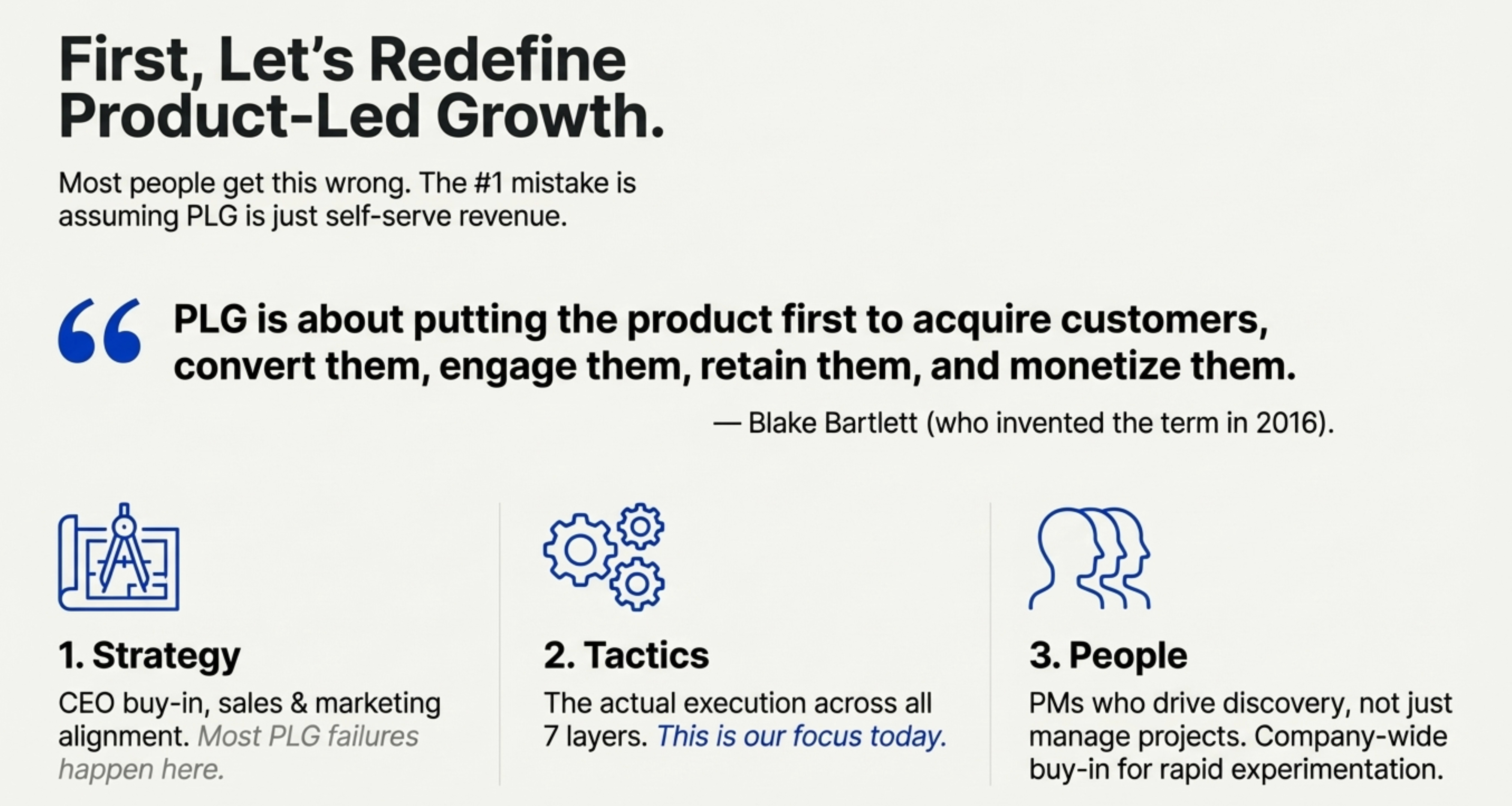
Strategy - CEO level buy-in, VP of sales supporting it, VP of marketing developing PLG leads. Most PLG failures happen here.
Tactics - actual execution across all 7 layers (we’ll cover this today)
People - PMs who can drive discovery (not just project managers), company-wide buy-in for rapid experimentation
If you don’t have leadership buy-in, tactics won’t save you. But if you have the pieces in place, you need to nail the tactics.
2. The 7-layer framework
I worked in PLG companies for 7-8 years without a coherent framework.
My friend Jaryd Hermann (director of product at Backstage) and I collaborated on deep dives. We analyzed Miro, Canva, Notion, Figma.
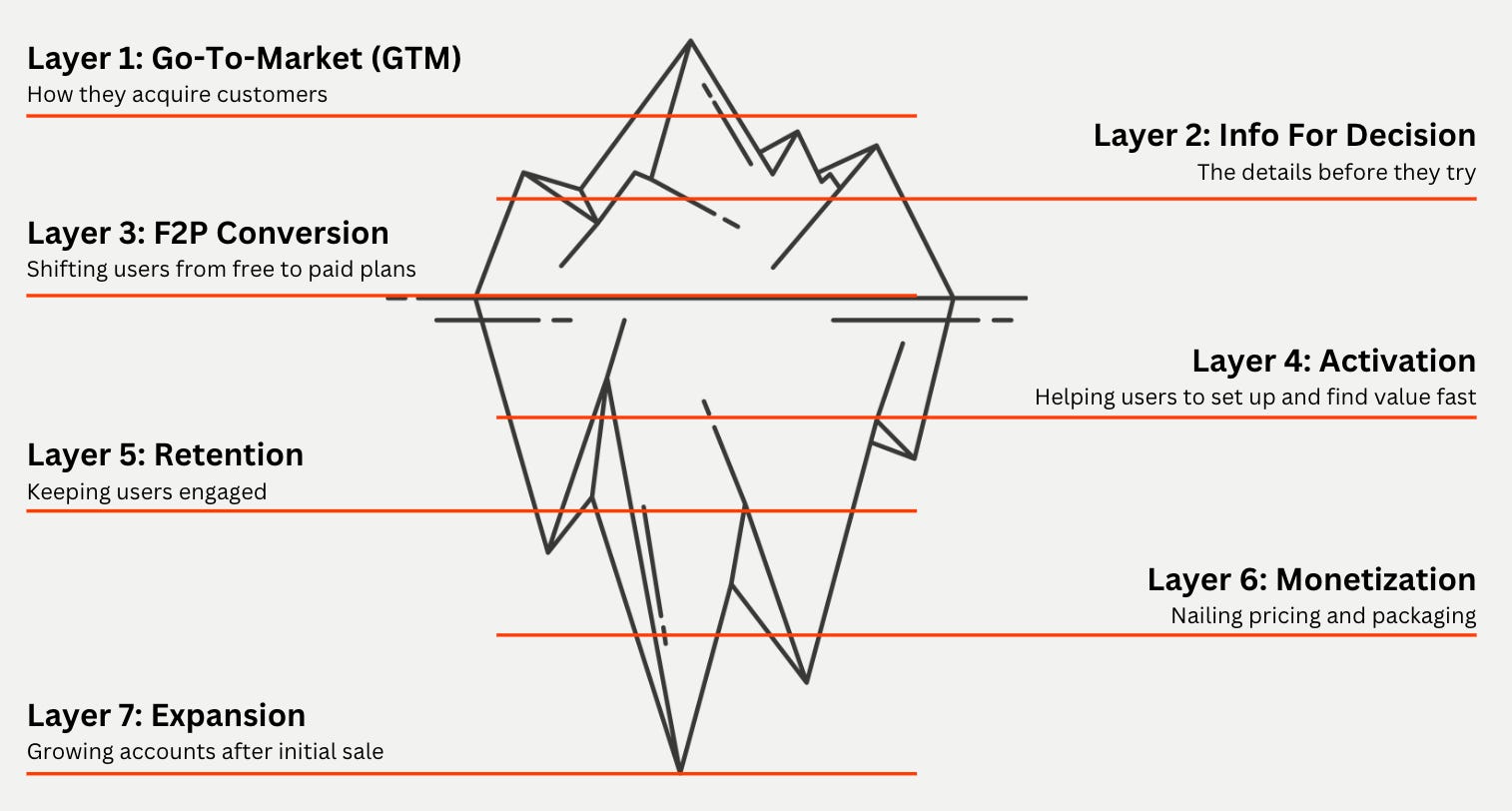
We found 7 layers you need to nail:
Go to market - how you acquire customers with your product
Information for decision - pricing pages, case studies, templates
Free-to-paid conversion - freemium config, billing gates
Activation - onboarding flow, in-product checklists, homepage
Retention - habit loops, product updates, ongoing value
Monetization - pricing tiers, pricing model (seat vs usage)
Expansion - additional features, cross-user expansion
Where to focus
Focus on the layer where you’re most broken, plus 1-2 layers below it.
If your go-to-market is broken (not generating PLG leads), it doesn’t matter if you’re running monetization experiments 6 layers later. You won’t have volume to test anything.
Layer 1 - Go to market
The two product surface areas
When I was a product leader leading growth teams 5-7 years ago, there wasn’t a clear definition of what surface areas to focus on.
Here are the two you need:
Your marketing - which really does matter (why product growth leaders like me spend so much time with marketing teams)
Your website - often owned by marketing, but super important for driving PLG success
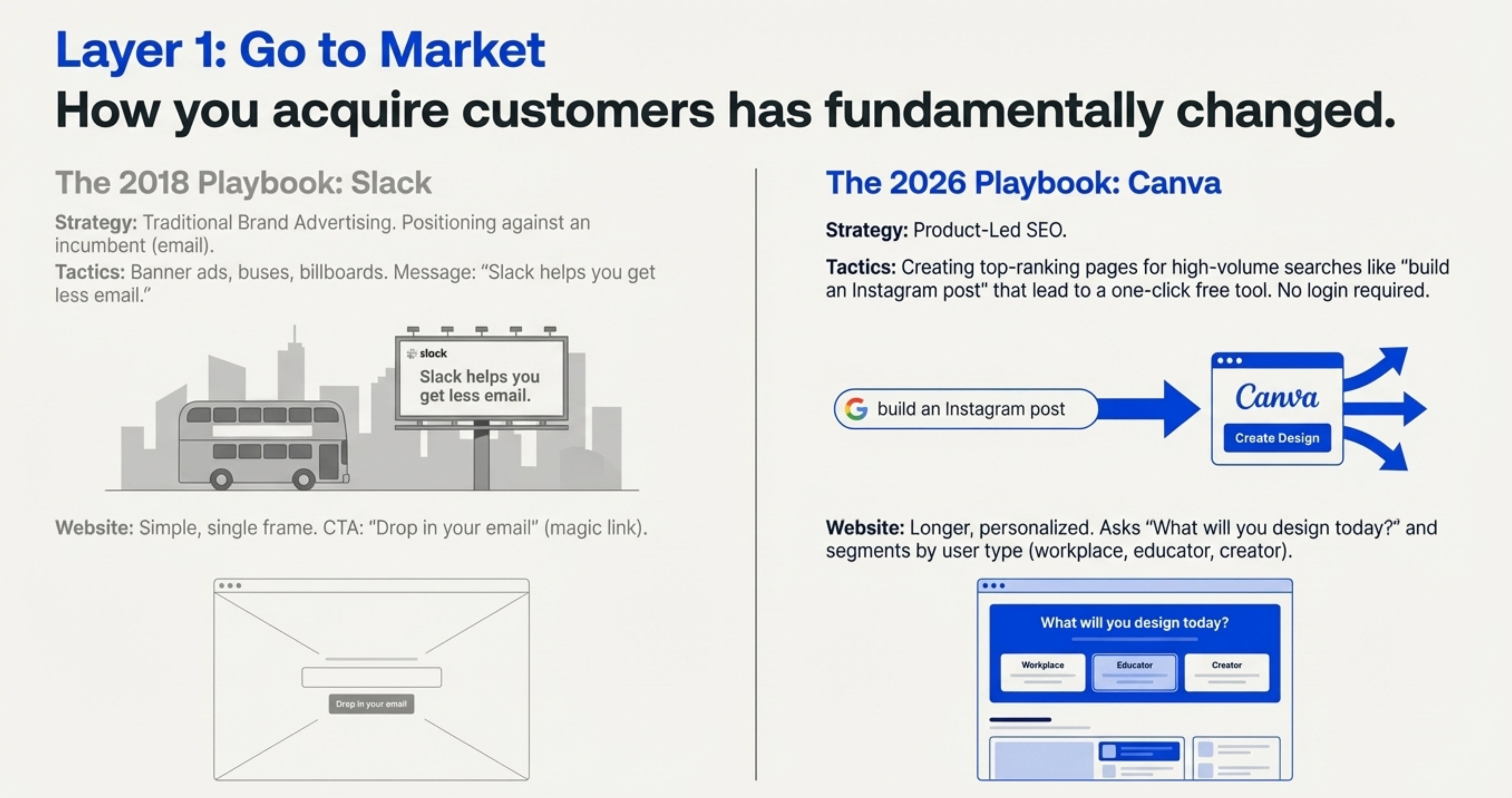
The 2018 playbook - Slack
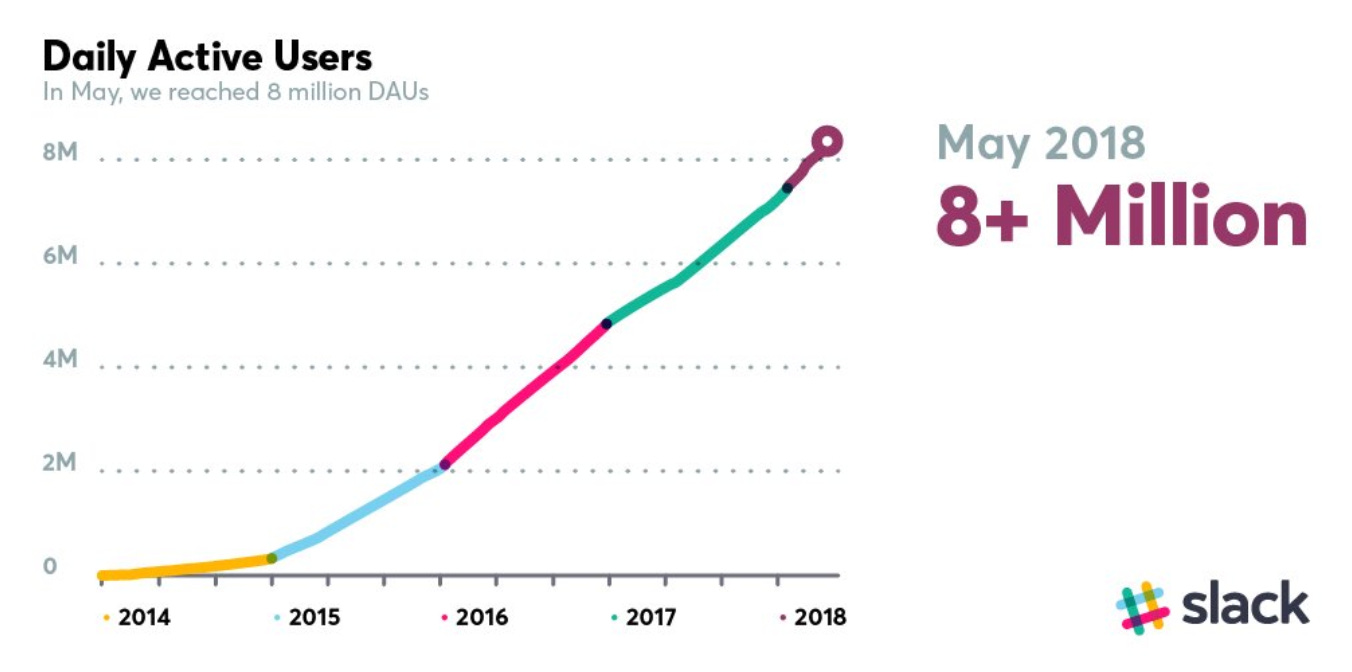
In 4 years, Slack grew from 0 to 8 million daily active users. Everyone studied their model.
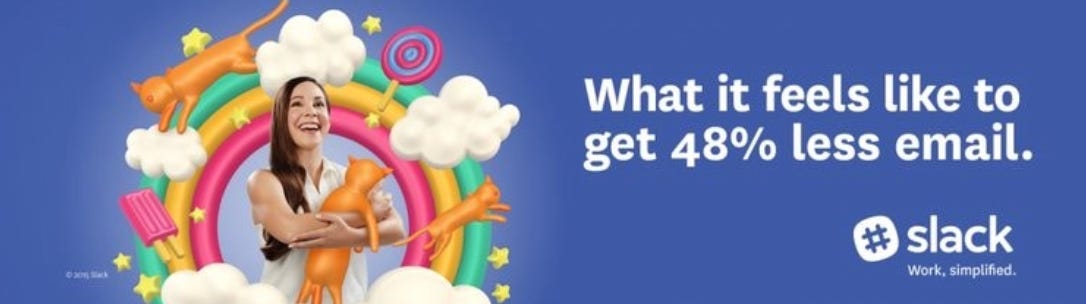
Marketing: Banner ads, buses, billboards, TV commercials. “Slack helps you get less email.” Positioning against the incumbent (email). Traditional brand advertising.
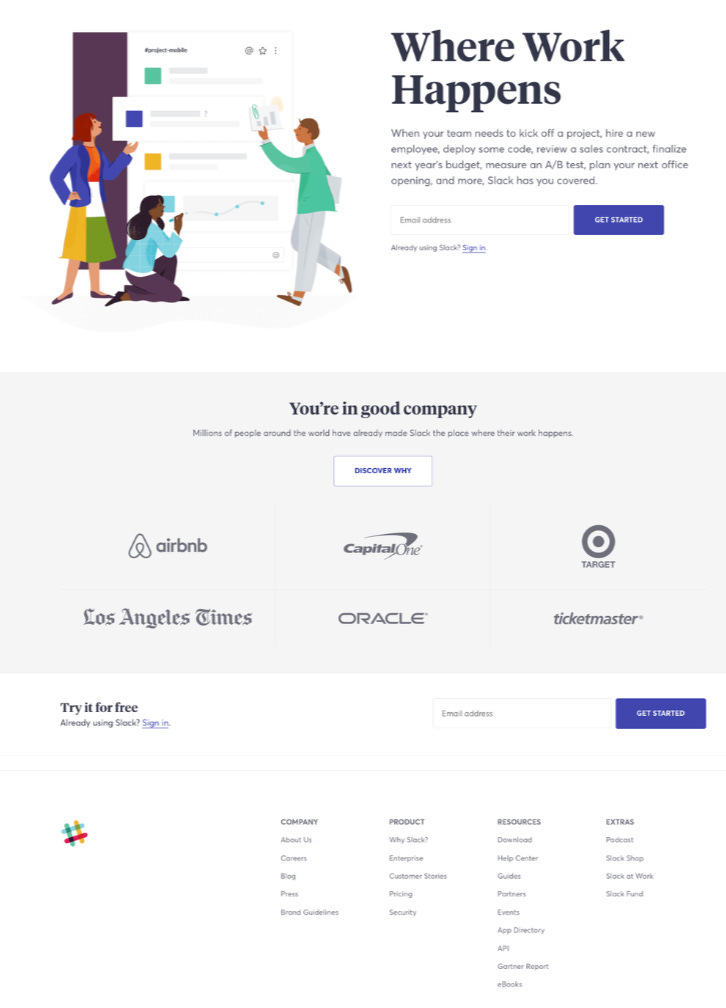
Website: Crazy simple. One frame.
Let me break down why this page is genius:
Where work happens - good positioning statement. Helps you understand what it is in terms of first order effect (not 5th order).
Drop in your email CTA - when you dropped in your email, you didn’t even set up a password. Magic link. One click later you’re into Slack workspace.
Client logos - showing off Airbnb (who everybody wanted to be).
Try it for free - emphasizing free, core theme of PLG.
Really good PLG for 2018. Getting people into product immediately.
The 2026 playbook - Canva
Canva 260 million monthly active users and $3.5 billion ARR growing 40%+ per year
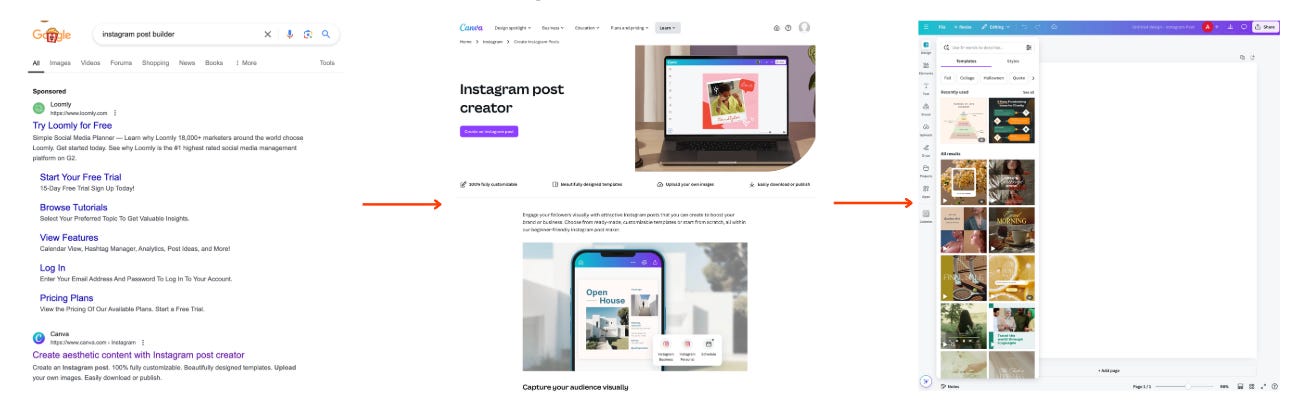
Marketing: Product-led SEO/AEO/GEO. Creating top-ranking pages for Google searches with enormous volume.
Example: Many people search “build an Instagram post.”
What do they see? One click to free tool to build Instagram post. No login. No credit card. Acquiring millions monthly who’ve never heard of Canva.
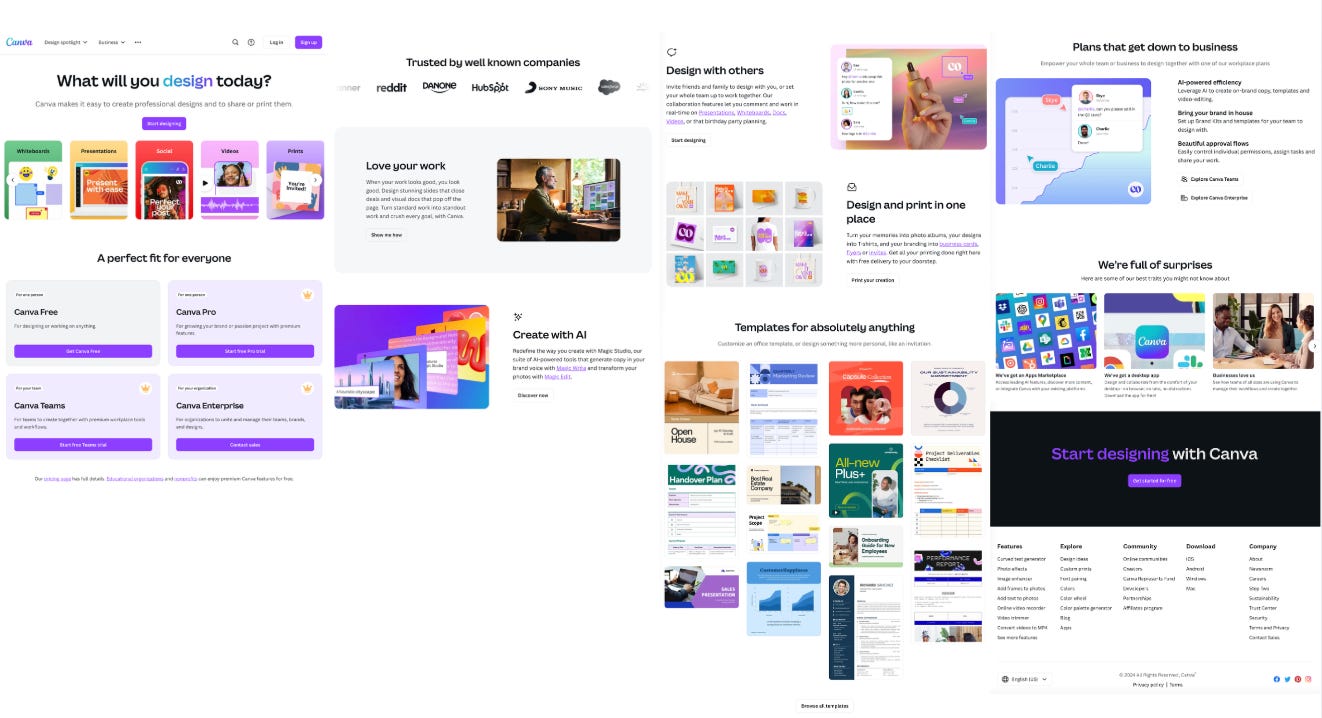
Website: Much longer. Highly personalized.
Let me break this down element by element:
Great positioning - “What will you design today?”
Personalized journeys - immediately helping you understand what type of user you are:
Workplace?
Educator?
Creator?
Helps you understand what plan you might choose (Free, Pro, Teams, Enterprise).Client logos - as expected
Product showcase - 4 slots to show off product
Template gallery - you see a lot of PLG companies using this now
AI features - talking about AI capabilities
CTA - “Sign up for free”
Much longer home page. Putting product first while personalizing for users.
What changed
As you can see, we’ve shifted from traditional marketing channels to product-led channels.
Canva is stealing $2 billion ARR from Adobe, but Adobe wasn’t mentioned anywhere on their website. Focus on the product and your user.
What are their needs? How can Canva solve those?
🔒 The rest of this issue is for paying subscribers only. Join to read the remaining 6 layers, including the specific experiments that doubled Attio’s conversion rate and how Figma’s AI features drove 90,000 new paid teams in just two quarters.
Annual subscribers get a year free of 10 amazing AI tools.