
A candidate got a job offer and replied the same day to say thank you, and that they would have a decision by the end of the next week.
The company replied within the hour. “As you consider your options, we are also considering our other options. Please do not assume you still have an offer from us.”
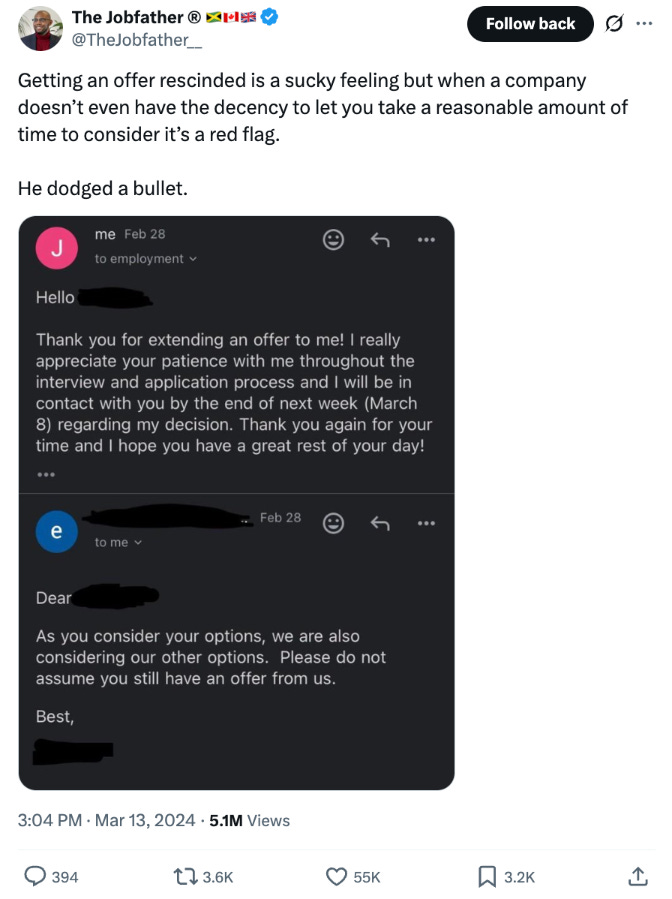
The candidate asked for time - not money. And then 5.1M people saw them get their leash pulled. That’s why many people just decide:
I’m not going to ask.
That’s a huge mistake. Me and the teachers at the Land PM Job cohort have helped many PMs with negotiations this year. In today’s issue, I profile 5 who all saw an increase. And not a single offer was pulled. Two were even currently unemployed, laid off from their last jobs.
You’ll get the real numbers, real script, everything.
Why I Needed to Write This
Every guide on the internet I found assumes you have a competing offer.
Haseeb Qureshi’s 10 rules for negotiation says it outright. “The strongest determinant of your final offer is the number and strength of the offers you receive.”
Levels.fyi’s own guide recommends “I’m waiting to hear back from a few other companies,” then warns two paragraphs later that companies ask to see the letter.
The PM negotiating in 2026 usually has no alternative at all. This isn’t 2021 when having multiple offers was common. Usually, you have 1.
There’s no guide built for if you have no competing offer, and if you are unemployed right now due to a layoff or firing. That’s today’s article.
The other content also skips the situations my cohort actually landed in. I looked at the top 9 articles and 0 covered PE backed equity, contract roles, or the term and notice on a contract.
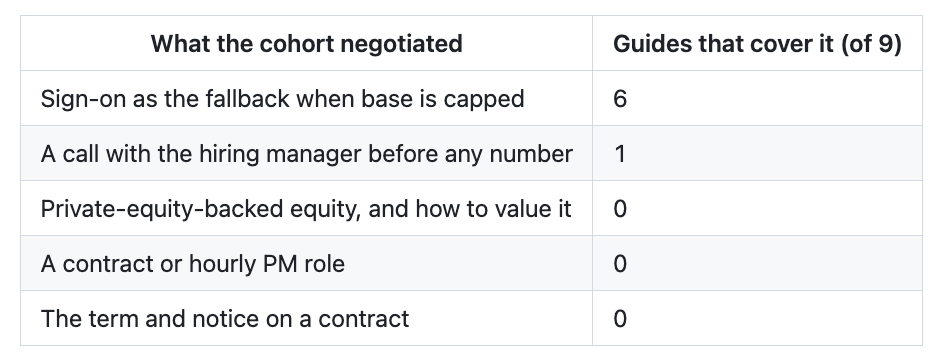
In today’s guide, I’m going to cover all these scenarios.
Today’s Post
Here’s the PM’s complete guide to negotiation in 2026:
What is actually negotiable in this job climate
How to interpret the components of an offer
Five negotiation case studies from real PMs
Your exact actions + scripts by stage
Negotiation psychology
The 10 Laws
Your AI coach
1. What Is Actually Negotiable in this Job Climate
Let’s start here: what can you actually get?
Well, that depends on your level. Here’s real negotiation results I’ve helped people with over the last 12 months:
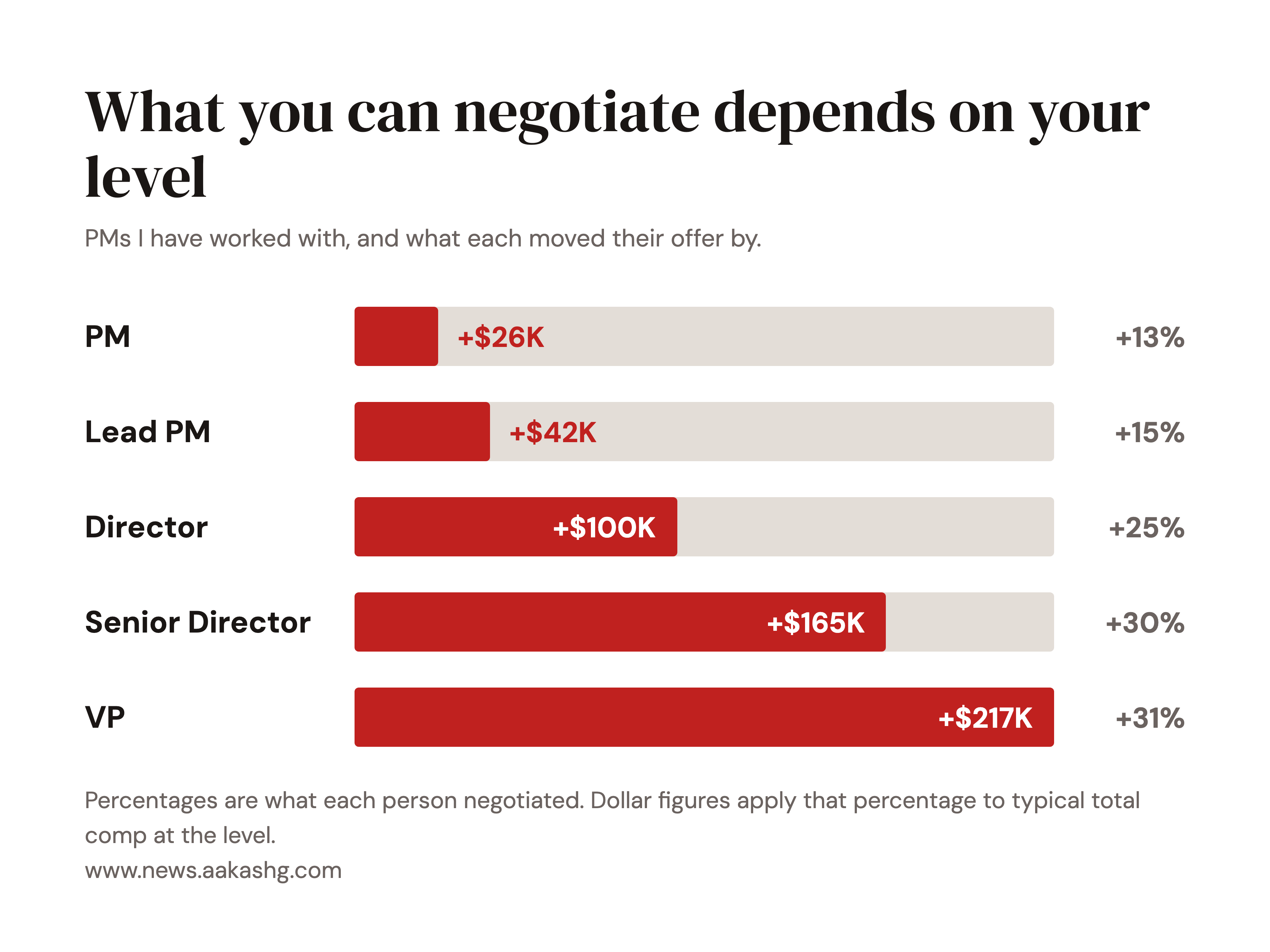
Both on a percentage and dollar basis, we saw larger gains the more senior you are. That’s because your leverage increases. Finding another ‘you’ is much harder for the company, and that translates into how much of a jump you can get.
I experienced something similar in my own journey of negotiation:
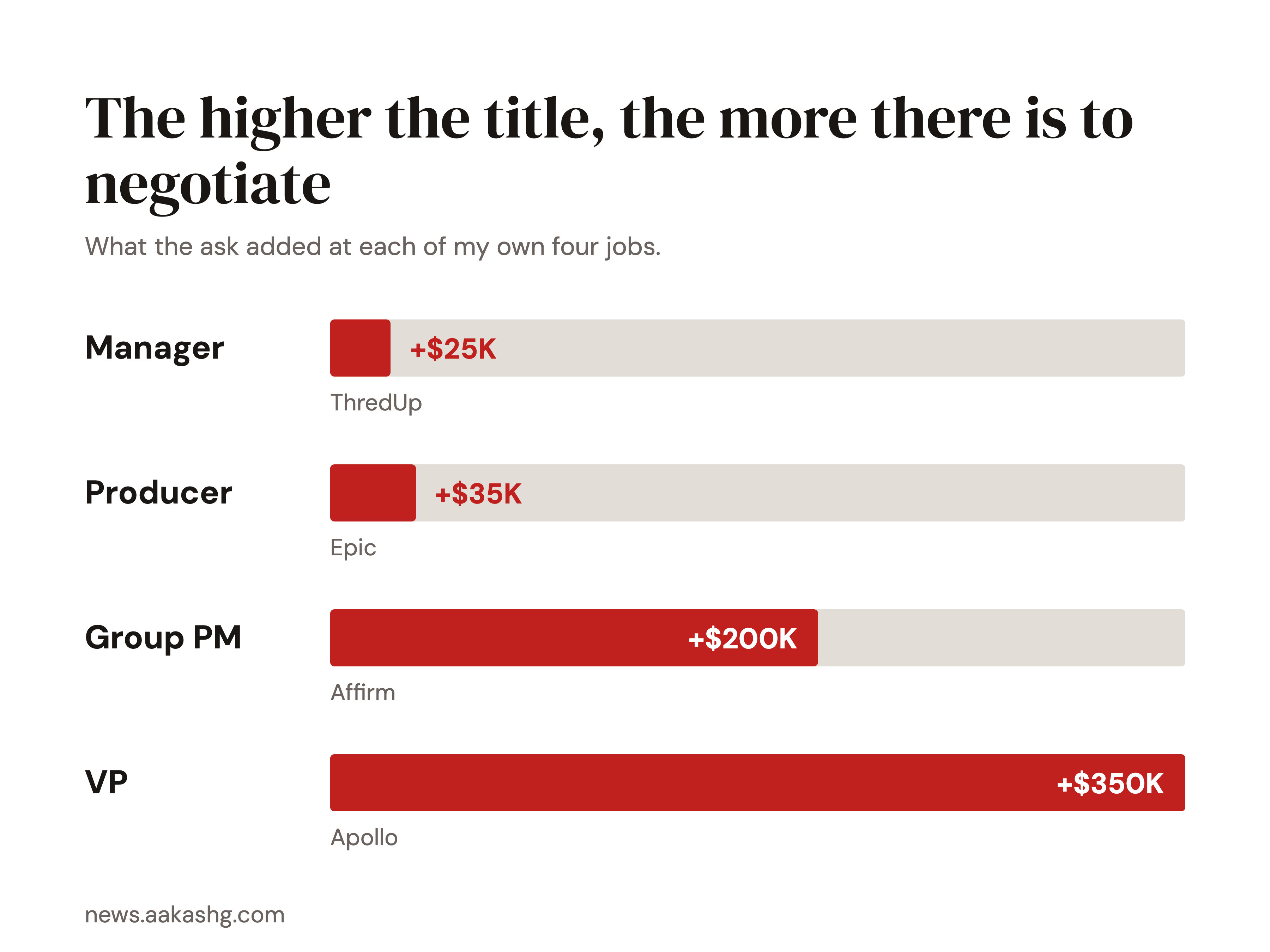
By the time I was interviewing at Apollo, I was one of the few PLG experts they could tap into. So I had more negotiation leverage. I was able to get $350K/year more in compensation (almost all equity).
In today’s post, we’ll help you achieve a similar result. And it starts with reading the offer right.
2. How to Interpret the Components of an Offer
This is the most important thing you need to know that you didn’t know.
When you get that e-mail:
Hey! We’re attaching the offer.
Your heart races. This is the moment. You’re here! Then all the self-doubt creeps in, “I don’t have other offers.” “What if they pull it?”
It’s normal. You have to accept it. But then, you need to get really smart on the terms of a standard PM offer.
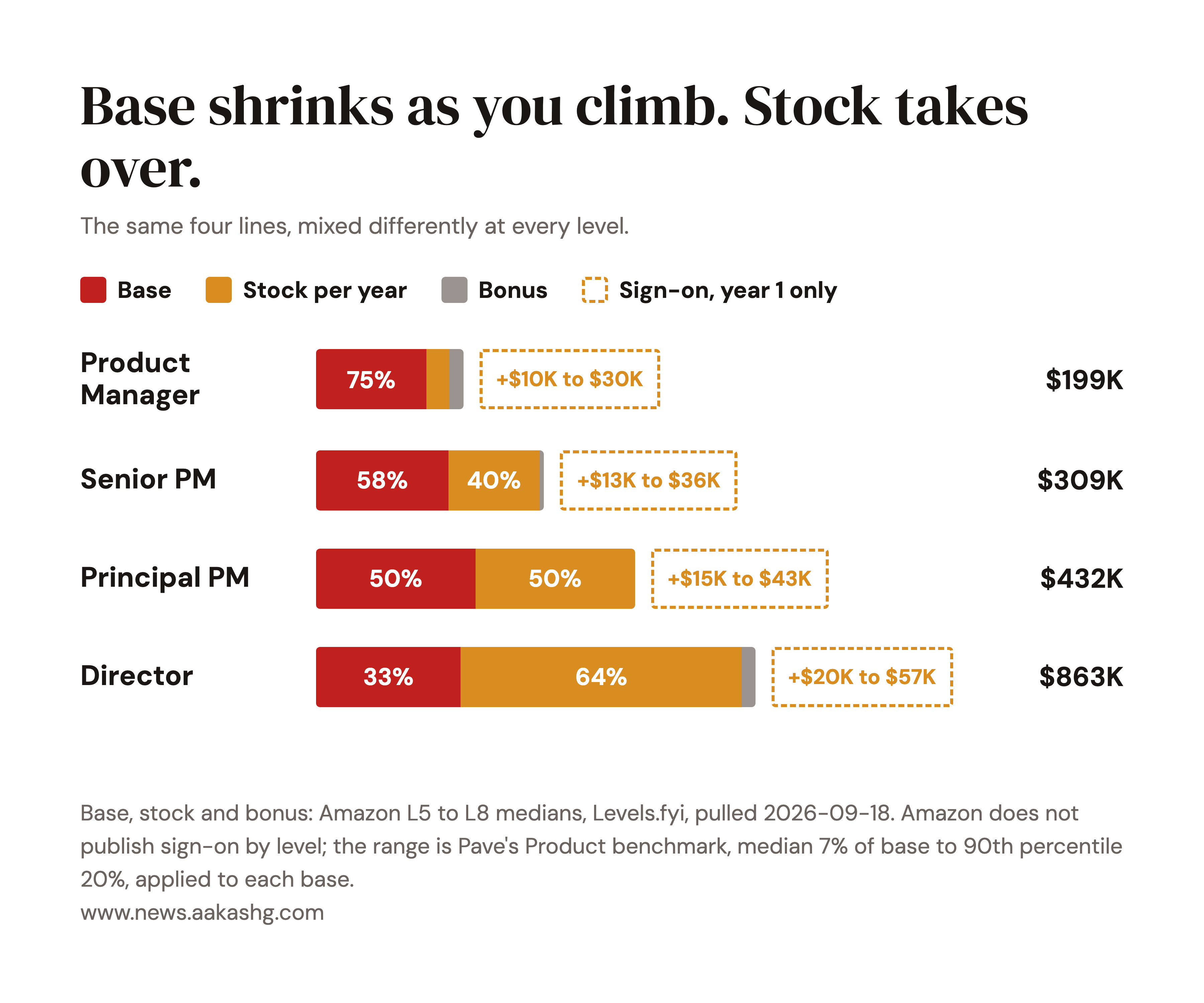
There are 4 key money components you need to understand:
Base: Three quarters of Total Compensation (TC) as a PM, only 1/3rd director+
Stock per Year: The trickiest part to calculate, which becomes more and more of your comp as you rise
Bonus: Cash bonus that exists but isn’t usually huge for PM, unlike sales
Sign-On Bonus: The component most guides miss, but is critical and amongst the easiest to negotiate
Deep Dive Into Equity
Most of the 4 components are straightforward, with the exception of equity. Equity is a whole mess. Let me simplify it for you.
4 Types of Equity
There are 4 different variants you need to understand:
RSUs: Restricted Stock Units
Public company RSUs are shares on a given day’s price. You can sell it the day it vests if you like. They are taxed like income.
Private company RSUs are shares priced from a recent valuation. Most companies issue double-trigger RSUs which don’t actually settle, and get taxed, until a tender offer, IPO, or acquisition.
ISOs: Incentive Stock Options are the right to buy shares at a set strike price. You pay to exercise, which can trigger taxes then even before selling.
PPUs: Profit Participating Units are the right to a share of future profits rather than actual equity, priced off the last funding round.
PIs: Profits Interests are what many PE-owned companies issue. They’re a share of the company’s growth above its value on the day you’re granted them.
Now the question is how to value them. Let’s walk through each.
Valuing Public Company RSUs
This one is easy. Face value.
A $400K grant from Google is worth $400K. You can sell the shares the day they vest. That’s the gold standard everything else gets measured against.
Valuing Private Company RSUs and PPUs
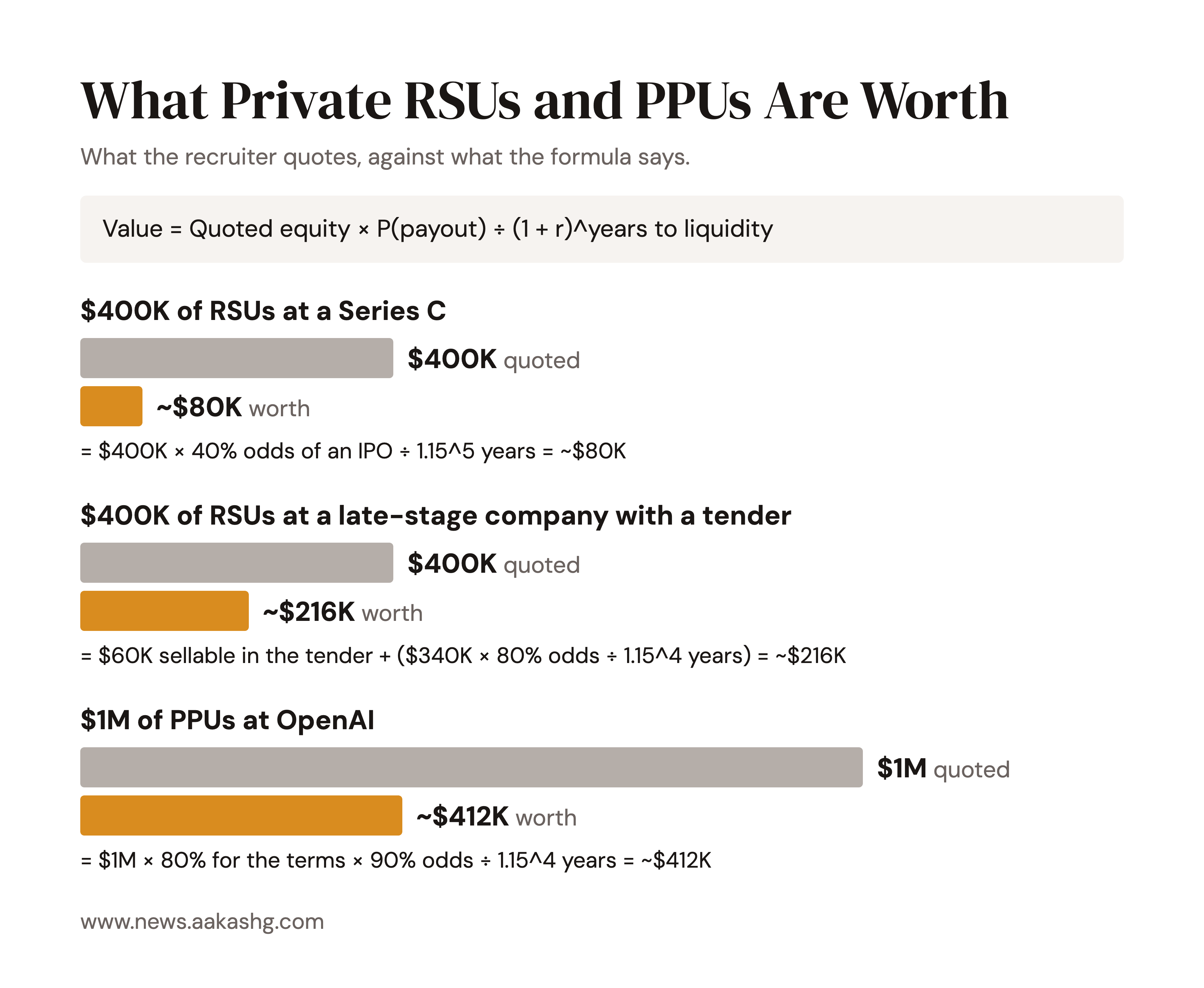
Private company RSUs require some math. I advise you use this formula:
Value = Quoted equity × P(payout) ÷ (1 + r)^years to liquidity
r is your discount for time and illiquidity only. Use 15%. That’s the premium over public stock (~10%) for money you can’t touch. Don’t inflate r for company risk, that’s the next variable’s job.
P(payout) is the probability the company ever delivers a payday at or above the quoted valuation. Late-stage with real revenue and a tender history, 70-90%. Growth stage, 40-60%. Series B or earlier, 20-40%.
For example, you get a $400K grant at a Series C, where you assess an IPO to be 5 years out at 40% odds. Then it’s worth $400K × 0.4 ÷ (1.15)^5 = ~$80K.
Now some late stage companies have tender offers to also factor in. Say it’s a late-stage company that runs a tender every year, capped at 15% of your vested stake. Split the grant in two. The sellable slice, 15% × $400K = $60K, valued near face because you can turn it into cash within a year. The locked remainder, $340K, runs through the formula with better inputs since this is a proven late-stage name. 80% odds, 4 years to full liquidity. $340K × 0.8 ÷ (1.15)^4 = ~$156K. The Total is then $60K + $156K = ~$216K.
The bottom-line:
Even at the best late-stage company, that $400K grant is worth roughly half a $400K grant from Google.
At a Series C with 5 year 40% odds, it’s worth one fifth.
One special case before we move on: OpenAI issues PPUs. These are a contractual claim on future profits rather than shares. Value them like RSUs with a haircut of ~20% for the terms. So Value = Quoted Equity ($1M) × Terms Discount (80%) × Payout Probability (90%) ÷ (1 + r (15%))^years to liquidity (4) = ~$412K.
Valuing ISOs
ISOs need their own formula.
Value = (Exit price − Strike) × Shares × P(payout) ÷ (1.12)^years
Exit price is the terminal value per share × (0.85)^rounds until exit, because each round dilutes you about 15%. My default terminal value is 3x the last round with 2 rounds to go, so a $10 last round gives $10 × 3 × (0.85)² = ~$21.70.
P(payout) is 20-40% for the Series A-C startups that issue these, and years is usually 5-7. The 12% is roughly the S&P 500’s long-run return, so whatever comes out is what the grant is worth beyond just buying the index.
Say you get 50,000 options at a $7 strike. ($21.70 − $7) × 50,000 × 0.3 ÷ (1.12)^6 = ~$112K. That’s the number you negotiate on. The recruiter implied $500K.
Now the trap. When you leave, you usually get 90 days to exercise, which here means wiring $350K. Run the formula on the shares that cash buys, 4 years out, and you get ~$207K of value for $350K paid. That’s −$143K.
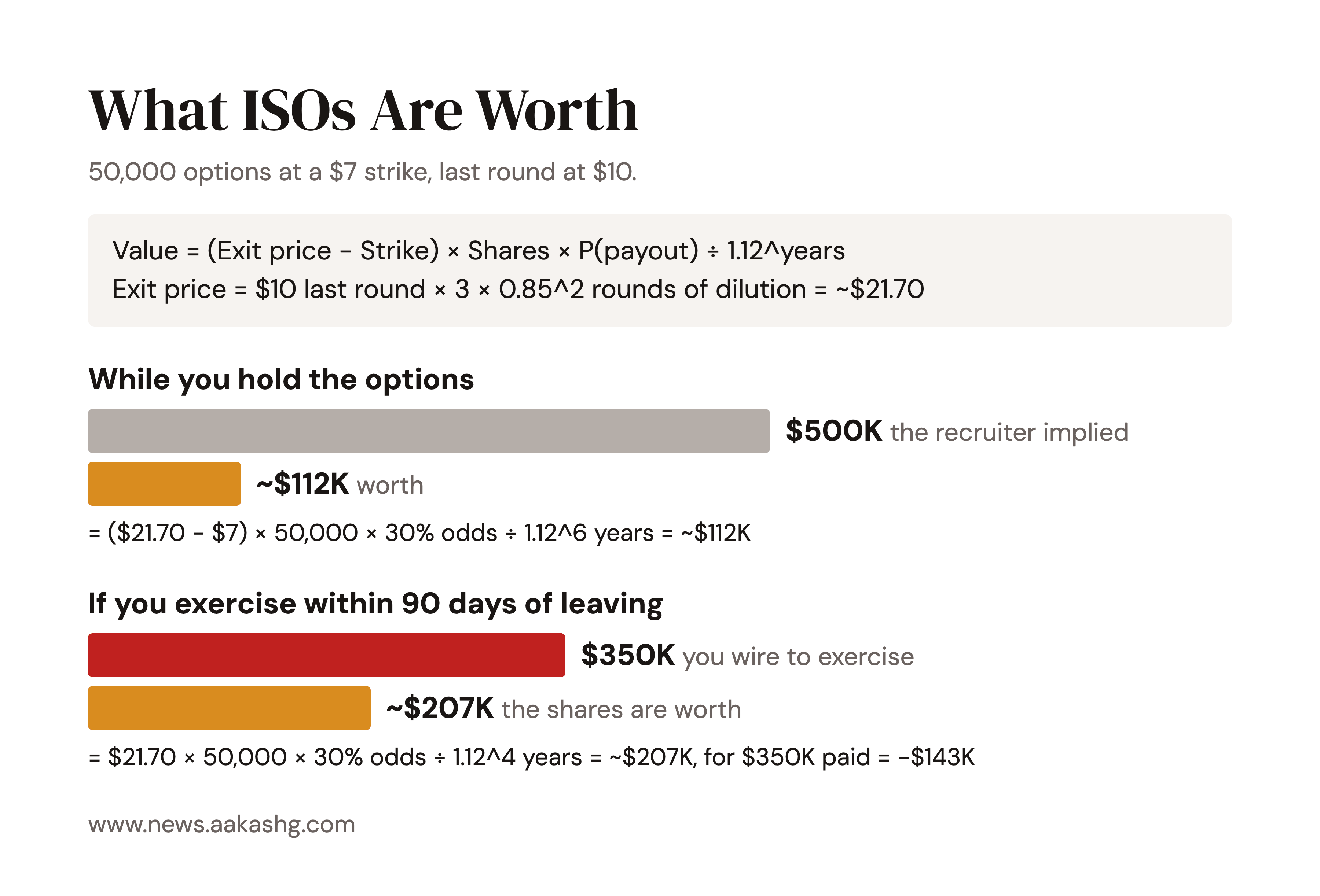
The option is worth $112K for as long as you can wait. The deadline forces you to bet before you know the answer. So if you’re leaving and your insider odds aren’t way above the base rate, walk away. And in the negotiation, ask for a longer post-termination exercise window. It costs the company almost nothing.
Sometimes it goes way beyond 3x. My ThredUp exit price per share was ~10x my strike, which is why I stayed in.
Valuing Profits Interests (PIs)
Profits interests use a close cousin of the ISO formula.
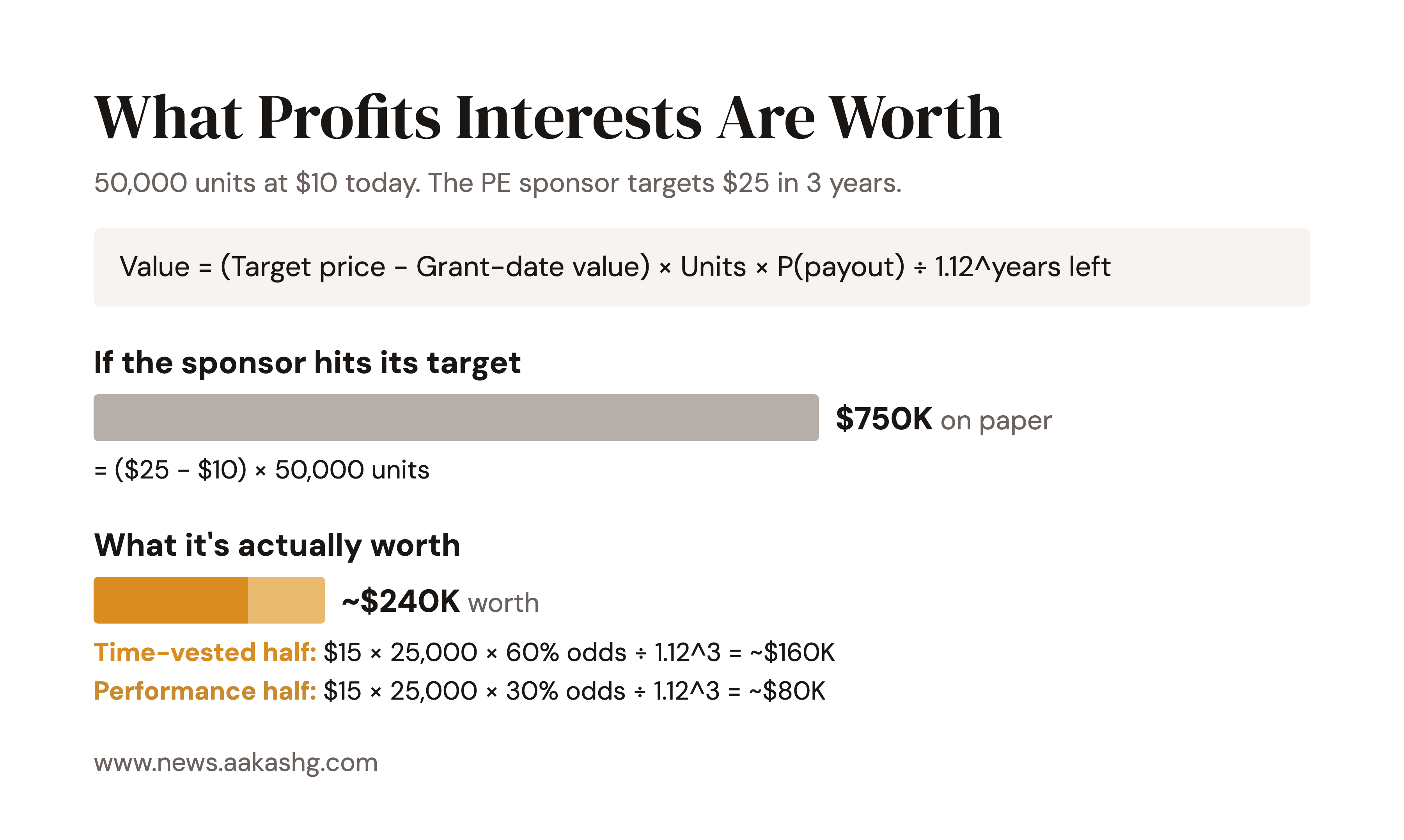
Value = (Sponsor’s target price − Grant-date value) × Units × P(payout) ÷ (1.12)^years left in hold
The target price is what the PE firm plans to sell each unit for, with no dilution since sponsors fund with debt. Years is what’s left of their hold, usually 4-7 from buy-in. If part of the grant only vests when the sponsor hits a return like 3x, give that part lower odds. (Getting PE options instead? Same formula, with your strike in place of grant-date value.)
Say you get 50,000 units at $10 today, and the sponsor targets $25 in 3 years. At 60% odds on the time-vested half and 30% on the performance half, it’s worth ~$240K.
You can’t see any of these inputs from the outside, so ask for the valuation, shares outstanding, how they got to the current value, 4-year projections, and your leaver terms. No data, weight it near zero. One of my students sent this exact list to his CEO mid-negotiation, and you’ll see in the case studies how that went.
The Timing Variable
On top of RSU vs ISO vs PPU vs PI, there’s the topic of vesting schedule. In the case of Amazon, where a 5/15/40/40 vesting schedule is common, here’s what your yearly comp actually looks like as a Director:
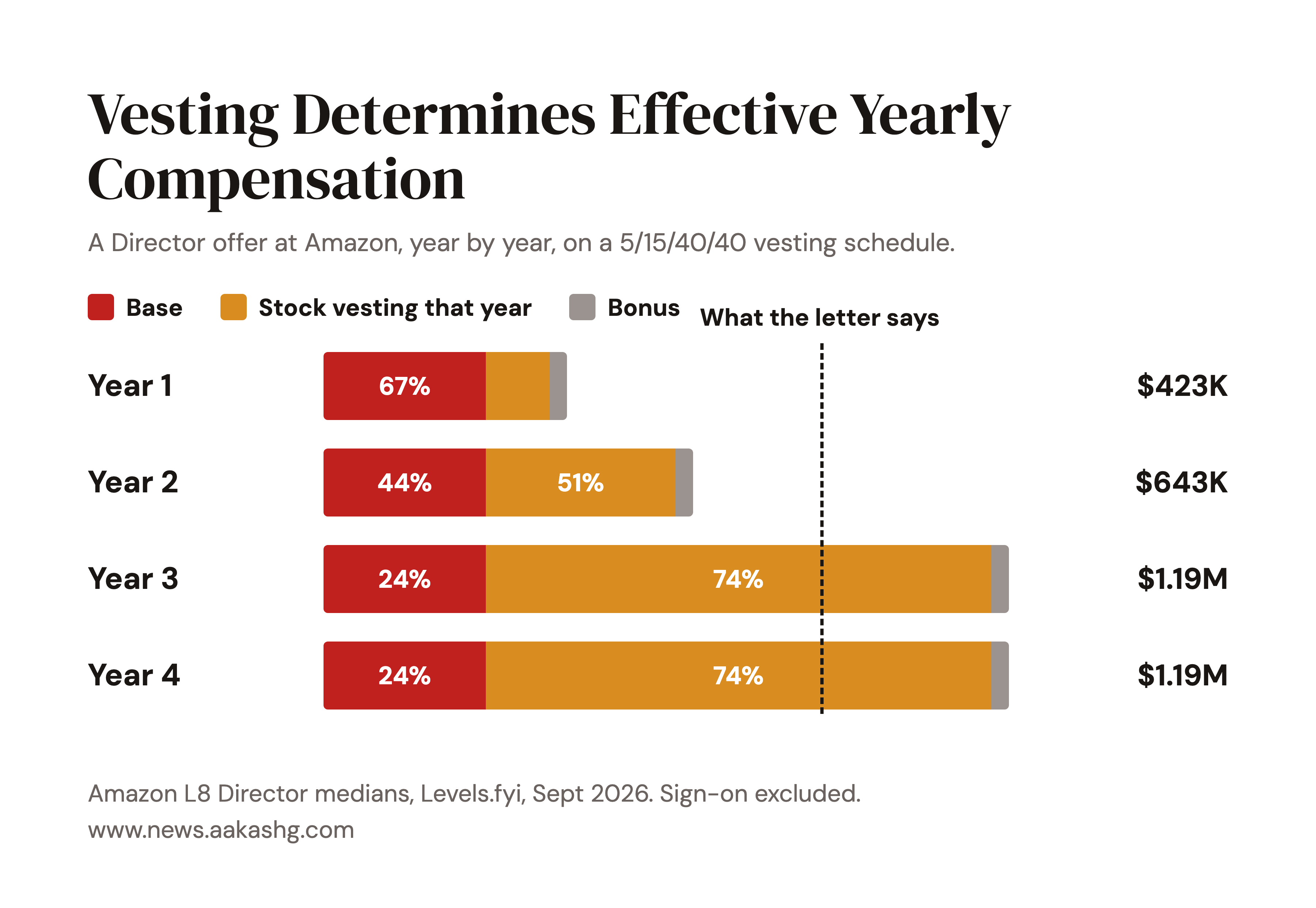
And that’s why “TC” might be the most misused term in tech. When it comes to negotiations, it’s less important to think about TC and more important to think about Effective Compensation (EC).
How to Calculate Effective Compensation
Effective Compensation is where you make a forecast about:
How long you will likely stay at the company
What the equity is actually worth, using the formula for your equity type above
Then you calculate it on the yearly level like this:
EC per year = Cash per year + (Equity Value × % that vests in your window ÷ years you’ll stay) + (Sign-on ÷ years you’ll stay)
This is the real number you should be calculating. You don’t reveal it to the recruiter. But it’s where you figure out your leverage on what you want to negotiate.
Let’s give an example. You get a Series C offer of $200K base, $40K signing bonus, $30K target bonus, $400K RSU grant. The first thing is to determine how long you’re likely to stay. Let’s say it’s 2 years.
Then, your effective yearly compensation is just $270K/year:
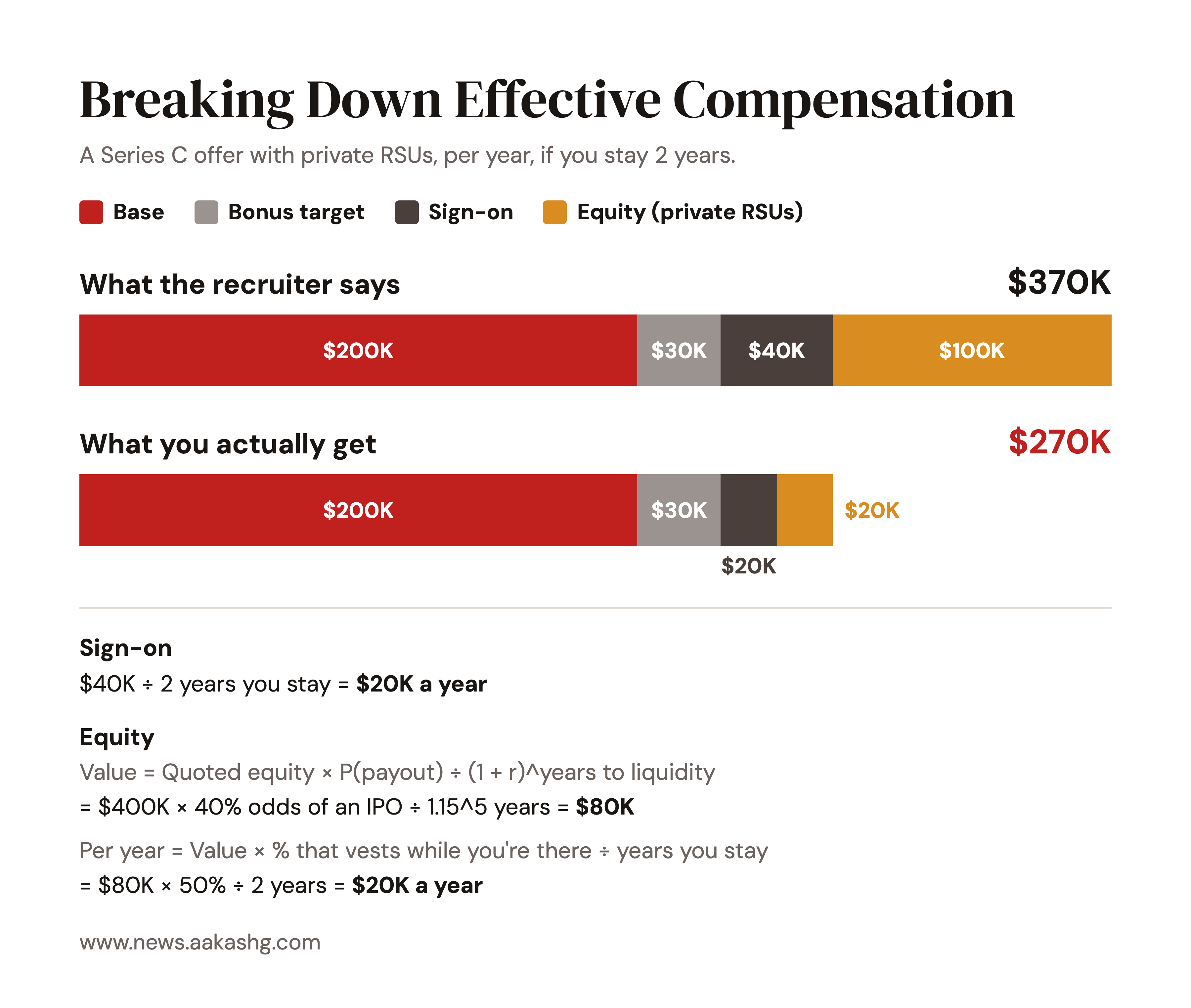
That’s $100K a year less than the $370K the recruiter wants you to think the offer is worth. Their number is year 1 on paper: $200K base, the $40K sign-on, the $30K bonus, and a quarter of the grant at face value.
When you see it this way, you understand what to negotiate.
Your expected tenure tells you which component to negotiate hardest:
Planning a shorter stay (2-3 years)? Push on sign-on and front-loaded vesting. The one-time money is worth more per year to you, and back-loaded equity you’ll never see is worth nothing.
Planning a longer stay (4+ years)? Push on base and equity. Base and equity compound through every raise, bonus calculation, and equity refresher for years. Sign-on gets diluted into a rounding error.
Since all of this can be very difficult to calculate yourself, and there’s more nuance than I’ve just covered, I’ve built a skill that covers everything. Point your AI to this file and your offer:
Even better if you install it inside a Job Search OS.
The rest of this article is for paid subscribers only. They get access to:
5 real complete negotiation case studies from students of mine
Scripts + the playbook for each and every stage of the negotiation
How to handle the psychology of the negotiation
The 10 Immutable Laws of Negotiation