
Jaclyn Konzelmann is an AI PM Director at Google. Here’s the 5 questions she shared on her substack that she asks every AI PM candidate:
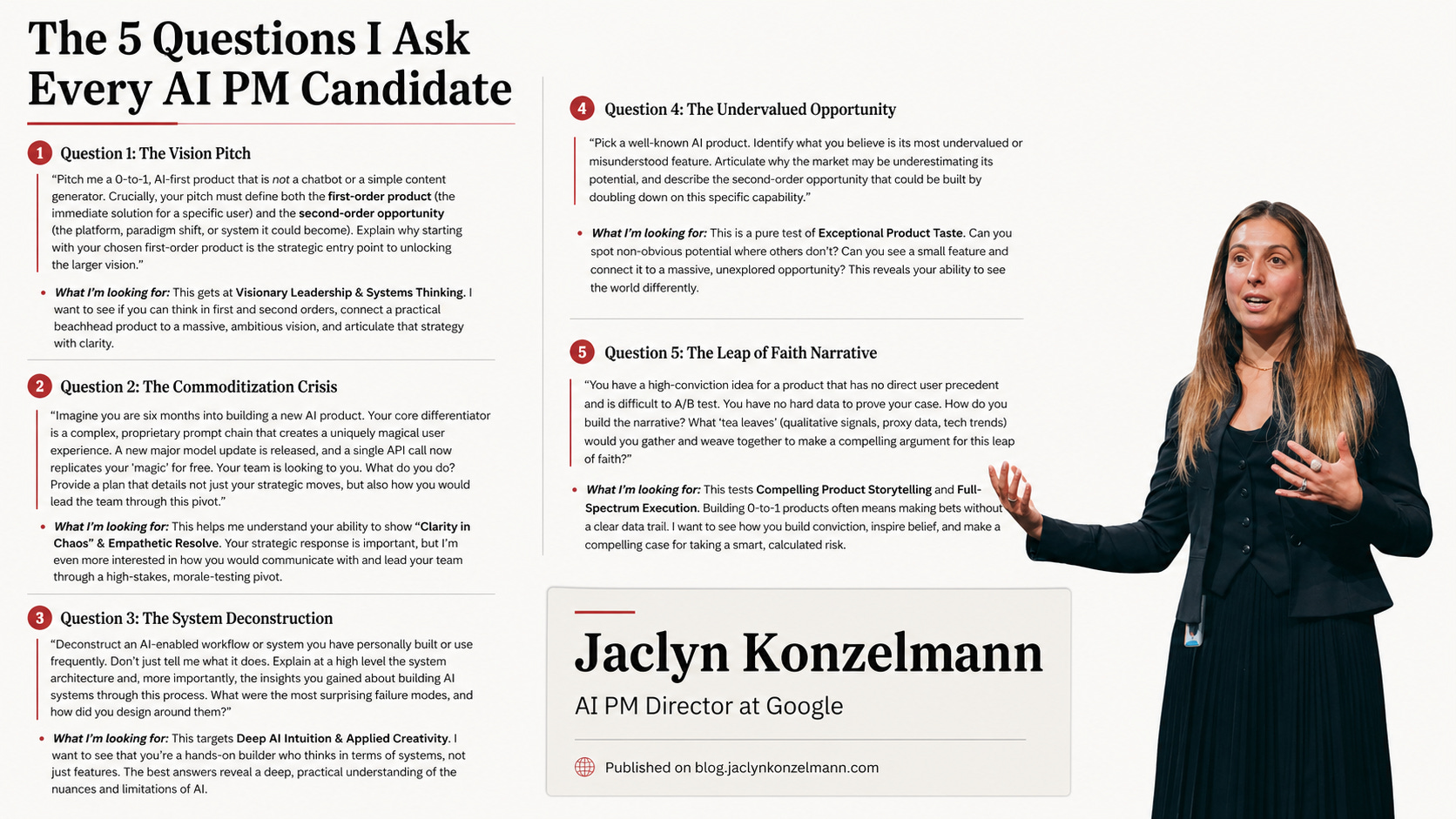
Do you see what these questions are asking? You need to combine a depth of knowledge on product sense and AI.
Today’s guide helps you do so.
Not Just Google
Ankit Virmani, former Group Product Manager at Meta, just finished a full AI PM job search - nabbing offers at Cisco, Uber, and Atlassian. He told me something I didn’t expect.
70-80% of his rounds were still traditional behavioral and product sense. The same “tell me about yourself” and “improve Snapchat” stuff. But the one round that showed up at every single top AI company was AI product sense.
To show you exactly what a 10/10 looks like in April 2026, I recorded a full mock with Ankit on one of the hardest AI product sense questions in circulation right now -
The question - “How would you increase Claude Code weekly active users 10x?”
This is the type of question top AI companies actually ask. And what makes the mock realistic is the curveball. Halfway through Ankit’s answer, I threw him a pivot he didn’t see coming.
For Live Coaching
Want live coaching like this from Ankit and I? Apply for our Land PM Job cohort which starts Monday. Here’s our teaching schedule:
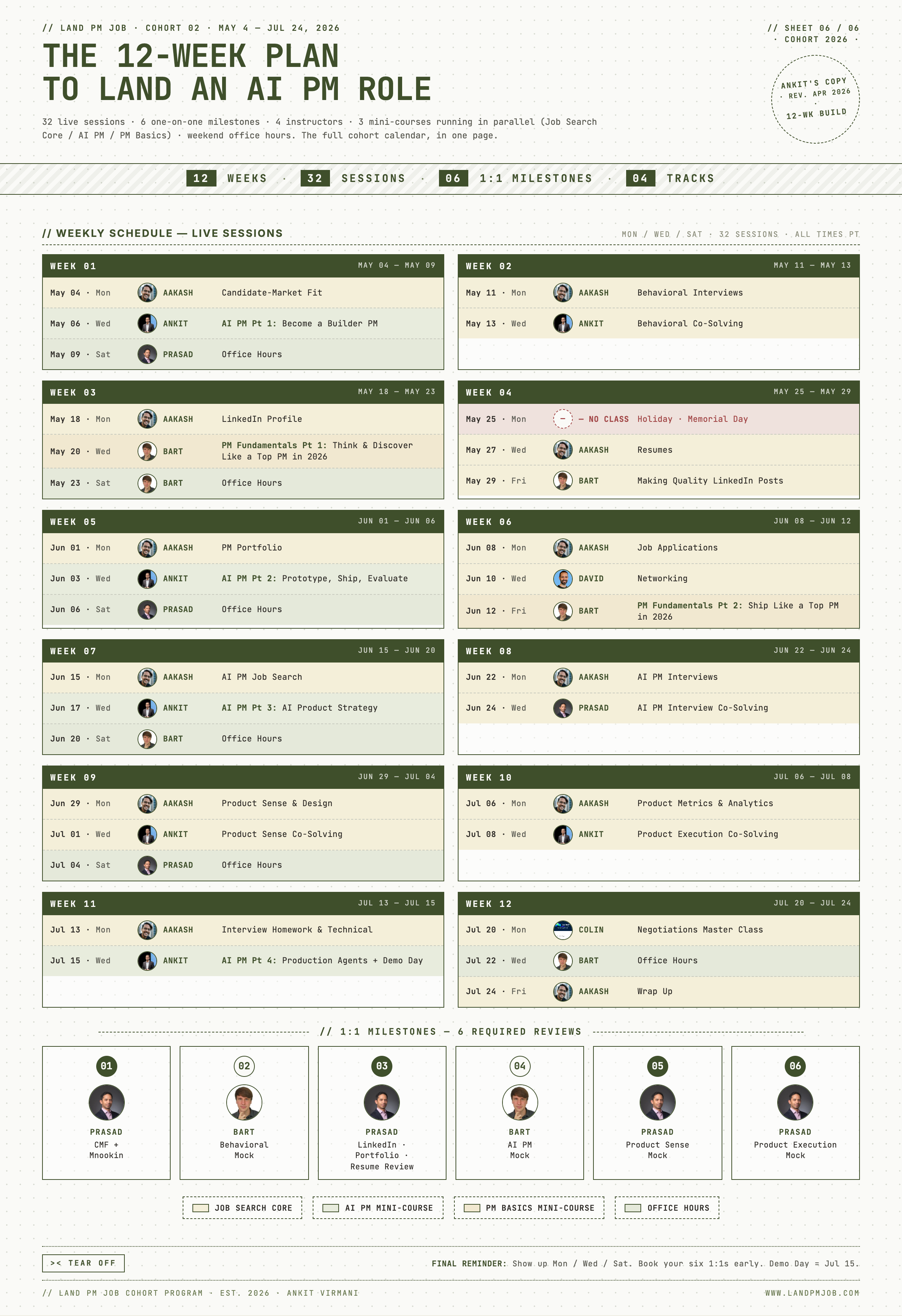
This is our third cohort. We have added in both AI PM and PM fundamental mini-courses. This is the only PM cohort I'm aware of that runs dedicated AI PM and PM fundamental mini-courses alongside the core curriculum.
Apply now. 41/75 seats left.
Why Now
Six months ago, I published the first AI product sense interview guide on the internet. I did a mock with Dr. Bart Jaworski on “How would you double ChatGPT image creation WAU with 3 engineers?”
That guide has been read by 80,000+ people. And in the six months since, I’ve coached another 80 candidates through 2 cohorts - including folks who encountered AI product sense rounds at OpenAI, Anthropic, Figma, Meta, and Amazon.
The round has changed again. Significantly.
In October 2025, AI product sense was a niche round at a handful of AI-native companies. Today, it’s spreading everywhere. Meta literally added it as a 4th interview.
Per IGotAnOffer's deep dive with ex-Meta Sr. Product Leader Audrey, the "Product Sense with AI" round is for IC6+/M1/M2 roles in their Central Products org, where candidates vibe-code a prototype while the interviewer evaluates judgment.
Google’s AI teams test it like Jaclyn, inside existing interviews. Even Stripe and Uber are weaving AI into their product sense rounds now.
And the bar has moved since October.
Today’s Post
I’ve updated everything I know about AI product sense based on 6 months of new coaching data:
What Changed Since October 2025
How to Pass the Updated Interview
2 practice tools (Claude Skill, Custom GPT)
What Ankit did differently from every candidate I’ve coached below a 7
The 5 AI-specific thinking shifts that separate strong from weak
The Full Breakdown
The Ankit mock analyzed in detail (what I scored and why)
How the top 5 companies ask this differently in April 2026
Where to practice next
1. What Changed Since October 2025
When I wrote the first guide, I said “this interview doesn’t exist yet, but it’s coming.” Six months later, it’s here.
The round is no longer optional. It’s spreading everywhere.
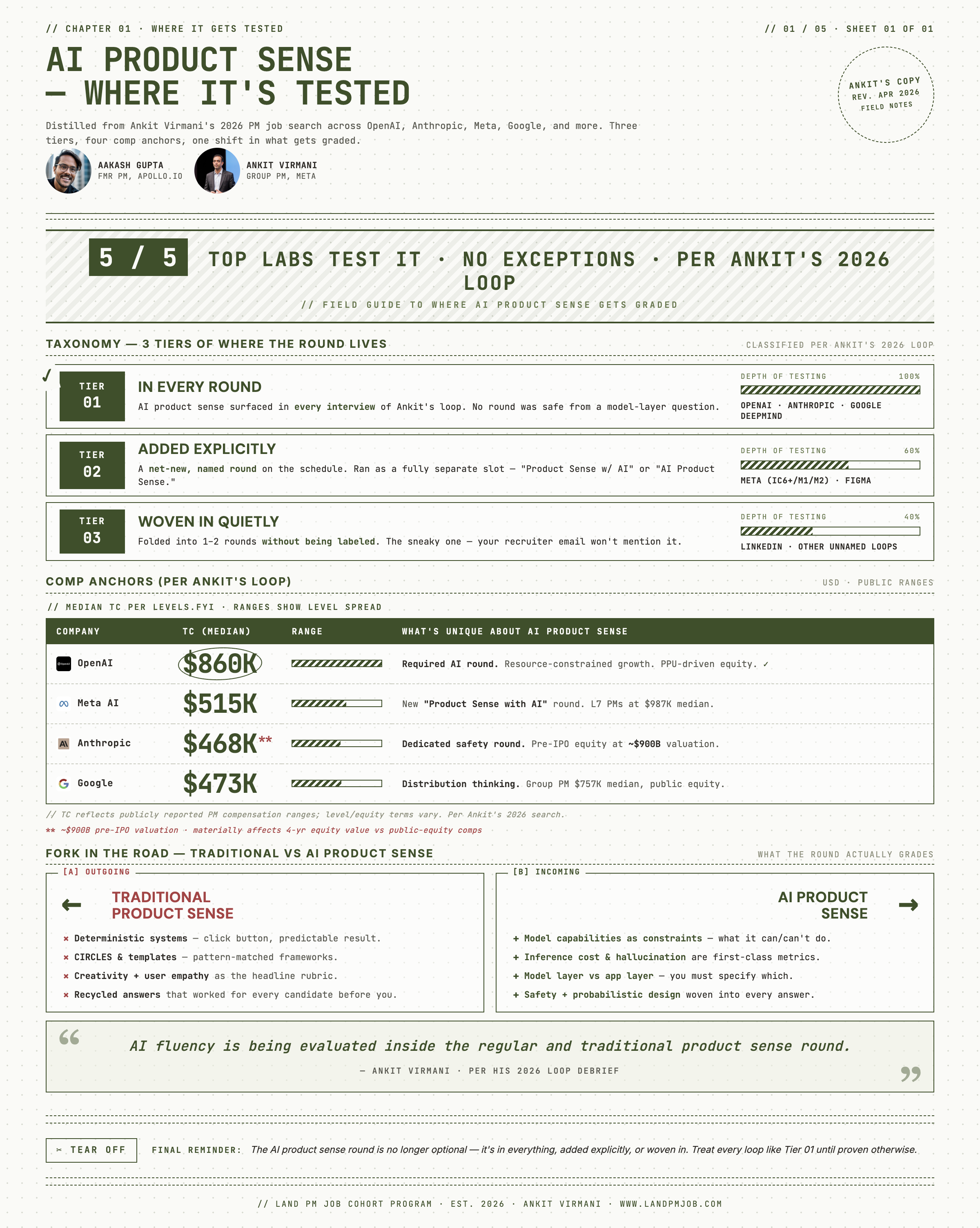
Ankit categorized the landscape into three tiers based on what he actually experienced during his search -
Tier 1 - In Everything. OpenAI, Anthropic, Google DeepMind. AI product sense is part of every interview in some way. At OpenAI, you get questions like “how would you double ChatGPT image creation with just three engineers?” At Anthropic, “how would you increase Claude Code WAU 10x?”
Tier 2 - Added to existing loops explicitly. Meta is the biggest shift here. They literally added a 4th interview called “Product Sense with AI” for IC6+/M1/M2 roles. This is specific to the Central Products org. Figma has also added a specific round called ‘AI Product Sense.’
Tier 3 - Woven into 1-2 rounds. For instance, LinkedIn asked Ankit about how OpenAI and Anthropic launching into their markets should reshape product strategy in another interview. This is the sneaky one. Your recruiter email won’t mention “AI product sense.” But if you’re interviewing for an AI PM role, expect it.
Here’s the thing Ankit said that hit me hardest.
“Even at companies that don’t have a dedicated AI round, AI fluency is being evaluated inside the regular and traditional product sense round. The bar has very much shifted.”
I’d triple-click on this for you. If your recruiter doesn't list 'AI product sense,' that doesn't mean you won't be tested on it. It means it's embedded inside a round with a different name. The candidates who prep for it specifically are the ones who walk out knowing they nailed it.
The nature of what’s being tested has changed.
In a traditional product sense interview, you’re designing features for a deterministic system. User clicks a button, something predictable happens. You can use CIRCLES. You can follow a template. You can honestly pattern-match your way through it.
That’s the fundamental shift. Traditional frameworks can’t solve for this. You can’t CIRCLES your way through “how would you increase Claude Code WAU 10x?” because the answer requires you to understand how agentic workflows work, what Opus 4.6 is capable of, how slash-loop infrastructure enables proactive behavior, and what Cowork is as a product surface.
The round now decides your level, not just your pass/fail.
This is the insight from our Land PM Job cohort data that blew my mind.
Across 80 cohort candidates, the pattern I keep seeing is that AI product sense correlates more with level placement than behavioral. Candidates who came back saying 'I was expecting L5, I got L4' more often than not pointed to the AI round when we debriefed.
Ankit's framing on this was the clearest I've heard. 'Behavioral gets you through the door. AI product sense is the round that truly decides your offer. The level, the money, the negotiation leverage all flow from this round.
The compensation makes this the highest-stakes round in PM.
The Tier 1 comp data below comes from public Levels.fyi medians and cohort candidates who interviewed at the frontier labs over the last six months -
OpenAI - $860K median, ranges from $300K (Manager) to $950K+ (Staff). PPU-driven equity.
Meta - $515K median, ranges from $173K (L3) to $2.24M (Senior Director). L7 PMs at $987K median.
Google - $473K median, ranges from $182K (APM1) to $2.45M (L9/L10). Group PM at $757K median, public equity.
Anthropic - $468K median, ranges $468K-$651K. Pre-IPO equity at $60B+ valuation, which could change the comparison materially over 4 years.
These are public-data US medians for the PM role at each company, not specifically AI PM medians (which Levels doesn’t break out separately). Ankit’s experience and what I’ve seen in cohort placements suggest AI PM roles cluster at or above these medians at frontier labs. Specific offers vary by team, level, and negotiation. AI PM roles in India, Europe, and at non-frontier-lab companies (think enterprise AI, healthcare AI, fintech AI) operate on different curves.
The takeaway from Section 1 - If you’re interviewing for an AI PM role in April 2026, you will face AI product sense. The question is whether you’ve prepared for it differently from traditional product sense. If you’re still using CIRCLES or the old frameworks, you are bringing a knife to a gunfight.
🔒 The rest of this post is for paid subscribers only. You’ll get -
The 5 AI-specific thinking shifts with before/after examples from real interviews
The full Ankit mock breakdown (what I scored 10/10 and what cost him 1 point)
How OpenAI, Anthropic, Google, Meta, and Amazon ask this differently in April 2026
2 practice tools I built (Claude Skill, Custom GPT)
Where to go from here